

Phnom Penh des origines à 1975: lieux de pouvoir et des lieux de mémoire [Phnom Penh from the Origins to 1975: Nuclei of Power and Memory]
by Suppya Nut
A preliminary sketch of an upcoming book on the social and cultural history of Phnom Penh.

- Author
- Suppya Nut
- Publication
- in Cambodge: Cartographie de la mémoire, Patrick Nardin, Suppya Hélène Nut & Sokho Pay (eds.), Paris, L'Asiathèque, 2017, 224p.: 61-82. ISBN-13 978-2360570942. [reproduced with author's permission].
- Published
- 2017
- Pages
- 21
- Language
- French
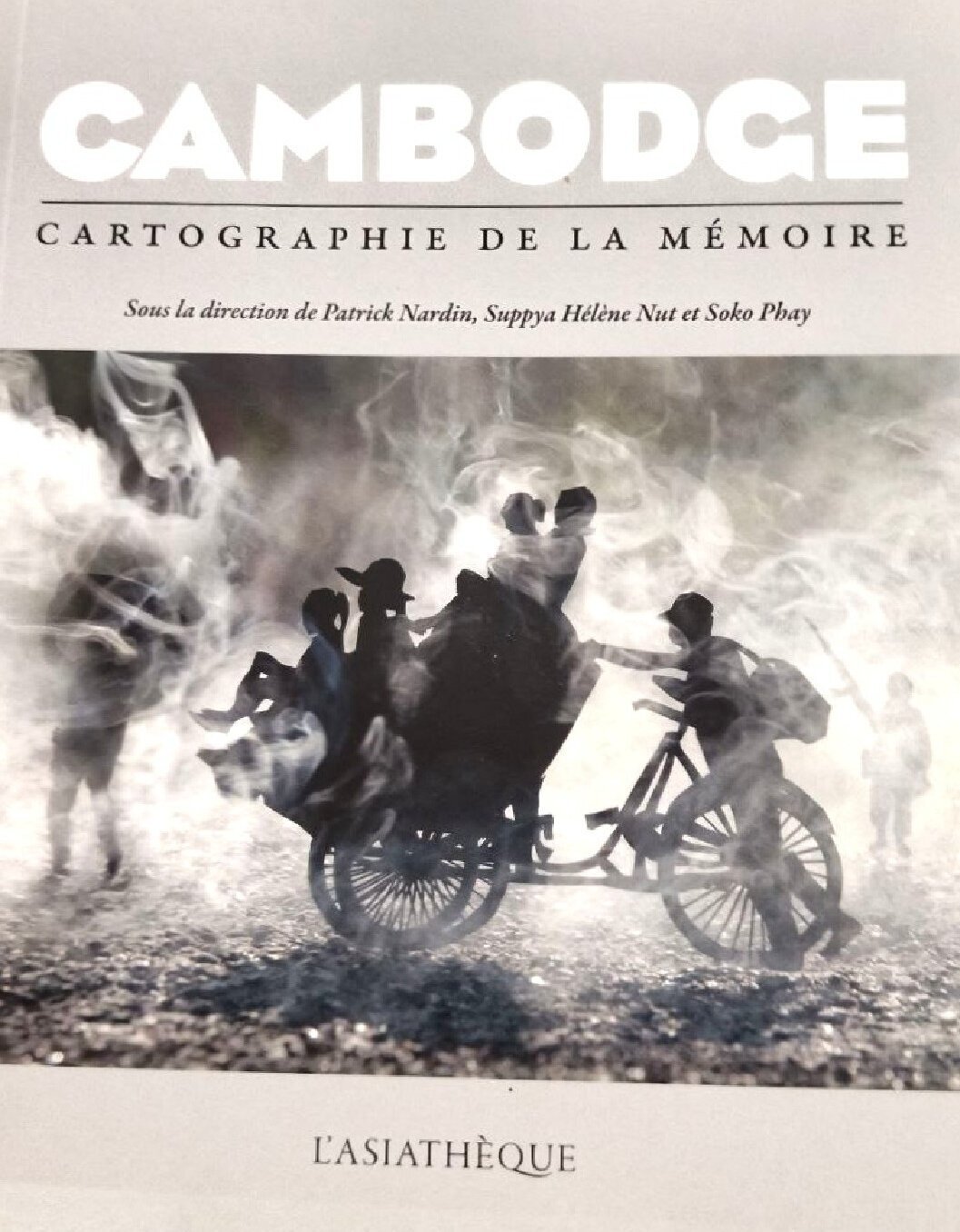
pdf 16.3 MB
Full title: “Phnom Penh des origines à 1975: émergence et constitution des lieux de pouvoir et des lieux de mémoire” [“Phnom Penh from its origins to 1975: emergence and constitution of nuclei of power and nuclei of memory”]
The city of Phnom Penh and its urbanistic development has been mainly considered so far through the prism of and historic background linked to the French Protectorate period and to the colonial written sources. This study published in 2017 is one of the first attempts to change the perspective by leaning on the sociological history of the Cambodian denizens of the capital city. As the author — currently (2026) completing a book on the history of Phnom Penh — explained, she was aiming at
étudier l’espace social de ces élites, qui suit un processus interne de construction et de délimitation par ceux-là mêmes qui le font vivre. Ce travail d’investigation s’appuie moins sur les sources coloniales qui, par leur nature impériale et administrative, sont muettes sur la société khmère. Il l se fonde sur les enquêtes auprès des personnes ayant résidé en ces lieux et qui, pour la majorité d’entre elles, ont refait leur vie ailleurs ou né sont revenues qu’après les premières élections de 1993. Il a été facilité par les Iiens encore vivaces, entretenus entre la mémoire collective, le groupe social et le lieu, entre les traditions et le cadre bâti, bien que ce dernier disparaisse à une vitesse croissante face à l’expansion de la ville et à la spéculation foncière. Avec cette rapide disparition, ce sont les témoignages concrets qui sont en train de disparaître sous les tours et les condominiums de luxe émergeant au centre-ville. Pour certains lieux symboliques, il est déjà trop tard, même dans le cas des monastères bouddhiques, où se trouvaient les stupas des familles aristocratiques dont on pouvait suivre la filiation jusqu’à nos jours, à l’exemple du Vat Prayuvong, encerclé de cabanes jusqu’au pied de ses murs et dont les rares stupas restants sont dispersés au milieu des habitations. Excepté pour quelques familles, dont certains membres de la famille royale, la plupart des stupas abandonnés par leurs descendants sont rasés pour faire place à ceux de la nouvelle élite, dont les membres cherchent à inscrire leur lignée dans un lieu qui demeure, à leurs yeux, attaché à un passé prestigieux. [p. 62 – 3]
[examining the social space of these elites as it undergoes an internal process of construction and delimitation by those who inhabit it. This investigative work relies less on colonial sources, which, by their imperial and administrative nature, are silent on Khmer society. Instead, it is based on interviews with people who resided in these areas and who, for the most part, have rebuilt their lives elsewhere or only returned after the first elections in 1993. It has been facilitated by the still-vibrant connections maintained between collective memory, social group, and place, between traditions and the built environment, even though the latter is disappearing at an increasing rate in the face of urban expansion and land speculation. With this rapid disappearance, hard evidence is vanishing under high-rises and luxury condominiums emerging in the city center. For some symbolic sites, it is already too late, even in the case of Buddhist monasteries, where the stupas of aristocratic families once stood, families whose lineage could be traced to the present day. Wat Prayuvong, for example, is surrounded by huts right up to its walls, and its few remaining stupas are scattered among the houses. Except for a few families, including some members of the royal family, most of the stupas abandoned by their descendants are being razed to make way for those of the new elite, whose members seek to establish their lineage in a place that, in their eyes, remains linked to a prestigious past.]
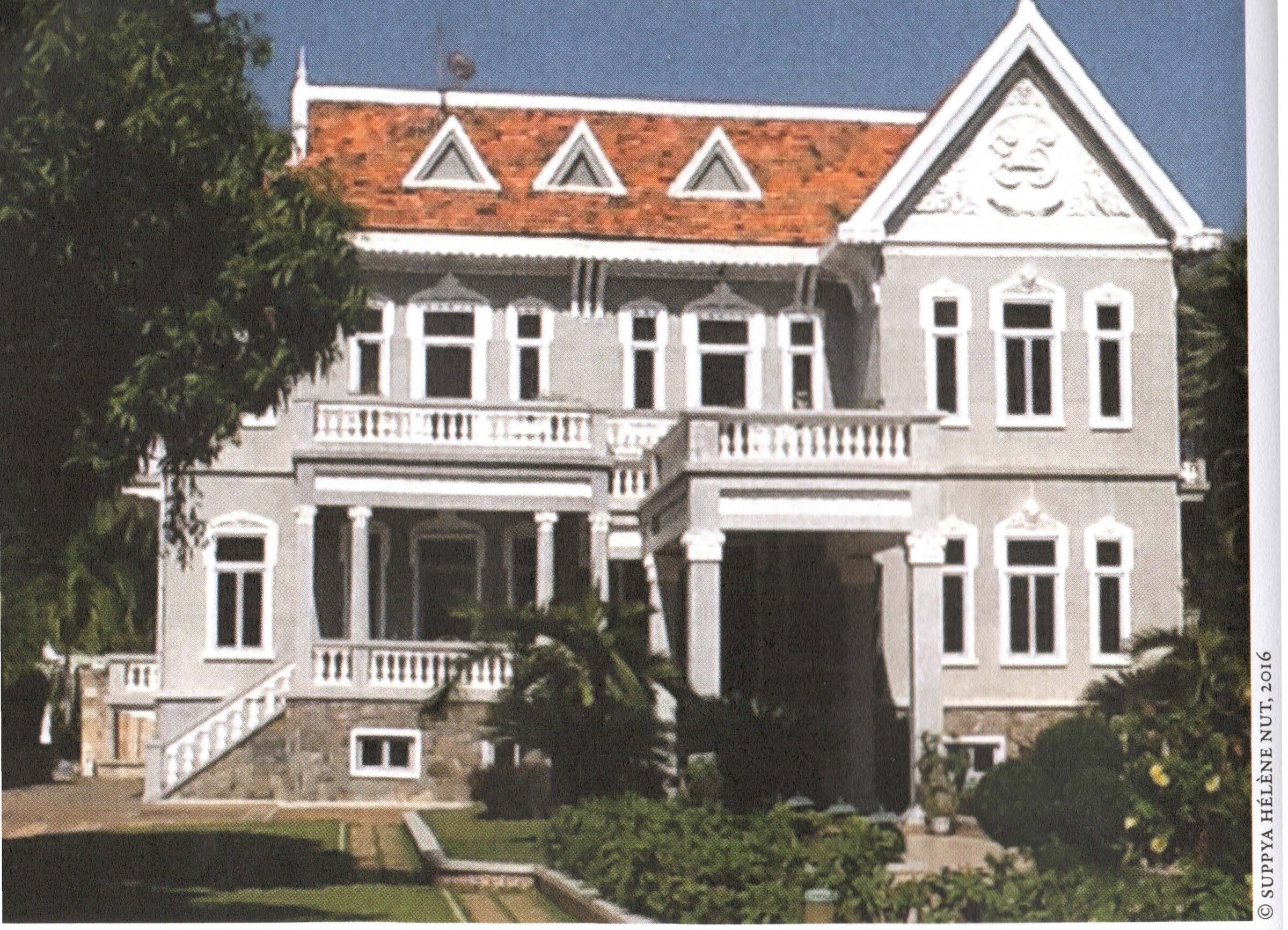
Princess Malika’s private residence off Preah Ang Yukhantor Street (St. 19), Phnom Penh, 2016. [photo © Suppya Nut]
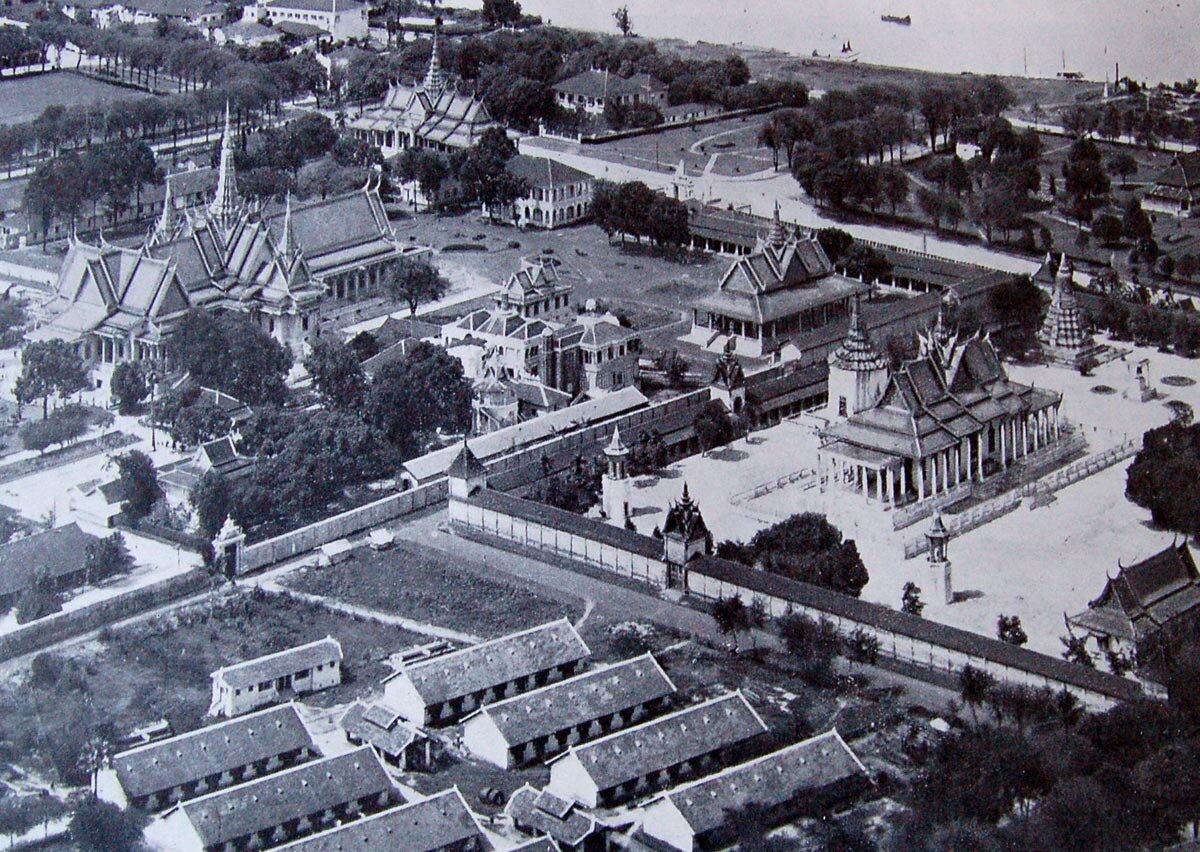
Phnom Penh Royal Palace circa 1930 [photo SPI (Service photographique de l’Indochine}.
1) Princess Malika’s private residence off Preah Ang Yukhantor Street (St. 19), Phnom Penh, 2016. [photo © Suppya Nut]. 2) Phnom Penh Royal Palace circa 1930 [photo SPI (Service photographique de l’Indochine}.
The study focuses on the ‘Khmer District’ (‘Quartier Cambodgien’) in the vicinity of the Royal Palace, as well as its evolution during the post-Independence years (1953−1975) and after the traumatic takeover and expulsion of the urban population by the Khmer Rouge in 1975:
Le quartier khmer a été conçu par et pour la maison royale, dans une perspective magico-religieuse, avec pour centre névralgique le Palais royal, le roi et tout autour ses subordonnés, famille royale, noblesse et gens du Palais. Il devient au cours des années un lieu prisé par les populations non khmères, dont l’ascension sociale a été favorisée par le protectorat. Séduits par la culture raffinée de la cour, ses règles et ses habitudes, les Khmers de Cochinchine et les Sino-Khmers qui sont en quête d’honorabilité s’y installent et se marient avec les membres de l’aristocratie. Intégrer ces nouveaux venus est une occasion pour celle-ci de se « remettre le pied à l’étrier », après avoir été dépossédée de ses pouvoirs par les Français. À travers ses institutions religieuses et éducatives, l’aristocratie assure définitivement l’adhésion de ces groupes à son programme de rénovation et de reprise de pouvoir, qui se concrétisera en 1953 par l’accession de Norodom Sihanouk à la tête du royaume devenu indépendant.
Si les anciens propriétaires de ces lieux ont disparu, le prestige de ce quartier est resté intact auprès de la nouvelle classe dirigeante, mélange d’anciens Khmers rouges, de communistes provietnamiens et de survivants ralliés à la cause du plus fort. Dès le début des années 1980, ses villas sont occupées par les plus hauts responsables du gouvernement ou par les conseillers vietnamiens, alors que les demeures tout aussi belles qui se situent dans le quartier français sont négligées jusqu’au début des années 2000. [p. 82]
[The Khmer quarter was designed by and for the royal family, from a magical-religious perspective, with the Royal Palace, the king, and his subordinates — the royal family, nobility, and palace staff — at its nerve center. Over the years, it became a popular area for non-Khmer populations, whose social advancement was facilitated by the protectorate. Seduced by the refined culture of the court, its rules and customs, Khmers from Cochinchina and Sino-Khmers seeking respectability settled there and married members of the aristocracy. Integrating these newcomers provided the aristocracy with an opportunity to regain its footing after being stripped of its power by the French. Through its religious and educational institutions, the aristocracy definitively secured the support of these groups for its program of renewal and consolidation of power, which culminated in 1953 with Norodom Sihanouk’s accession to the throne of the newly independent kingdom.
While the former owners of these properties had passed away, the prestige of this district remained intact among the new ruling class, a mix of former Khmer Rouge, pro-Vietnamese communists, and survivors who had rallied to the cause of the strongest. From the early 1980s onward, its villas were occupied by top government officials and Vietnamese advisors, while the equally beautiful residences in the French Quarter were neglected until the early 2000s.]
Elite Formation and Colonialism: Education at Stake
Without confronting directly the mechanisms of power deployed by the French Protectorate, Cambodian elites in Phnom Penh looked for developing their own cultural devices, in particular in the field of education. The author was particularly intent in studying the schooling of girls and young women:
Les familles princières n’ont pas tardé à investir dans la formation de leur progéniture, à commencer par l’école des enfants du Palais royal, qui s’ouvre aussi pour les jeunes filles et d’où sortiront les premières institutrices du Cambodge, les enfants du [Prince] Yukanthor et de [la Princesse] Malika, les princesses Ping Peang (1894−1966) et Peng Pos (1892−1969). À l’initiative des princesses Norodom Malika (1872−1951) et Norodom Phangangam (1874−1944) ainsi que de sa fille Rasmi Sobhana, plus connue sous son titre de Samdech Kanitha (1898−1971), deux écoles primaires franco-khmères sont ouvertes en 1911 pour éduquer les filles de bonne famille.
Ces deux nouvelles écoles rencontrent un immense succès auprès des parents, rassurés et par leur proximité des lieux de résidence et par le pedigree des fondatrices. Sans que l’on puisse l’affirmer de façon précise, il semble d’après nos entretiens qu’un certain nombre de jeunes filles aient reçu une éducation de base — lire, écrire et compter — à domicile avant que né soient créées les écoles de filles. Certaines ont même poussé plus loin leurs études, comme la première écrivaine Sou Sith ou Tep Vom, la fille du ministre de la Justice Uk, devenue l’une des premières institutrices.
Ces deux institutions se partagent les élèves suivant la proximité des liens familiaux et accueillent non seulement les filles, mais aussi les garçons. L’école Sutharot, qui se situe dans la résidence du prince Sutharot à côté du Vat Svay Popè, accueille le clan Suramarit, dont Sihanouk et les enfants issus du second lit (avec Khun Kim An Yeap ), la princesse Vacheara, les princes Sirivudh et Preyasaphon, et le clan Sihanouk, dont ses enfants, la princesse Buppha Devi et Ranariddh. Le clan Nhieuk Nou, qui pourtant réside dans la rue Malika (ou rue 256), fréquente l’école Sutharot car Nhieuk Nou en personne y est professeur.
L’école Malika se situe dans la résidence des Yukanthor, qui occupe le coin de la rue Malika (rue 256) et de la rue Preah Ang Yukanthor (rue 19). Connue pour son excellent niveau de français, elle draine la plupart des familles de hauts fonctionnaires résidant dans son périmètre, comme celles de Son Sann, Ung Hi, et San Yun, ainsi que celles de certains membres de la famille royale, comme le clan Norodom Montana, ou les épouses de Sihanouk, Sisowath Pongsamoni et Sisowath Monikessan.
Cette culture raffinée, dont la maîtrise est une condition sine qua non de l’ancrage dans le milieu élitaire, a formé plusieurs générations de femmes, qui sont devenues les épouses des hommes les plus influents du Cambodge, comme Marie Cazeau, épouse du ministre Son Diep (ANC n° F7518), Son Sunnary, fille de ce dernier et épouse de Sisowath Monipong, Nou Sieng, mère de Saveros Pou, éminente linguiste, nièce de Nhieuk Nou, chef du protocole du Palais royal, Chhreung Sophoum, épouse de Nhieim Sokphal, ministre et député de 1958 à 196629, In Em, première femme bachelière et épouse de Sam Sary, haut fonctionnaire et proche de Sihanouk avant sa chute au début des années 1960, ou encore Tep Vom, descendante d’une vieille famille de mandarins, épouse du général Saukham Khoy, président du Sénat sous la République du Cambodge (1970−1975). [p. 77 – 9]
The princely families were quick to invest in the education of their offspring, beginning with the Royal Palace Children’s School, which also opened to girls and from which emerged Cambodia’s first female teachers: the children of Prince Yukanthor and Princess Malika, Princesses Ping Peang (1894−1966) and Peng Pos (1892−1969). At the initiative of Princesses Norodom Malika (1872−1951) and Norodom Phangangam (1874−1944), as well as the latter’s daughter, Princess Rasmi Sobhana, better known by her title Samdech Kanitha (1898−1971), two Franco-Khmer primary schools were opened in 1911 to educate girls from good families.
These two new schools have been immensely successful with parents, who are reassured by their proximity to their homes and by the founders’ distinguished backgrounds. While it cannot be stated definitively, our interviews suggest that a number of young girls received a basic education — reading, writing, and arithmetic — at home before the girls’ schools were established. Some even pursued further studies, such as Sou Sith, the first female writer, and Tep Vom, the daughter of the UK Minister of Justice, who became one of the first teachers.
These two institutions share students based on family ties and welcome not only girls but also boys. Sutharot School, located in Prince Sutharot’s residence next to Wat Svay Popeh, served the Suramarit clan, including Sihanouk and his children from his second marriage (with Khun Kim An Yeap), Princess Vacheara, Princes Sirivudh and Preyasaphon, and the Sihanouk clan, including his children, Princess Buppha Devi and Prince Ranariddh. The Nhieuk Nou clan, despite residing on Malika Street (or Street 256), attended Sutharot School because Nhieuk Nou himself teaches there.
Malika School was located in the Yukanthor residence, which occupies the corner of Malika Street (Street 256) and Preah Ang Yukanthor Street (Street 19). Known for its excellent teaching of French language, it attracted most of the families of high-ranking officials residing within its boundaries, such as those of Son Sann, Ung Hi, and San Yun, as well as those of certain members of the royal family, like the Norodom Montana clan, or the wives of Sihanouk, Sisowath Pongsamoni and Sisowath Monikessan.
This refined culture, mastery of which is a prerequisite for integration into elite circles, shaped several generations of women who became the wives of Cambodia’s most influential men, such as Marie Cazeau, wife of Minister Son Diep (ANC No. F7518); Son Sunnary, the latter’s daughter and wife of Sisowath Monipong; Nou Sieng, mother of Saveros Pou, an eminent linguist and niece of Nhieuk Nou, head of protocol at the Royal Palace; Chhreung Sophoum, wife of Nhiem Sokphal, minister and member of parliament from 1958 to 1966; In Em, the first woman to earn a bachelor’s degree and wife of Sam Sary, a high-ranking official and close associate of Sihanouk before his fall in the early 1960s; and Tep Vom, a descendant of an old mandarin family and wife of General Saukham Khoy, president of the Senate under the Republic of Cambodia. (1970 – 1975).]
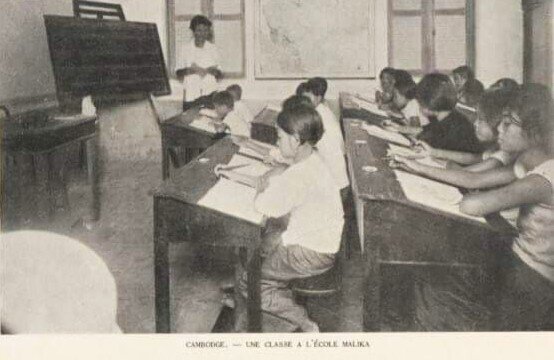
A classroom at Malika School, Phnom Penh.
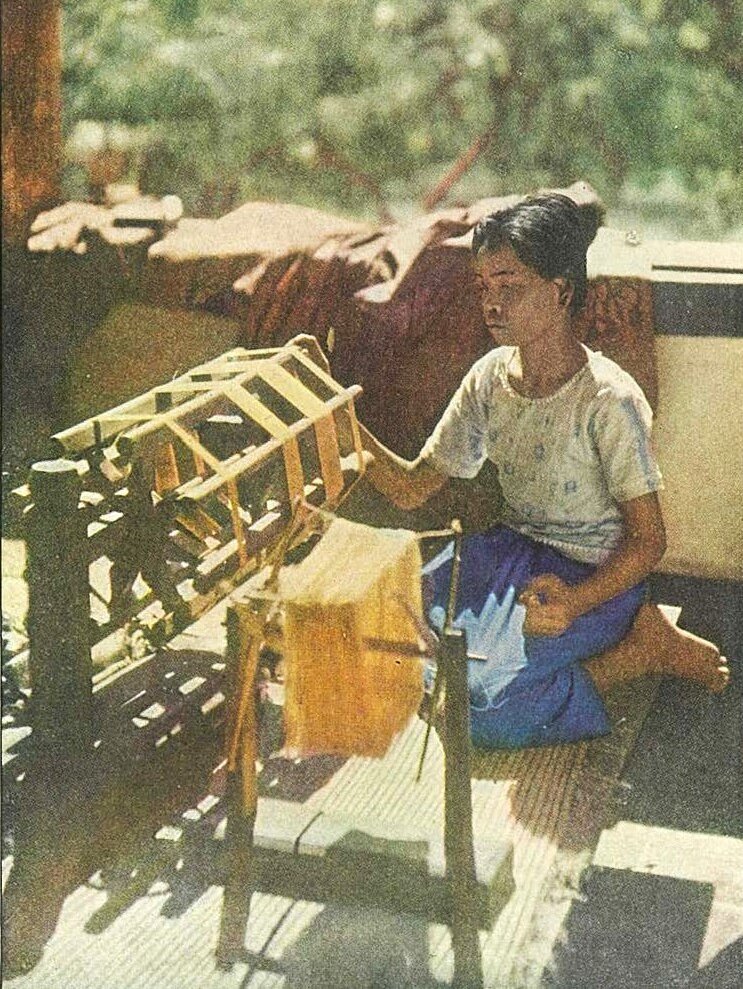
1) A classroom at Malika School for girls, Phnom Penh, 1920s. [archive photo retrieved by Amazing Cambodia]. 2) French colonial representation of Cambodia in the 1920s promoted mostly vocational and applied arts education for girls [autochrome photo by J. Gervais-Courtellemont, National Geographic, Sept. 1928.]
1) A classroom at Malika School for girls, Phnom Penh, 1920s. [archive photo retrieved by Amazing Cambodia]. 2) French colonial representation of Cambodia in the 1920s promoted mostly vocational and applied arts education for girls [autochrome photo by J. Gervais-Courtellemont, National Geographic, Sept. 1928.]
Rebirth of a City and Memory
Plus de quarante ans après la prise du pouvoir par les Khmers rouges en 1975, le Cambodge n’a pas encore entamé son travail de mémoire face à l’urgence de reconstruire un pays dévasté par la guerre civile, les bombardements aveugles des Américains (1 970‑1975) et le régime de terreur du Kampuchéa démocratique (1975−1979 ), qui ont ébranlé la société khmère. La question de mémoire s’est seulement invitée sur la place publique en 2004, lors de la mise en place du Tribunal traduisant les principaux chefs Khmers rouges (Chambres extraordinaires au sein des tribunaux cambodgiens) et de la diffusion télévisée de ses séances. La mise en lumière de cette période traumatique, qui n’a épargné aucune famille, a occupé un tel espace dans les médias khmers et étrangers et les travaux universitaires qu’elle occulte la mémoire des périodes précédentes, celles
du Sangkum (1953−1970) et de la République khmère (1970−1975). [p. 61] […]Cette mise en lumière de la géographie spatiale et sociale des anciennes élites permet de rendre la mémoire de Phnom Penh à ses habitants disparus ou exilés; travail incomplet certes, dans le champ encore en friche de l’histoire sociale de Phnom Penh. Mais l’important est pour le moment ailleurs. Il s’agit, comme l’a dit Pierre Nora, “de “marquer” un passé, pour faire une place au mort … et aider ainsi au travail de deuil”. [p. 82] La question de « l’attachement des sociétés à leurs lieux » se pose ici d’une façon particulière. Pour les Khmers, la survie de leur capitale, même très dégradée, était importante à ce moment-là. Les lieux symboliques étaient toujours là : le palais, les pagodes principales, les lieux du pouvoir, ainsi que les lieux de mémoire plus populaires, le marché central, la promenade publique le long du fleuve… On retrouvait aussi les particularités d’un urbanisme hérité de la colonisation française, avec ses espaces verts et ses vastes avenues plantées d’arbres, nés du remblaiement de zones marécageuses. La société a été complètement bouleversée, mais les lieux ont en grande partie subsisté. On peut dire que c’est la société qu’il fallait reconstruire, plus que la ville. On n’est pas confronté ici à des habitants réintégrant une ville reconstruite, mais à une société renaissant après être sortie tout juste de l’enfer, et s’installant dans une ville dégradée. Ce faisant, cette société meurtrie a pu petit à petit faire revivre la capitale, contribuant ainsi à relever la nation. [p. 110]
More than forty years after the Khmer Rouge seized power in 1975, Cambodia has yet to begin its process of coming to terms with its past, given the urgent need to rebuild a country devastated by civil war, indiscriminate American bombing (1970−1975), and the reign of terror of Democratic Kampuchea (1975−1979), which shook Khmer society to its core. The issue of historical memory only entered the public sphere in 2004, with the establishment of the Extraordinary Chambers in the Courts of Cambodia (ECCC), which brought the principal Khmer Rouge leaders to trial, and the televised broadcast of its proceedings. The spotlight on this traumatic period, which spared no family, has occupied such a prominent place in Khmer and foreign media and academic works that it overshadows the memory of the preceding periods, those of the Sangkum (1953−1970) and the Khmer Republic (1970−1975). [p. 61] […]
This highlighting of the spatial and social geography of the former elites allows us to restore the memory of Phnom Penh to its inhabitants who have disappeared or gone into exile; admittedly an incomplete task, in the still largely unexplored field of Phnom Penh’s social history. But the important thing for the moment lies elsewhere. It is, as Pierre Nora said, “about ‘marking’ a past, to make room for the dead… and thus help with the work of mourning.” [p. 82] The question of “societies’ attachment to their places” arises here in a particular way. For the Khmer people, the survival of their capital, however dilapidated, was crucial at that time. The symbolic sites were still there: the palace, the main pagodas, the seats of power, as well as the more popular places of remembrance, the central market, the public promenade along the river… The distinctive features of an urbanism inherited from French colonization were also still present, with its green spaces and wide, tree-lined avenues, created by reclaiming marshy areas. Society had been completely upended, but the places largely survived. One could say that it was society that needed rebuilding, more than the city itself. We are not dealing here with inhabitants returning to a rebuilt city, but with a society reborn after having just emerged from hell, and settling into a degraded city. In doing so, this wounded society was able, little by little, to revive the capital, thus contributing to the nation’s recovery. [p. 110]
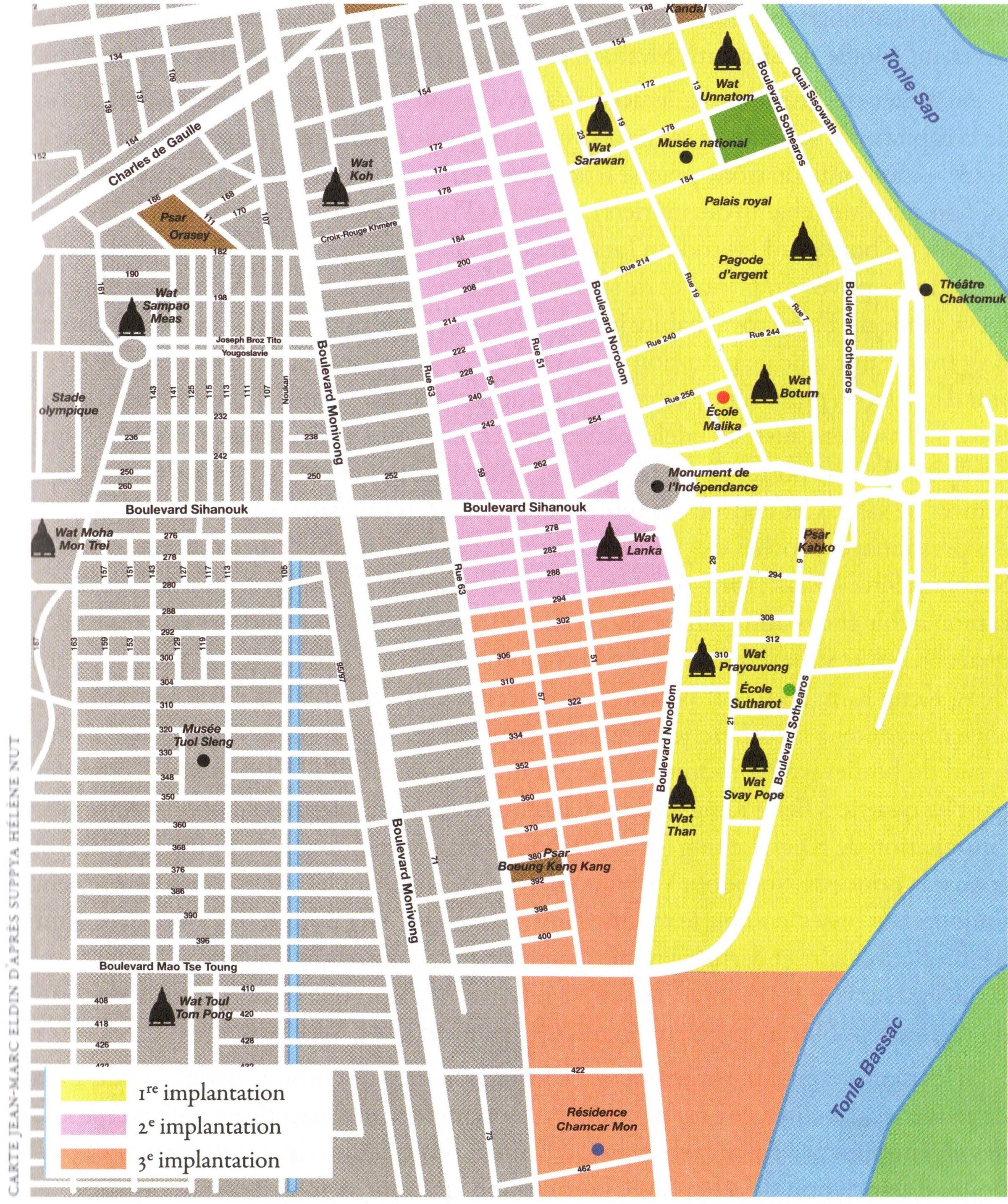
1) Map of Phnom Penh Royal Palace Area illustrating the historic phases of settlement by the
1) Map of Phnom Penh Royal Palace Area illustrating the historic phases of settlement by the
ADB Input: More about cartography in Cambodia
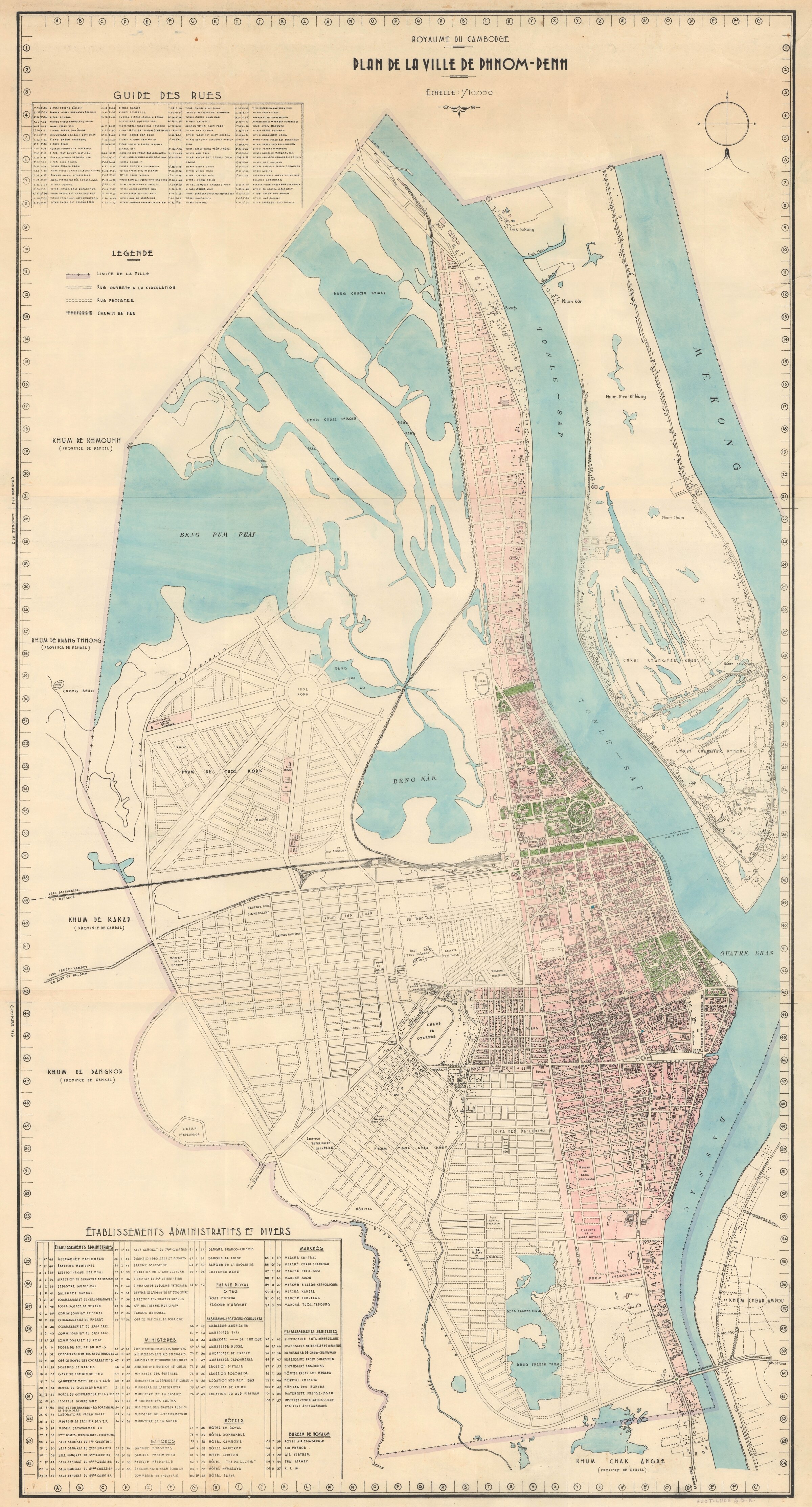
1956 – 1960 Draft by Service Géographique Khmer (SGK) from a 1935 map by colonial Service Géographique de l’Indochine (SGI). [compressed file from hi-res image purchased from Geographicus.com, July 2026. email hidden; JavaScript is required for available highest resolution file.]
Plan de la Ville de Phnom Penh — Project, est. date 1956 – 1960 (*). — This is a fascinating example of how cartography in post-Independence Cambodia had to draw from colonial legacy. The project by Service Géographique Khmer (SGK) drew from a 1935 map by colonial Service Géographique de l’Indochine (SGI), as it showed the Central Market (Psah Thmei), inaugurated in 1935. The SGK was created in 1955 with funding from the US government (which might explain why the US Embassy is listed first). The map listed the office of Royal Cambodian Air, the national airline established in 1956. While this rare document showed ‘Khmerized’ street names and outlined future districts in development, it did not show the new Orussey Quarter, developed by architect Lu Ban Hap when he was appointed Director of the Municipal Service in 1960, with UN expert Gerald Henning as advisor. (*) estimation by Angkor Database team in consultation with architecture historian Walter Koditek. [compressed file from hi-res image purchased from Geographicus.com, July 2026. email hidden; JavaScript is required for available highest resolution file.]
The rare document above illustrates how cartography in modern Cambodia had to evolve from spatial representations edicted by the colonial administration of the French Protectorate. Granted, historians have remarked the scarcity of cartographic documents produced by Cambodian researchers or travelers during the 19th and early 20th centuries.
Studying three rare instances of Cambodian “provincial” maps, researcher Grégory Mikaelian, exploring a worldview in which “la borne prime sur le plan” [“Boundary-marking takes precedence over mapping”], remarked
Si l’on peut affirmer que la carte est restée une préoccupation allogène, guère prisée par les Cambodgiens qui né l’utilisent pour ainsi dire pas, il serait cependant erroné de prendre ce désintérêt manifeste pour une incapacité à conceptualiser l’espace. Tout au contraire, les données anthropologiques comme linguistiques attestent la richesse et la complexité dont la tradition cambodgienne fait preuve pour évoquer la position dans l’espace des êtres animés comme celle des objets, et c’est pourquoi la relation entre cette tradition et l’absence d’une praxis de la carte devrait se lire à l’inverse : celle-ci, solidement ancrée, rendrait la société cambodgienne comme imperméable à l’exercice cartographique. À la limite, la carence cartographique agit ici en tant que révélateur de la richesse ‘spatiographique’ cambodgienne. [p. 101]
[…] La pensée en carte, phénomène allogène, triplement colonial (siamois, kinh puis français) ou récemment impérial (pensons aux couvertures cartographiques de l’armée américaine dans les années soixante-dix) n’a pas fait souche y compris jusque dans les strates les plus occidentalisées des élites cambodgiennes. Il suffit pour s’en convaincre d’observer la manière dont l’objet est aujourd’hui utilisé dans les négociations pour l’établissement des frontières du Cambodge, qui relève plus de la technique du bornage rituel que de la recherché d’une raison graphique. Finalement, le seul emploi véritablement intégré de la carte se trouve être le fait de la propagande nationaliste, sous la forme de caricatures signifiant la perte des territoires khmers face à l’avancée des Thaïs ou des Vietnamiens, un emploi ‘galactique’ d’ailleurs commun aux pays indianisés puisqu’on le retrouve aussi bien en Thaïlande qu’en Inde même. On peut en dernier lieu se demander si, paradoxalement, cette persistance d’un rapport galactique au territoire n’a pas largement permis aux élites cambodgiennes de résister face aux appétits de leurs voisines depuis qu’elles ont adopté, à partir de la fin du XVIIIe siècle, une logique géographique impériale. [p. 135] [“Note sur la première cartographie provinciale cambodgienne (c. 1897)” [“Note on the first Cambodian provincial mapping”] (c. 1897), Péninsule 54 – 1, 2007: 99 – 135.]
[While it can be said that maps have remained an alien concern, hardly valued by Cambodians who practically do not use them, it would be wrong to mistake this evident disinterest for an inability to conceptualize space. On the contrary, anthropological and linguistic data attest to the richness and complexity that Cambodian tradition displays in describing the position in space of both living beings and objects. Therefore, the relationship between this tradition and the absence of a map-making practice should be interpreted in reverse: this deeply rooted practice would render Cambodian society impervious to cartographic practice. Ultimately, the cartographic deficiency here acts as a revealer of the richness of Cambodian ‘spatiography’. [p. 101]
[…] Map-based thinking, an alien and triply colonial (Siamese, Kinh, then French) or more recently imperial (think of the American army’s map-covering campaigns in the 1970s) concept, has not taken root, even among the most Westernized strata of the Cambodian elite. To be convinced of this, one need only observe how the map is currently used in negotiations for establishing Cambodia’s borders, which is more akin to ritualistic demarcation than the search for a graphic rationale. Ultimately, the only truly integrated use of maps is found in nationalist propaganda, in the form of caricatures depicting the loss of Khmer territories to the advance of the Thais or the Vietnamese — a ‘galactic’ use, moreover, common to Indianized countries, since it is found in Thailand as well as in India itself. Finally, one might wonder whether, paradoxically, this persistence of a galactic relationship to territory has not largely enabled Cambodian elites to resist the ambitions of their neighbors since they adopted, from the end of the 18th century onwards, an imperial geographical logic. [p. 135]]
Read also
- Michel Bruneau, “La notion de frontière et sa signification dans la Péninsule indochinoise” [“The Concept of Border and its Meaning in Mainland Southeast Asia”], Moussons 3, 2001[in French, online].
- Sophie Clément-Charpentier, “Mort et renaissance d’une capitale: Phnom Penh victime des Khmers rouges” [Death and rebirth of a capitale: Phnom Penh, victim of the Khmer rouge], Géographie et cultures 65, 2008: 91 – 110 [In French, online].
- Nasir Abdoul Carime, “Le Cambodge et la représentation géographique occidentale avant 1511”, Association d’échanges et de formation pour les études khmères (AEFEK), nd, 20 p | “À travers la cartographie occidentale de la péninsule indochinoise (XVIe — XIXe siècles)”, AEFEK, 2023, 19p.
Tags: modern history, Cambodian elites, Royal Palace, education, women, Phnom Penh, urbanism
About the Author

Suppya Nut
Researcher, linguist and historian, a teaching fellow at INALCO (Paris) and the University of Cologne (Germany), Suppya Hélene Nut [also Hélène Suppya Bru-Nut] (1960, Phnom Penh) is the founder of the Khmer Dance Project in collaboration with the Center for Khmer Studies, the Anne Hendricks Bass Foundation and the Jerome Robbins Dance Division at the New York Public Library for the Performing Arts.
A former dancer with the Khmer Classical Ballet in Paris, Suppya Nut is a leading specialist in Khmer court and traditional dance historiography. She has acted as editorial adviser to HRH Princess Buppha Devi since 2006.
Publications
- “Die Flüchtlingslager in Thailand (aus dem Französischem übersetzt von Stephan Fessen)”, Kambodschanische Kultur 3, Berlin, 1990 : 42 – 50.
- Étude du Vocabulaire du théâtre royal khmer, Cahiers d’Etudes Franco-Cambodgiennes 6, Service culturel de l’Ambassade de France, Phnom-Penh, 1996, 83 p.
- [with Michel Rethy Antelme] Dictionnaire français–khmer វចនានុក្រម បារាំង‑ខ្មែរ, L’Asiathèque, Paris, 2001, 912 p.; 2d augmented ed., Paris, L’Asiathèque, 2013, 1693 p.
- “La naissance des Apsaras : le barattage de la mer de lait” ; “Phalla danceuse sacrée”, in Les danseuses sacrées d’Angkor, dir. Christophe Loviny, Paris : Éd. Jazz-Le Seuil, 2002.
- “Le théâtre royal”, in Le Cambodge d’Adhémard Leclère (1853−1917) et le trésor indochinois d’Alençon, Le Fresne, ed. De l’Étrave, 2009 : 67 – 74.
- “Reconstructing National Identity, the Case of the Cambodian Royal Ballet”, Paper presented at the Institute of Southeast Asian Studies, Singapore, 11 September 2009.
- “Le théâtre royal”, in Le Cambodge d’Adhémard Leclère (1853−1917) et le trésor indochinois d’Alençon, Alençon-Paris, Ed. Le Fresne ; Éd. De l’Étrave, 2009 : 67 – 74.
- Musique et chants Pinpeat, Vincennes-Phnom Penh : Buda Productions, 2011, 12 p. [CD booklet]
- “Les femmes du ballet royal : du Palais à la banlieue de Phnom Penhʺ, La lettre de l’Afrase 78, 2011: 18 – 19.
- “Écrivaines du Cambodge”, Dictionnaire des créatrices, Paris, Éd. Des femmes, 2013.
- “Des voix d’ici et ailleurs ou comment narrer l’indescriptible”, Le génocide effacé, dir. Pierre Bayard & Soko Phay-Vakalis, Paris : Éd. Cécile Defaut, 2013 : 227 – 244.
- [with Michel Antelme] Le khmer sans peine, Paris, Assimil, [book, 816 p. + 5 CDs], 2014 . ISBN 978 – 2700580419.
- [with Michel Rethy Antleme] Parlons khmer, L’Harmattan, Paris, 2014. ISBN 978 – 2700517842.
- ‘The Apsara Dance from Fantasy to an Iconic Classical Dance,’ Paper presented at the ASEASUK Conference, 12 – 14 September 2014, Brighton, UK.
- ‘The Legend of Apsara Mera: Princess Norodom Buppha Devi’s Choreography for the Royal Ballet of Cambodia,’ Asian Theatre journal 31 – 1, 2014: 279 – 289.
- ‘Queen Khun Than: When Women Challenged French Power in Early Colonial Cambodia,’ Paper presented at the 40th annual meeting of the French Historical Society, 25 – 28 June 2014, Siem Reap, Cambodia.
- ‘The Glass Plate Photographs of the Cambodian Royal Dancers: Contested Memories,’ Udaya 12, 2015: 41 – 59.
- ‘Khun Than, the First Lady, and the French: A Predictable Confrontation.’ [forthcoming]
- ‘Lokhon Luang, the Cambodian Court Theatre: Toward a Decline of Women’s Supremacy?,’ Asian Theatre Journal 32 – 2, 2015: 416 – 439.
- [ed. with Patrick Nardin & Soko Phay], Cambodge: Cartographie de la mémoire, L’Asiathèque, 2017, 224 p. ISBN 978 – 2360570942.
- ‘Phnom Penh des origines à 1975: émergence et constitution des lieux de pouvoir et des lieux de mémoire’, in Nardin, Nut, Phay (eds.), Cambodge: Cartographie de la mémoire, L’Asiathèque, 2017: 61 – 82.
- ‘The Royal Ballet of Cambodia: From Ritual to a National Identity,’ Asia Dialogue, University of Nottingham: Asia Research Institute, 9 Jan. 2019 [online].
- ‘Traditional performing arts under the influence of NGOs: Myth or reality?’, in The Cultural Turn in International Aid: Impacts and Challenges for Heritage and the Creative Industries, Sophia Labadi (ed.), Routledge, 2020: 139 – 151. ISBN 9780367776992.
- [with Boreth Ly] ‘Princess Norodom Buppha Devi (1943 – 2019): A Life in Dance’, Asian Theatre Journal 37 – 2, 2020: 311 – 327.
- Traditional performing arts under the influence of NGOs: myth or reality? » The Cultural Turn in International Aid: Impacts and Challenges for Heritage and the Creative Industries, dir. Sophia Labardi, London, Routledge, 2020: 139 – 151.
- “In memoriam Nouth Narang (1937−2023)”, Péninsule 87 – 2, 2023 : 5 – 7.
- Upcoming: “Cambodian Theater”, in Asian Theatre Then and Now: A Guide for the Future. Londres : Routledge.
Interviews and Documentaries
Khmer Dance Project at New York Public Library [Jerome Robbins Dance Division]
- Interview with Soth Somaly, 14 Jan. 2008 | 9 Jan. 2009 | 8 Sept. 2009.
- Int. with Proeung Chhieng, 15 Jan. 2008.
- Int. with Em Theay, 22 March 2008 | 27 March 2008.
- Interviews with Ros Kong + student rehearsal footage, 3 March 2008 | 29 March 2009 | 23 Dec. 2009.
- Int. with Sin Sama Deuk Chho, 30 March 2008 & 15 July 2008.
- Int. with Soth Sam On, 23 March 2008 | 30 March 2008.
- ‘Rehearsal of Sovannahong’, 3 Jul. 2008.
- ‘Performance of Sovannahong’, 4 Jul. 2008.
- Int. with Proeng Pruon, 7 Jul. 2008.
- ‘Ceremony of paying homage to the spirits of dance’, 17 Jul. 2008.
- Int. with Sim Muntha, 18 July 2008.
- Int. with HRH Princess Norodom Buppha Devi, 25 July 2008.
- Int. with Sophiline Cheam Shapiro, John Shapiro, Toni Shapiro, & dancers of Khmer Arts Academy, 22 Aug. 2008.
- ‘The School of Dance at Siem Reap,’ 7 Jan. 2009.
- Int. with Kim Boran, 13 Jan. 2009.
- ‘Make-up & Costumes’, 13 – 15 Jan. 2009.
- Int. with Nginn Karet Ravynn, So Chan Nu, Keo Saroeum, 17 July 2009.
- Int. with Sim Muntha, 17 Jul. 2008 | 24 Jul. 2008.
- ‘Rehearsal of Enao Bosseba’, 6 – 12 Aug., 3, 21, 31 Sept. 2009.
- Int. with Lim Sylvain and Sim Montha, 9 Aug. 2009.
- Int. with Chhem Sok, 12 Aug. 2009 | 16 Aug. 2009.
- Int. with Lim Sylvain, 13 Aug. 2009.
- Int. with Pen Sokhuon, 14 Aug. 2009.
- ‘Demonstration of Ngos gestures by Master Sin Sama Deuk Chho and Voth Chan Moly,’ 2012.
- Int. with Chhem Sok, 12 Aug. 2009.
- ‘Ceremony of paying homage to the spirits of dance’, 3 Sept. 2009.
- Int. with Chin Chan Soda, 24 Dec. 2009.
- Int. with Sor Thavarak, 24 Dec. 2009.
- Int. with Sam Satya, 24 Dec. 2009.
- Int. with Nol Kol, 2 Jan. 2010.
- Int. with Hang Sopheap, 2 Jan. 2010.
- Int. with Vuth Chan Moly, 2 Jan. 2010.
- Int. with Roth Chan Mony, 2 Jan. 2010.
- Int. with Sam Savin, 2 Jan. 2010.
- Int. with Sin Sakada, 2 Jan. 2010.
- Int. with Pum Bun Chanroth, 6 Jan. 2010 | 8 Jan. 2010.
- Int. with Soum Sinoeum, 8 Jan. 2010.
Conferences
- ‘Les mots nouveaux dans la langue khmère’, Centre Culturel Français, Siem Reap, April 2002.
- ‘Les mots nouveaux dans la langue khmère et présentation du dictionnaire Fr-Kh “, Centre Culturel Français, Phnom-Penh, April 2002.
- ‘Le vocabulaire royal : du vieux khmer au khmer moderne’, Université Royale de Phnom-Penh, Département de Linguistique, April 2002.
- [with Ms. Savay MEAS] “Une raison de la survie des danses royales khmères, un théâtre total, une codification totale”, le 24 novembre 2007, INALCO, Centre Dauphine, Conférence : Cambodge, construction et déconstruction, les diagnostics apportés par l’analyse, les leçons apportées par l’expérience, Paris, 2007.
- ‘Le théâtre royal khmer’, Médiathèque d’Alençon, Nov. 2009.
- ‘The Khmer Royal Ballet : A Symbol of Khmer Identity’, Institute for South-East Asian Studies (ISEAS), Singapore, Sept. 2009.
- ‘Literary genres in Cambodian Literature’, Koln University, Department of Linguistics, May 2010.
- [with Kathy Basset] ‘Du rituel au spectacle : Le théâtre royal à travers le cas de Bali’, Journée culturelle du Cambodge, Centre Inalco, Paris, Nov. 2010.
- ‘The Khmer Royal Theatre’, University of Amsterdam, Department of Musicology, Dec. 2010.
- ‘Des voix d’ici et ailleurs ou comment narrer l’indescriptible’, Colloque “Le génocide effacé”, Université Paris VIII, Dec. 2010.
- “Reconstitution de la mémoire du ballet royal après le génocide khmer rouge à travers les témoignages des artistes”, Séminaire de Master 2, La fabrique de l’histoire au Viet-Nâm, Laos, Cambodge : Sources et méthodologie, Paris, Université Paris Denis Diderot-Paris 7, Paris, 17 Nov. 2011.
- ‘Reconstitution de la mémoire du ballet royal après le génocide khmer rouge à travers les témoignages des artistes’, Séminaire de Master 2, La fabrique de l’histoire au Viet-Nâm, Laos, Cambodge : Sources et méthodologie, Université Paris VII, Nov. 2011.
- ‘Un panorama de la littérature moderne du Cambodge’, Séminaire de Master 1, Littérature et société en Asie du Sud-Est : Écritures de soi/Écritures de l’autre, Inalco, Nov. 2011.
- ‘Le vocabulaire royal khmer : genèse, développement et évolution’, Colloque “Quelle(s) science (s) pour le pays khmer? Approches empiriques et théoriques”, Aefek / Case / Inalco / Péninsule, Paris, 26 Nov. 2011.
- ‘Les femmes et l’écriture au Cambodge : des témoins de leur temps’, Séminaire de Master 1, Littérature et société en Asie du Sud-Est : Écritures de soi/Écritures de l’autre, Séminaire de Master 1, Inalco, Nov. 2013.
- ‘Sources et transmission en danse : le cas du Ballet royal du Cambodge’, Séminaire de Master 2, Circulation des idées et des savoirs, réseaux transnationaux et acteurs, Université Paris VII, Feb. 2014.
- ‘Khmer Dance Project: A Presentation’, Giornata di Studi, Ricostruire la Cambogia dopo i Khmer Rossi: L’Esperienza di vita e di lavoro di Onesta Carpené. Fondazione Giorgio Cini, 9 May 2014, Venetia, Italy.
- ‘Queen Khun Than: When Women Challenged French Power in Early Colonial Cambodia’, The 40th annual meeting of the French Colonial Historical Society/ La 40e rencontre annuelle de la Société d’histoire coloniale française, du 26 au 28 juin 2014/June 26 – 28 2014, Siem Reap, Cambodia/Siem Reap, Cambodge.
- ‘The Apsara Dance: From French Fantasy to an Iconic Classical Dance’, Conférence ASEASUK (Association for Southeast Asian Studies in the United Kingdom), 12 – 14 Septembre 2014, Brighton, UK.
- ‘L’écriture de l’indicible : les narrations littéraires du génocide cambodgien’, Séminaire de Master 1, Littérature et société en Asie du Sud-Est : Écritures de soi/Écritures de l’autre, Inalco, Nov. 2014.
- [co-direction with Soko Phay & Patrick Nardin] “Images du Cambodge : mythe, histoire et mémoire”, Colloque international, Université Paris 8, Archives nationales, Pierrefitte-sur-Seine, 10 – 11 avril 2015.
- ‘Phnom Penh : Émergence des lieux de pouvoir et des lieux de mémoire’, Conférence internationale, Images du Cambodge : mythe, histoire et mémoire, Université Paris 8, Archives nationales, Pierrefitte-sur-Seine, 10 – 11 avril 2015.
- ‘Music and Dance in Pre-colonial Cambodia’, SEASIA (Consortium for Southeast Asian Studies in Asia), Center for Southeast Asian Studies, Kyoto University, Kyoto International Conference Center, Kyoto, Japon, 12 – 13 Dec. 2015.
- ‘Au temps où les animaux instruisaient les hommes: Regard sur les contes khmers’, Séminaire de Master 1, Littérature et société en Asie du Sud-Est : Écritures de soi/Écritures de l’autre, Inalco, Nov. 2015.
- ‘Cartographie de Phnom Penh avant 1975 : Émergence, et formation des élites, constitution des lieux de pouvoir’, Séminaire de Master 2, Anciennes et nouvelles élites en Asie du Sud-est : statuts, pouvoirs, légitimités et concurrences, Université Paris VII, Inalco, CNRS, Université de Picardie, Dec. 2015.
- “Intangible Heritage in Cambodia. The Role of Cultural NGOs : Between Collaboration and Tension”, Conférence Heritage as Aid and Diplomacy in Asia, International Institute for Asian Studies (IIAS), 26 – 28 Mai 2016, Leiden, Pays-Bas, 28 May 2016.
- [co-direction with Soko Phay & Patrick Nardin) “Cartographie de la mémoire”, International Symposium, RUFA/Bophana Center, 12 – 13 Jan. 2016.
- ‘Cartographie de Phnom Penh : lieux de pouvoir’, in “Cartographie de la mémoire”, RUFA/Bophana Center, Phnom Penh, 12 – 13 Jan. 2016.
- Co-organizer of ICAS Panel Intermarriage and new ethnicities in Portuguese Asia, past and present. [communication:] “De Monteiro or the Rise of a Portuguese Descent Family in Cambodia”, ICAS 10, 20 – 23 July 2017, Chiangmai, Thailand. (22 July 2017).
- La fabriques des élites femmes : les écoles Malika et Sothearos”, 6e Congrès organisé par le GIS Asie, Paris, France, 27 June 2017.
- “Metamorphoses: Rodin and the Greek Myth Psyche”, Interculturalism and Southeast Asian Performing Arts, EUROSEAS 2019, 10 – 13 Septembre 2019, Humbolt-Universität zu Berlin, Berlin, Allemagne (12 Sept. 2019).
- “Unearthing Sites of Memory in Phnom Penh”, Contested Heritage and the Politics of Memory, Trauma and Mobility in Asia, ICAS 2019, 16 – 19 Sept. 2019, Leiden, Pays-Bas (17 July 2019).
- “Les écoles Malika et Sutharot ou l’appropriation du savoir moderne au service des grandes familles Phnom Penhnoise”, Conférence sur la présence des études khmères organisée par Association des amis de Yosothor & Aefek, Inalco Paris, France, 27 Sept. 2024.
- “Angkorisation de la danse Apsara ». Conférence 50 ans après la prise de pouvoir par les khmers rouges”, Héritage et modernité cambodgiens, une exploration de la musique de la danse et du cinéma, organisée par la section de Khmer et l’Aesci, Inalco Paris, France, 7 May 2025.
- “Sons de l’Empire : la Fanfare philippine du roi du Cambodge, panel Écoutes et pratiques musicales en contexte colonial. 3e Congrès biennal de la Société française de musicologie, 23 – 25 Oct. 2025, Aix-en-Provence (25 Oct. 2025).
- “Elite au Cambodge : L’histoire des élites métisses portugaises, l’exemple des Monteiro”, Séminaire Asie Cessma, 27 février 2024, Université Paris Cité.