Succeeding Jean Moura as France Representative in Cambodia on 1st Jan. 1879, the author traveled the Kingdom extensively — he was the first European on record to write about many remote places, including the Stung Treng area, which Henri Mouhot had crossed in 1859. Under the guidance of French Sanskritist Abel Bergaigne, he was to develop a passion for Khmer epigraphy, a pioneer work that would be praised, commented and criticized by younger Khmerologists, in particular George Coedès.
The scope of this 3‑volume work is impressive, especially as the explorer-epigraphist-historian had to deal with a Kingdom of Cambodia severely reduced in size: the demarcation line with Siamese-occupied provinces then went just shy of Beng Maelea westward, and that is why the important discoveries he made in the Siem Reap and Battambang were treated in the second volume, Le Cambodge: les provinces siamoises (1901).
Combined with a really perceptive eye, there is a sincere desire to acknowledge the efforts of previous explorers such as Lucien Fournereau, Albert Tissandier — for their illustrative talent more than their historical accuracy, he noted -, Jean Moura, Doudart de Lagrée and Francis Garnier obviously, but also photographers Emile Gsell or Felix Faraut, whose pictures were used in the book with full credit, a most commendable care.
In his introduction to the first volume, the author put forward his ambitious plan:
J’espère que le public et les corps savants répondront à l’attente de l’intelligent éditeur qui a accepté de faire imprimer ce volume malgré un chiffre tres minime de souscriptions, et qu’il me sera possible de continuer cette publication qui doit comprendre trois parties dont la préparation est des maintenant assez avancée pour que l’impression puisse se suivre sans discontinuité. Après cette première partie, Le Royaume actuel, viendrait la seconde intitulée: Les Provinces siamoises, provinces si riches en monuments qu’il a fallu en distraire ceux qui dépendaient directement par leur situation de l’ancienne capitale, de telle sorte que la troisième partie aurait pour titre : Le groupe d’Angkor et l’Histoire.
[I hope that the public and scholarly circles will respond to the expectations of the intelligent publisher who agreed to print this volume despite a very small number of subscriptions, and that it will be possible for me to continue this publication which must include three parts whose preparation is now sufficiently advanced so that printing can follow without interruption. After this first part, Cambodia:The Kingdom of Today, would come the second entitled: The Siamese Provinces, provinces so rich in monuments that it seemed necessary to remove those which by their situation were directly vinculated to the ancient capital, so that the third part would be naturally titled The Angkor Group and History. [p. XXII]
Such dividing was not only geographic or archaeologically related: French explorers at the turn of the century had to tiptoe around the Siem Reap and Battambang provinces, still under the Kingdom of Siam’s control even if the French-Siamese negotiations had started and would ultimately conclude with the 1907 treaty of restitution.
Here following, we have selected a few themes reflecting the insightful depth of Aymonier’s research on the field, in oral traditions and in Khmer etymology. Some 130 years later, his ‘Cambodge’ remains stunningly alive, replete with echoes of the past, vivid descriptions of the country and its inhabitants. If the scope of his interest and the pioneering aspect of his work evidently exposed the author to the likehood of factual errors and misinterpretations, we can only marvel at his remarkable perceptiveness, and at a knowledge that remains useful for generations of researchers to come. His work went out in 1900, the same year of the foundation of EFEO: soon, the “amateur Orientalists”, to use Pierre Singaravélou’s term, would be replaced with professional, highly specialized researchers, yet Aymonier was certainly the most enlightened and insightful of the former category.
The Baku
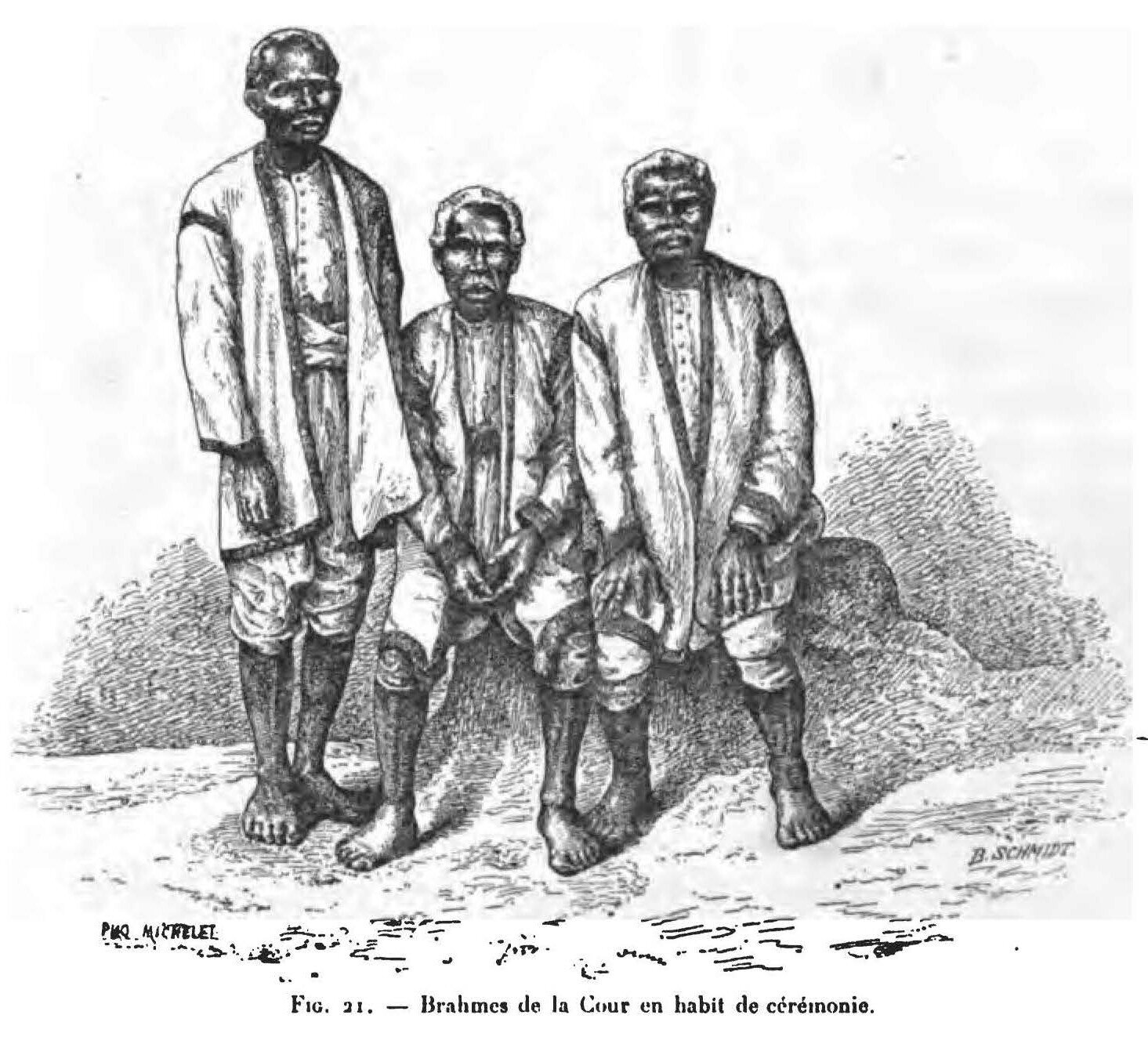
Les Brahmes, incontestablement les descendants des anciens Brahmanes, dont le maintien traditionnel à la cour du Cambodge est un vestige important de l’antique religion, sont appelés officiellement Bram ou Brahmana et vulgairement Pago, prononcé Bakou, nom qui est identique à celui de la huppe, oiseau très commun du pays, et qui est peut-être du à la chevelure que les gens de cette caste conservent longue et nouée en chignon; mais ce nom peut ètre aussi une corruption de Brah go “les boeufs sacrés, les vaches sacrées.
Cette caste, qui compte au Cambodge quelques centaines de familles, se transmet par les mâles; les mésalliances, rares d’ailleurs, n’ont à lutter que contre les préjugés populaires. Vêtus comme tous les Cambodgiens dont seule les distingue extérieurement leur longue chevelure — et encore la coupent-ils souvent quand ils n’ont pas de fonctions officielles à remplir — les Bakous travaillent, cultivent ou se livrent au commerce comme les autres habitants. Bouddhistes quand meme, ils passent aussi leur enfance à la pagode. Mais ils pratiquent certaines abstinences et observent à la maison des précautions traditionnelles. Leur principale charge est de se rendre au Palais royal, à tour de rôle, sur convocation de leurs chefs, pour la garde de l’épée sacrée, Brah khan, glaive antique et vénété, sorte de palladium du royaume. Ils jouissent en revanche de nombreux privilèges. Dispensés de corvées et d’impôts, justiciables de leurs seuls chefs, ils né sont pas exécutés mais exilés en cas de crime entrainant la peine capitale. Ils étaient affranchis des droits régaliens que le roi possédait sur les enfants jumeaux ou difformes de son royaume ainsi que sur les biens tombés en déshérence; ces biens revenaient à leurs chefs particuliers.
Les charges et les privilèges concernent surtout ces chefs, au nombre de sept ou huit, choisis par le roi dans la caste et appelés plus spécialement purohit (= purohita) « chapelains » et distingués par des titres personnels. Le Brah Dharma Riddhi isi sil siddh riddhi cestha, appelé vulgairement Brah isi bhus est à leur tête, grand justicier des litiges intérieurs, veillant à la discipline de la caste. Les autres sont le Brah Debacar (= devacarya), le Brah ln (= Indra), le Brah Brahm (= Brahma); le Brait Ram (= Rama), etc.
En fait, ces « chapelains » sont les seuls prêtres du pays; seuls ils accomplissent des rites, conferent des sacrements. Ils conservent au palais quelques vestiges du culte des anciennes divinités brahmaniques représentées par des statuettes de métal que le commun des Brahmes garde avec le glaive sacré ou emporte à la suite du roi lorsqu’il prend le commandement de ses armées. Ils préparent les eaux lustrales, les présentent au roi dans des conques marines bordées de filets d’or lorsqu’il pratique ses ablutions et purifications du nouvel an et des grandes cérémonies, ou avant et après les batailles; ils récitent les man (= mantra) et agam (= agama) ou formules mystiques; ils allument le feu sacré des douze bougies circulant, sur autant de petits disques de métal, jusqu’à dix-neuf tours dans les grands pradaksina; ils mettent le feu au bucher de crémation des princes si le roi né remplit pas lui-même ce dernier devoir; en un mot, ils président aux sacres et aux diverses cérémonies du palais; ou bien ils assistent le roi qui est le pontife suprème. Dans les rites populaires qui sont souvent — la coupe des cheveux par exemple — une réduction des fetes royales, ces brahmes sont remplacés par des achar (= acharya) “maitres”) , titre que prend spontanément quiconque est versé dans la connaissance des anciennes coutumes.
Ces chapelains aux fonctions si importantes jouissaient de nombreux privilèges; ainsi ils pouvaient épouser des princesses el ils percevaient une part déterminée dans l’impot de riz du royaume. Leur plus grande prérogative, éventuelle et toute platonique il est vrai, lient à une tradition très ancrée dans l’esprit de la nation, quoiqu’ elle né soit plus formulée nulle part, qui attribue le trône aux Brahmes, en cas d’extinction complete de la famille royale; les mandarins devant ètre tenus, en ce cas, de choisir le nouveau roi, non parmi les Brahmes de lointaine descendance royale, mais dans la caste religieuse, de plus haute consideration et, implicitement, parmi ses chefs, les seuls membres réellement en vue. [p 63 – 5]
[The Brahmes, unquestionably the descendants of the ancient Brahmins — whose traditional presence at the Cambodian court represents a significant vestige of the ancient religion — are officially known as Bram or Brahmana and commonly as Pago (pronounced Bakou). This latter name is identical to that of the hoopoe - a very common bird in the region — and may well derive from the hairstyle worn by members of this caste, who keep their hair long and tied in a bun. …but this name may also be a corruption of Brah go, meaning “sacred oxen” or “sacred cows.” [1]
This caste, comprising a few hundred families in Cambodia, is passed down through the male line; marriages outside the caste — which are rare in any case — face only popular prejudice. Dressed like all Cambodians — distinguished outwardly only by their long hair (though they often cut it when not performing official duties) — the Bakous work, farm, or engage in trade just like other inhabitants. Being Buddhists nonetheless, they too spend their childhoods at the pagoda. However, they observe certain forms of abstinence and follow traditional precautions at home. Their primary duty is to go to the Royal Palace in rotation, when summoned by their leaders, to guard the sacred sword (the Brah Khan [Prah Khan]), an ancient and venerated blade that serves as a sort of palladium for the kingdom. In return, they enjoy numerous privileges. Exempt from forced labor and taxes, and answerable only to their own leaders, they are not executed but rather exiled if they commit a crime punishable by death. They were also exempt from the royal prerogatives the king held over twins or deformed children born in the kingdom, as well as over unclaimed estates; such assets reverted instead to their own specific leaders.
These duties and privileges primarily concern the leaders, seven or eight in number, whom the king selects from within the caste. Known specifically as purohit (or purohita), meaning “chaplains,” they are distinguished by personal titles. At their head stands the Brah Dharma Riddhi isi sil siddh riddhi cestha, commonly called Brah isi bhus, who acts as the chief arbiter of internal disputes and oversees caste discipline. The others include the Brah Debachar (or devacharya), Brah In (or Indra), Brah Brahm (or Brahma), Brah Ram (or Rama), and so forth.
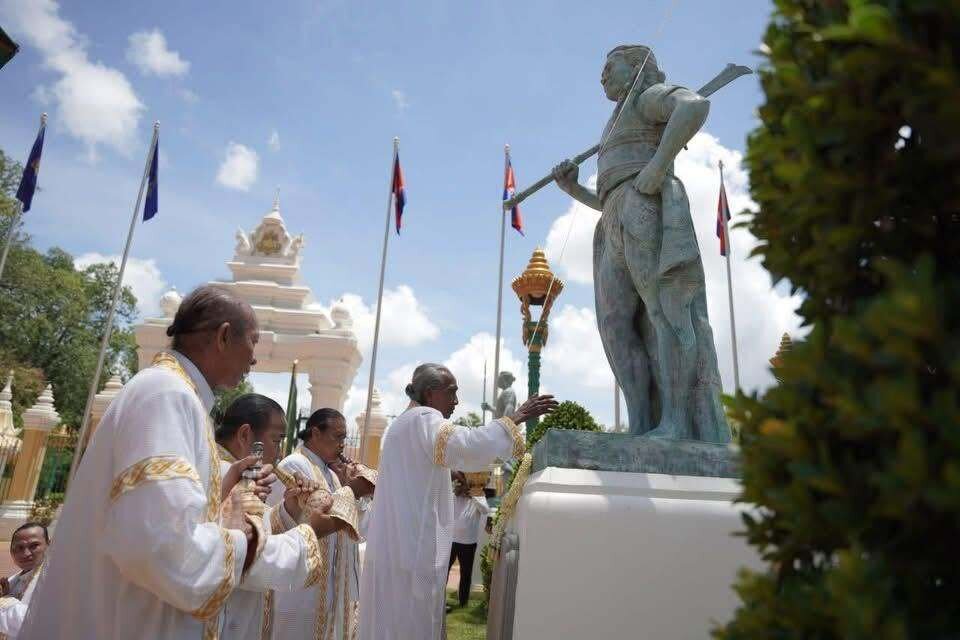
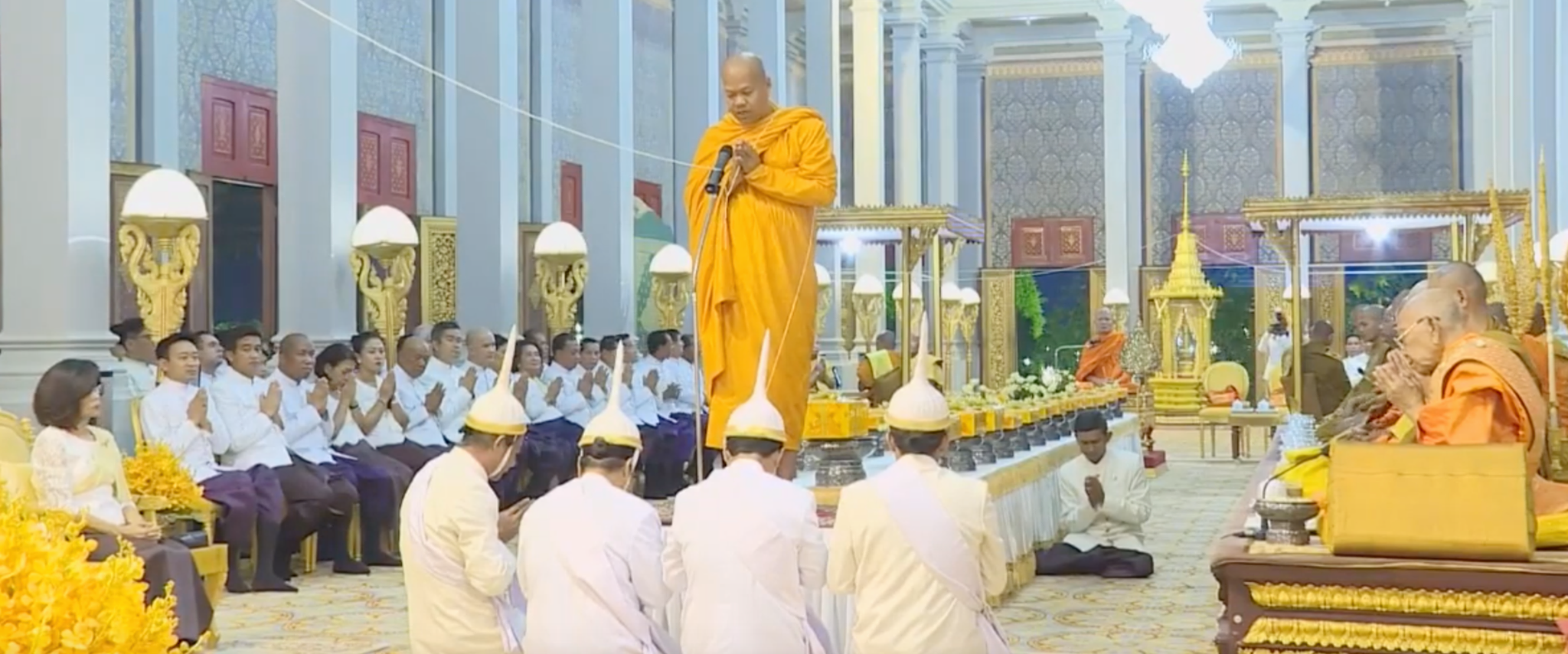
1) Royal court ‘Brahmes’ [Bakus] [illustr. by Schmidt and Michelet in Aymonier, Le Cambodge I] 2) Offerings performed by the Bakus at the Royal Palace, 2025 [King Sihamoni Photo Collection on social media]. 3) A Buddhist monk blessing Bakus (kneeling beneath) and members of the Royal family, including HRH Princess Norodom Buppha Devi, far left, during a dedication ceremony at Khemarin Palace, Royal Palace, Phnom Penh [photo by Prince Ravivadhana Monipong posted online in 2019].
1) Royal court ‘Brahmes’ [Bakus] [illustr. by Schmidt and Michelet in Aymonier, Le Cambodge I] 2) Offerings performed by the Bakus at the Royal Palace, 2025 [King Sihamoni Photo Collection on social media]. 3) A Buddhist monk blessing Bakus (kneeling beneath) and members of the Royal family, including HRH Princess Norodom Buppha Devi, far left, during a dedication ceremony at Khemarin Palace, Royal Palace, Phnom Penh [photo by Prince Ravivadhana Monipong posted online in 2019].
1) Royal court ‘Brahmes’ [Bakus] [illustr. by Schmidt and Michelet in Aymonier, Le Cambodge I] 2) Offerings performed by the Bakus at the Royal Palace, 2025 [King Sihamoni Photo Collection on social media]. 3) A Buddhist monk blessing Bakus (kneeling beneath) and members of the Royal family, including HRH Princess Norodom Buppha Devi, far left, during a dedication ceremony at Khemarin Palace, Royal Palace, Phnom Penh [photo by Prince Ravivadhana Monipong posted online in 2019].
1) Royal court ‘Brahmes’ [Bakus] [illustr. by Schmidt and Michelet in Aymonier, Le Cambodge I] 2) Offerings performed by the Bakus at the Royal Palace, 2025 [King Sihamoni Photo Collection on social media]. 3) A Buddhist monk blessing Bakus (kneeling beneath) and members of the Royal family, including HRH Princess Norodom Buppha Devi, far left, during a dedication ceremony at Khemarin Palace, Royal Palace, Phnom Penh [photo by Prince Ravivadhana Monipong posted online in 2019].
In fact, these “chaplains” are the country’s only priests; they alone perform rites and administer sacraments. Within the palace, they preserve vestiges of the worship of ancient Brahmanic deities, represented by metal statuettes which ordinary Brahmins guard alongside the sacred sword or carry in the king’s retinue when he takes command of his armies. They prepare lustral waters and present them to the king in conch shells rimmed with gold filigree when he performs New Year ablutions and purification rituals for major ceremonies, or before and after battles; they recite mantras and agamas (mystic formulas); they light the sacred fire — comprising twelve flames circulating on as many small metal discs — during the great pradakshina processions, where the fire is carried around the temple up to nineteen times; they ignite the cremation pyres of princes if the king does not fulfill this final duty himself; in short, they preside over coronations and various palace ceremonies, or assist the king, who serves as the supreme pontiff. In popular rites — such as the hair-cutting ceremony — which are often scaled-down versions of royal festivals, these Brahmins are replaced by acharyas (“masters”), a title spontaneously adopted by anyone well-versed in ancient customs.
Since they were such significant roles, the Bakus enjoyed numerous privileges. For instance, they could marry princesses and received a fixed share of the kingdom’s rice tax. Their greatest prerogative — albeit a potential and largely symbolic one — stems from a deeply ingrained national tradition (though it is no longer formally codified) that assigns the throne to the Brahmins in the event of the royal family’s complete extinction. In such a case, the mandarins would be obliged to select the new king not from among Brahmins with distant royal lineage, but from the religious caste, which commanded the highest respect and, implicitly, from among its leaders, the only members who held truly prominent status. [p. 63 – 5]]
[1] The Eurasian Hoopoe (Upupa epops) is indeed a common bird in Cambodia, and can be spotted even in urban areas in Phnom Penh where trees still stand (Wat Phnom, Koh Pich…). For the etymology of the term Baku, see here.
The Governors
Les provinces n’ont pas de chef-lieu déterminé : les gouverneurs résidant ou bon leur semble dans leur circonscription territoriale. On appelle ces fonctionnaires chauhvay sruk (pron. tchaofaï srok), c’est-a-dire “Seigneurs du pays”. Le premier terme de cette expression est siamois d’origine. Ils sont tous nommés et révoqués par le roi qui leur remet en audience solennelle leur sceau et leur brevet. Deux fois par an, ils doivent venir à la capitale preter serment, “boire l’eau”, sous peine d’amende: s’ils sont empêchés par cas de maladie, de force majeure, ils préviennenl les ministres et l’eau leur est portee a domicile par un mandataire’ qui recoit leur serment de fidélité. À la capitale, ils rendent aussi hommage au mandarin dont ils relèvent: selon l’expression indigène, “ils montent recevoir les ordres”. Outré l’administration de la justice (qu’ils partagent avec d’autres fonctionnaires) et le maintien de l’ordre public, ils ont pour fonctions de veiller aux levées des corveables et des hommes de guerre, d’assurer la perception des impôts et redevances. Né touchant ni solde ni traitement fixe, ils recoivent une part déterminée de ces impôts et ils ont la jouissance de certaines terres dont les produits sont affectés à leur charge. [p 71 – 2]
[The provinces have no designated administrative seat; governors reside wherever they choose within their territorial jurisdiction. These officials are known as chauhvay sruk (pronounced tchaofaï srok), meaning “Lords of the Land”, the first element of this term being of Siamese origin. They are all appointed and dismissed by the King, who presents them with their seal and official warrant during a formal audience.
Twice a year, they must travel to the capital to swear an oath — “drinking the water” — under penalty of a fine; if prevented by illness or force majeure, they notify the ministers, and the water is brought to their residence by an envoy who receives their oath of loyalty. While at the capital, they also pay homage to the mandarin to whom they are subordinate; in local parlance, “they go up to receive orders.” In addition to administering justice (a duty shared with other officials) and maintaining public order, they are responsible for overseeing the conscription of laborers for corvée duty and military service, as well as ensuring the collection of taxes and levies. Receiving neither a salary nor a fixed wage, they are allotted a specific share of these taxes and enjoy the usufruct of certain lands, the produce of which is designated to support their office. [pp. 71 – 2]]
Taxation in pre-colonial Cambodia
Le roi du Cambodge n’avait donc pas d’armée permanente; d’un autre côté, ses dignitaires vivaient des cadeaux royaux ou de leur fortune personnelle ou de certains bénéfices spéciaux et traditionnels, plus encore du produit de leurs exactions; il s’ensuivait que le revenu de tous les impôts, ban (prononcé pone, de vanta, “part”, ou de bandha, “lien” ?), du royaume n’était autre que le revenu personnel du roi, c’est à ce point de vue surtout qu’il pouvait dire: l’État c’est moi! L’impôt foncier n’existe pas dans ce pays ou il est de tradition de frapper seulement les produits et principalement le premier de tous, le riz, du droit du dixième. La dime du riz, dans toutes les provinces, revenait donc au Maître des vies, de la terre el de l’eau, afin de le nourrir, lui, sa famille, son harem, ses mandarins, gardes, ouvriers, esclaves et gens de service. Les autres dignitaires princiers jouissaient des revenus des provinces qui relevaient de leurs maisons respectives.
Impôt du riz. — Les opérations de la fixation de cet impôt, qui est la plus ancienne peut-ètre de toutes les taxes, né sont pas sans analogies avec celles du recensement triennal de la population màle et valide, mais elles ont lieu chaque année à la fin de la moisson. c’est-à-dire en février-mars, alors que le riz en grains est entassé dans les greniers des paysans. Des commissions, composées de trois déIégués, l’un de la couronne, l’autre des chefs des greniers royaux, et le troisieme du gouverneur de la province, se transportent successivement dans tous les villages où ils sont reçus par le chef des paysans qui leur feront des cadeaux fixés par les coutumes. […] Ils inscrivent immédiatement la quotité du dixième royal sur les registres, à la suite du nom du propriétaire: ils établissent leurs listes en trois expéditions respectivement destinées au gouverneur aux magasiniers de la capitale et au Chef de la Maison royale représenté par son ministre des finances.
Outré le dixième du roi. les propriétaires devaient payer, également en nature, des droits accessoires, additionnels, les uns fixes, d’autres proportionnels, tels que la part des chefs des Brahmes el la compensation prévue pour les pertes et déchets en magasin. Des contrôleurs pouvaient être désignés et parcourir le pays à la suite des délégués, afin de vérifier si les opérations de la fixation de l’impôt n’arnienl pas été faites au détriment du roi, ou de recevoir au besoin les plaintes des populations : ils adressaient leur rapport au Ministre des finances et aux chefs des greniers royaux. Les ministres, les hauts dignitaires, les Brahmes et les descendants même éloignés de la famille royale, les Bram Yait, étaient exempts de l’impôt sur le riz. […]
A une époque inconnue mais qoi né doit pas être très ancienne, les rois du Cambodge, en vertu cle leur droit régalien de propriétaire éminent, mirent la main sur les berges fertiles du fleuve et susceptibles de recevoir les riches cullurcs du coton, de l’indigo et du tabac : ils les louèrent annuellement aux cultirnteurs. D’un autre côté, transformant sans doute de vieilles redevances traditionnelles, ils établirent progressivement des impôts réguliers sur les cultures maraichères et sur les cultures diverses, d’après la superficie ou d’après le nomhre des pieds des arbres. […] Les régions forestières non occupées, appartenant donc directement au roi, étaient ainsi concédées par districts bien délimités, à des bénéficiaires qui étaient tenus d’offrir annuellement au roi des présents (« tributs royaux ») el qui cédaienl leur charge à des “chefs de forêts” habitant la contrée et chargés de percevoir des droits déterminés sur la chasse, la cueillette et la coupe du bois. […]
Les postes de douane, placés partout où la suneillance est nécessaire, sont facilement reconnaissables grâce à une longue perche qui supporte ces emblèmes indicateurs ou comminatoires: une petite cangue, un balai d’herbes et une étoile de bambous tressés. Il n’était pas d’usage d’exiger des droits déterminés sur les marchandises importées, mais il était sans doute de haute convenance de la part des marchands étmngers de faire des cadeaux au roi et aux mandarins du pays: le commerce étant a peu près impossible sans l’agrément de ces derniers. […] A une époque très récente, les étrangers (non européens) ont été soumis a un impôt de capitation et les fermes plus ou moins immorales de l’opium, des jeux el des loteries ont été créées.
Bref, les anciennes charges des sujets cambodgiens devaient être les levées d’hommes pour guerres et corvées, la dime de la récolte du riz et de nombreuses redevances en nature: les impôts indirects plus lucratifs, les fermes et les douanes seraient de création récente. Les revenus royaux, diminués du dixième au profit des collecteurs, diminués plus fortement encore en faveur de certains fonctionnaires bénéficiaires ou des apanagistes princiers, variaient entre deux et trois millions de francs à l’époque de la conquête française. [p 76 – 8]
The King of Cambodia, therefore, had no standing army; conversely, his dignitaries lived off royal gifts, their personal fortunes, or certain special, traditional perquisites and, to an even greater extent, the proceeds of their own exactions. It followed that the revenue from all the kingdom’s taxes, or ban (pronounced pone; derived from vanta, meaning “share,” or bandha, meaning “bond”?), was simply the King’s personal income; it was primarily from this perspective that he could declare, “I am the State!” Land tax did not exist in the country; instead, tradition dictated that levies be placed only on produce — chiefly the most important crop, rice — in the form of a one-tenth share. Thus, the rice tithe from every province went to the “Master of Lives, Land, and Water” to sustain him, his family, his harem, his mandarins, guards, laborers, slaves, and household staff. Other princely dignitaries enjoyed the revenues from the provinces attached to their respective households.
Rice tax. The procedures for assessing this tax, perhaps the oldest of all levies, bear some resemblance to the triennial census of the able-bodied male population; however, they take place annually at the end of the harvest, specifically in February or March, when the harvested rice is piled up in the peasants’ granaries. Commissions consisting of three delegates, one representing the Crown, one the heads of the royal granaries, and the third the provincial governor travel in turn to every village. There, they are received by the village headman, who presents them with gifts prescribed by custom. […] They immediately recorded the amount of the royal tenth in the registers, next to the owner’s name; they prepared their lists in three copies, intended respectively for the governor, the capital’s warehouse officials, and the Head of the Royal Household, represented by his Minister of Finance.
In addition to the king’s tenth, owners were required to pay also in kind various ancillary and additional levies; some were fixed amounts, while others were proportional — such as the share for the Brahmin leaders and compensation for storage losses and wastage. Inspectors could be appointed to travel the country following the delegates; their role was to verify that the tax assessment process had not been conducted to the king’s detriment, or to hear complaints from the population if necessary. They submitted their reports to the Minister of Finance and the heads of the royal granaries. Ministers, high dignitaries, Brahmins, and even distant descendants of the royal family, the Bram Yait, were exempt from the rice tax. […]
At an unknown date — though likely not in the distant past — the kings of Cambodia, exercising their sovereign right of ultimate ownership, took control of the river’s fertile banks, which were suitable for lucrative crops such as cotton, indigo, and tobacco; they leased these lands to farmers on an annual basis. Furthermore, likely transforming old traditional dues, they gradually established regular taxes on market gardens and various other crops, calculated based on either the surface area or the number of trees. […] Unoccupied forest regions, by definition the direct property of the king, were granted in clearly defined districts to beneficiaries. These individuals were required to offer annual gifts (“royal tributes”) to the king and to delegate their authority to local “forest chiefs” responsible for collecting specific fees for hunting, gathering, and logging. […]
Customs posts, situated wherever surveillance was required, were easily identified by a long pole bearing specific symbolic or warning emblems: a small cangue, a bundle of grass, and a star made of woven bamboo. While there was no standard practice of levying fixed duties on imported goods, it was considered highly appropriate for foreign merchants to present gifts to the king and local mandarins, as trade was virtually impossible without the latter’s approval. […] In more recent times, non-European foreigners were subjected to a head tax, and state-sanctioned monopolies,often of a dubious moral nature, were established for opium, gambling, and lotteries. [2]
In short, the traditional obligations of Cambodian subjects likely consisted of levies of men for warfare and forced labor, a tithe on the rice harvest, and various payments in kind; the more lucrative indirect taxes, monopolies, and customs duties appear to be of more recent origin. Royal revenues, reduced by a tenth for the tax collectors and further diminished by allocations to certain officials or princely fief-holders, ranged between two and three million francs at the time of the French conquest. [p. 76 – 8]
[2] See Francis Garnier, Travels…: “Norodom, dont les besoins et les convoitises grandissaient depuis qu’il était en contact avec la civilisation européenne, avait, dans le but d’augemnter ses revenus, affermé la plupart des branches de l’impôt à des Chinois dont les exactions irritaient profondément les populations. […] Les goûts dispendieux du roi, beaucoup accrus depuis son contact avec les Européens, laissent sa caisse toujours vide et l’ont obligé à affermer une à une toutes les branches de l’impôt ou du revenu public. Les Chinois, auxquels est en général concédée l’exploitation de ces monopoles, en tirent parti avec l’âpreté qui caractérise leur race, et le malheureux contribuable est souvent pressuré au point de n’avoir d’autre ressource que de se réfugier dans les forêts pour y devenir voleur ou rebelle.” [Norodom, whose needs and desires had grown since coming into contact with European civilization and in an effort to increase his revenues, had farmed out most tax sectors to Chinese individuals whose exactions deeply angered the populace. […] The king’s extravagant tastes, greatly intensified by his contact with Europeans, left his coffers perpetually empty and forced him to farm out, one by one, every branch of taxation or public revenue. The Chinese, to whom the operation of these monopolies was generally granted, exploited them with the rapacity characteristic of their race; the unfortunate taxpayer was often squeezed so hard that he had no recourse but to flee into the forests and become a bandit or a rebel. [p. 64, 70]
The mystery of Beng Maelea
The sections related to the regions then lying at the border of Siam and Cambodia, in particular Beng Meaelea and that portion of the ancient royal road linking Angkor to Kompong Svay, Preah Vihear and further on Wat Phu, are particularly interesting as they reveal the challenge raised by the political and diplomatic situation to French archaeologists [any archaeologist no matter his or her nationality at that time] — how to get a coherent image of the extent of Khmer buildings in the area when they technically belonged to different States, and states not really willing to foster scientific cooperation?
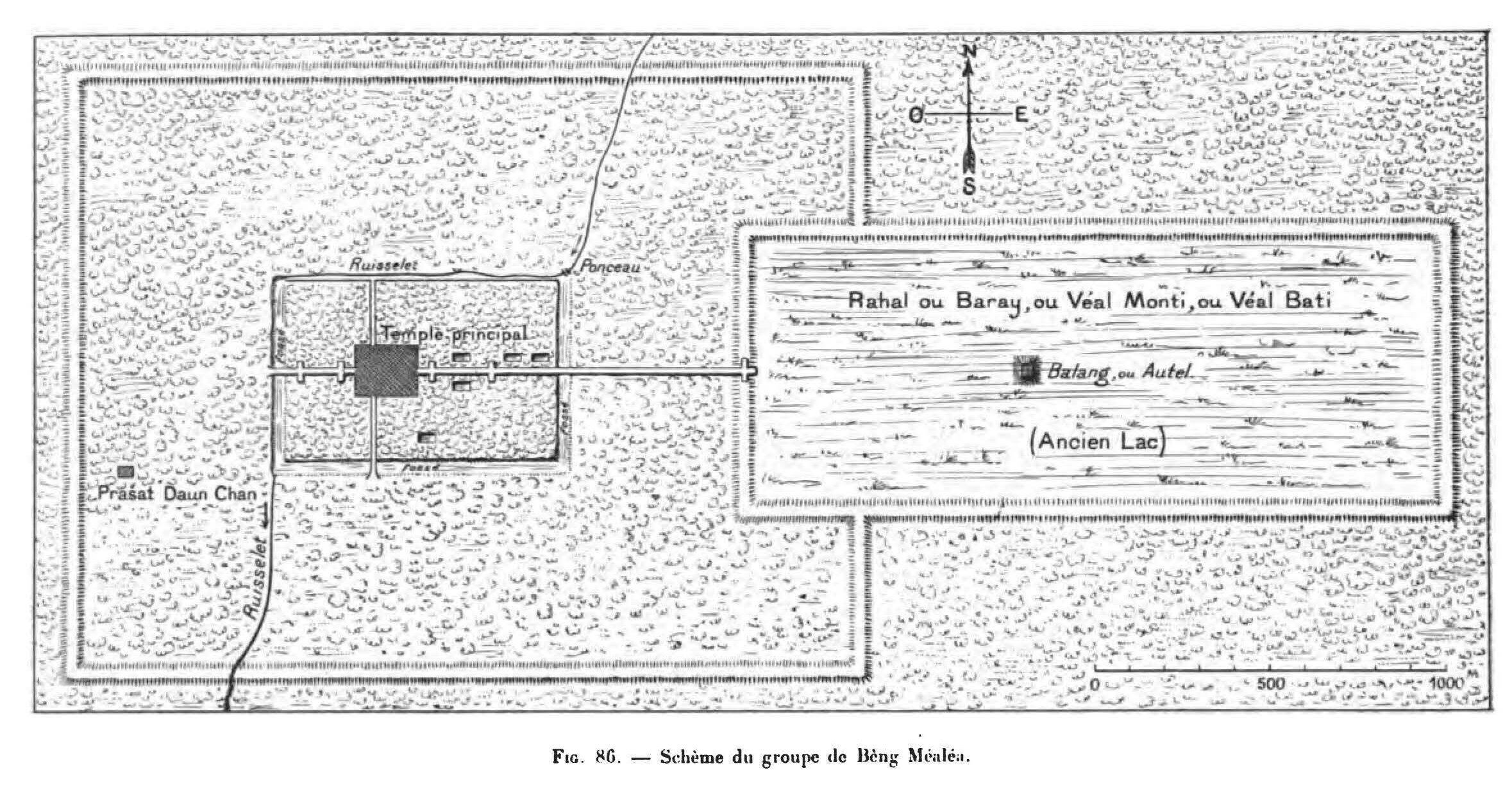
We’ll note here the author’s insights on Beng Maelea and Spean Ta Ong for their documentary importance and also because they show ‘Khmerology’ at a crossroad: while Tissandier had relied only on oral traditions to describe the area in his beautiful book, Aymonier was actually looking for the archeological significance, with extremely detailed measurements that remain helpful one century and a half later.
Diagram of Beng Maelea Group by Aymonier in Le Cambodge, vol. I.
Le monument tout entier fut construit en blocs de grès grisâtre, rosé parfois, mais toujours d’une grande finesse de grain. Les joints, excessivement soignes, attteignaient une telle perfection de polissage par frottement que la pierre en s’effritant se détache souvent en minces feuilles, de deux blocs contigus qui semblent n’en former qu’un seul. Partout dans le voisinage de ces ruines, le gres rosle ou gris apparait par blocs ou par bancs à la surface du sol: mais les plus beaux moellons devaient provenir des grandes carrières de Phnom Bei (le Bèn probablement de Francis Garnier) “les trois monts” ou buttes qui sont situées au pied du Koulèn, à une lieue el demie à l’ouest-nord-ouest de Beng Méaléa. […]
La décoration était digne du choix des materiaux. Plus de deux cents frontons, presque tous ruinés aujourd’hui, étalaient les riches sculptures de leurs reliefs représentant des dieux brahmaniques montés sur des chars, sur des animaux fantastiques, entourés d’adorateurs, de nymphes célestes, ou bien se heurtant en d’effroyables melées. Le gout sobre et pur de l’ornementation se retrouve aussi dans les motifs gracieux prodigués sur presque tous les pilastres […], attestant encore que l’art decoratif du Cambodge atteignit ici son plus haut degré de perfection. […]
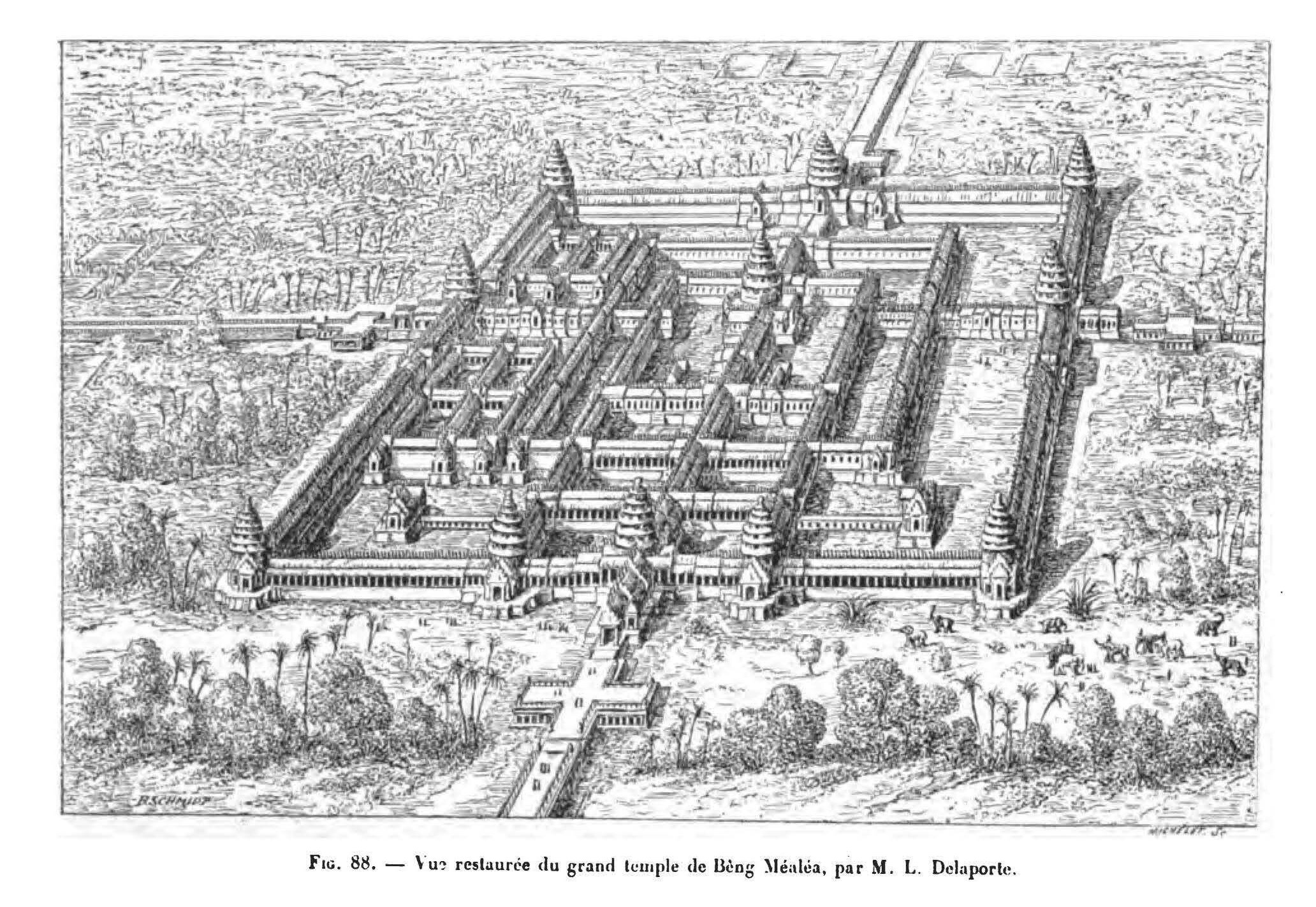
Beng Maelea semble avoir été aménagé pour servir d’habitation. Ses galeries fermées, très hautes, dépourvues de sculptures à l’intérieur, sont aussi spacieuses que pouvait le permettre le système employé pour la construction des voûtes cambodgiennes. La double galerie de la troisième enceinte permettait de bien isoler le sanctuaire central qui était peut-être le temple proprement dit. […] Il faut encore remarquer que les explorateurs n’ont jamais trouvé ici ces statues isolées du Bouddha ou des dieux brahmaniques qui sont si communes dans tous les anciens temples cambodgiens; les deux ou trois figurines bouddhiques absolument informes que [Louis] Delaporte y a recueillies doivent remonter à une époque très postérieure à l’édification du monument, et les quelques sculptures plates représentant des figures de dieux ou de bayadères célestes encadrées d’ogives qu’on apercoit disséminées dans les parcs né sont pas des représentations des divinités adorées, mais des sortes d’ex-voto ou de bornes sacrées.
[…] Nous avons déjà dit qu’aucun texte épigraphique n’a été découvert dans le groupe des ruines de Bèng Méaléa. Nous avons proposé autrefois et nous proposons encore d’identifier ce chef-d’oeuvre d’élégance et de bon goût architectural avec la Puri, “résidence”, que, selon nombre d’inscriptions sanscrites, le grand roi Jayavarman lI établit sur le mont Mahendra dans les premières années de son règne. Un faste, un éclat incomparable accompagna cette fondation qui fut pendant des siecles considérée comme un événement prodigieux. Nous savons par les inscriptions trouvées aux environs de Svay Kabal Toeuk, district de Khvao, à deux ou trois lieues au nord de Bêng Méaléa et aussi par d’autres textes sanscrits que nous rencontrerons dans la province de Siem Réap que ce nom de Mahendraparvata s’appliquait au mont Koulèn, du moins à sa partie orientale.
Etant données les idées et les tendances des Cambodgiens, les traces du soulèvement volcanique qui s’étendaient en plaine pourraient être considérées comme faisant partie du mont. Or, le monument est situé à moins de deux lieues du massif. Si l’hypothèse que nous émettons peut être admise, il en résulterait que Bèng Méaléa aurait été édifié aux environs de l’an 730 Saka, c’est-à-dire vers 800 de notre ère chrétienne et que cet édifice serait l’un des plus anciens parmi les grands monuments du Cambodge. [p 464 – 6]
The entire monument was erected with blocks of sandstone, grayish or sometimes pinkish, but always fine-grained. The joints were executed with such meticulous care and polished to such perfection through friction that, as the stone weathers, it often flakes off in thin sheets spanning two adjoining blocks, making them appear as one. Pink or gray sandstone outcrops or strata appear on the surface throughout the vicinity of these ruins; however, the finest building stones likely came from the large quarries at Phnom Bei (probably the “Bèn” mentioned by Francis Garnier) [3], the “three mounts” or hillocks located at the foot of the Kulen range, a league and a half west-northwest of Beng Mealea. […]
The ornamentation was worthy of the choice of materials. More than two hundred pediments — most now in ruins — displayed rich relief carvings depicting Brahmanic gods riding chariots or fantastic beasts, surrounded by worshippers and celestial nymphs, or locked in fierce combat. The restrained, pure taste of the ornamentation is also evident in the graceful motifs lavished upon nearly all the pilasters […], further attesting that Cambodian decorative art reached its pinnacle of perfection here. […]
Beng Mealea appears to have been designed as a residential complex. Its enclosed, soaring galleries devoid of interior carvings are as spacious as the Cambodian vaulting system allowed. The double gallery of the third enclosure effectively isolated the central sanctuary, which may have constituted the temple proper. […] It is also worth noting that explorers have never found here the freestanding statues of the Buddha or Brahmanic gods so common in other ancient Cambodian temples [4]; The two or three utterly shapeless Buddhist figurines collected there by [Louis] Delaporte must date from a period long after the monument’s construction; furthermore, the few flat sculptures, depicting gods or celestial “bayadères” framed by pointed arches, that one glimpses scattered across the grounds are not representations of the deities actually worshipped there, but rather a form of ex-voto or sacred boundary marker.
[…] We have previously noted, and we maintain that no epigraphic texts have been discovered within the Beng Mealea ruins. We have proposed, and continue to propose, identifying this masterpiece of architectural elegance and taste with the Puri, or “residence”, that, according to numerous Sanskrit inscriptions, the great King Jayavarman II established on Mount Mahendra during the early years of his reign. This foundation was marked by unparalleled splendor and magnificence, and for centuries it was regarded as a momentous event. We know from inscriptions found near Svay Kabal Toeuk (in Khvao district, two or three leagues north of Beng Mealea), as well as from other Sanskrit texts in Siem Reap province, that the name Mahendraparvata applied to Mount Kulen, or at least to its eastern section.
Given Cambodian concepts and tendencies, the traces of volcanic upheaval extending onto the plain could well be considered part of the mountain itself. Now, the monument is situated less than two leagues from the massif. If our hypothesis holds true, it would mean that Beng Mealea was built around the year 730 Saka — that is, circa 800 AD - making it one of the oldest of Cambodia’s great monuments. [pp. 464 – 6]
[3] The ‘Ben’ alluded to by Garnier was in fact located much further north, near the Dangkrek Mountains.
[4] Was it because Beng Maelea, as EFEO architect Jean de Mecquenemnoted as early as 1912, had been “the most heavily plundered Ancient Khmer site”?
Projected rendering of Beng Maelea temple-palace by Louis Delaporte [repr. in E. Aymonier, Le Cambodge I, 1900.]
Projected rendering of Beng Maelea temple-palace by Louis Delaporte [repr. in Aymonier, Le Cambodge I, 1900.]
Spean Ta Ong
Le nord de la province actuelle de Chikrèng était traversé jadis par une autre chaussée; celle qui venait de Prakhan, Khvao, Prasat Pram et qui conduisait, par le Spéan Ta Ong, Têâp Chéi, au grand monument de Beng Méaléa; ces trois dernières ruines sont situées dans le territoire de Chikrèng. De là celle chaussée se prolongeait vers Angkor, la capitale.
Le Spéan Ta Ong était flanqué de deux autres ponts moms importants, mais construits de même en blocs de limonite. A trois kilomètres vers l’est, le Spéang Komnéng “pool des jeunes gens”, long de vingt mètres, haut de quatre, aurait été jeté sur un petit ruisseau affluent de gauche de la rivière de Chikreng et appelé de nos jours Aur Dach Chuntop. A quinze cents metres au delà du Spéun Ta Ong, le “petit pont”, Spéan Tauch, long de quarante mètres, aurait été construit sur une rigole ou dépression naturelle. […]
Sous le Spéan Ta Ong (“pont de l’ancêtre Ou”) coulent les eaux de la rivière de ce nom, qui vient des plaines au nord du Koulen et qui prend plus tard le nom de Prèk Chikreng. De tous les grands ponts des anciens Cambodgiens, celui-ci est le mieux conservé. Construit en moellons de limonite qui atteignent jusqu’a deux mètres dans leur grande dimension, il mesure soixante-cinq mètres de longueur sur douze de largeur et huit de hauteur. Sa base puissante repose sur une couche de grès qui forme le lit de la rivière, dont la largeur initiale de trente mètres a été portée jusqu’a quarante-cinq.
Cet agrandissement était nécessité par le peu d’ouverture des arches qui mesurent quatre mètres de hauteur et seulement un mètre quatre-vingt de largeur, tandis que l’épaisseur des piles atteint un mètre soixante. Ces arches sont au nombre de quatorze. Aux extrémités, les culées s’appuient sur des massifs de terre parementés de blocs de limonite qui forment une vingtaine de marches. Sur les cotés, les assises horizontales, placées d’abord dans le sens de la largeur du pont, sont disposées plus haut dans le sens de sa longueur.
De larges dalles de grès recouvrent ce tablier que bordaient les parapets actuellemenl ruinés, des balustrades en corps de dragons dont les extrémités se redressaient en superbes morceaux de sculptures hauts de deux mètres qui déployaient en éventail leurs têtes multiples pour abriter des personnages représentés assis, les jambes croisées.
L’aspect général de l’ensemble architectural est encore imposant. Sa solidité, qui parait exagérée de prime abor, était nécessitée par la violence des eaux s’engouffrant sous les arches aux crues. N’étant plus entretenu depuis des siècles, il menace partout ruine, la forêt l’envahit, les racines des arbres écartent les lourdes assises : peu à peu les eaux le séparent de la rive orientale qu’elles fouillent et creusent tandis que l’autre rive s’ensable. [p 510 – 1]
The northern part of the present-day Chikreng province was once crossed by another causeway, one originating at Prakhan, Khvao, and Prasat Pram, and led via Spean Ta Ong and Teap Chei to the great monument of Beng Mealea; these last three ruins lie within the territory of Chikreng. From there, the causeway continued toward Angkor, the capital.
Spean Ta Ong was flanked by two other, less significant bridges, though they were constructed in the same manner, using blocks of laterite. Three kilometers to the east, Spean Komneng (the “Pool of the Young Men”) measuring twenty meters in length and four in height, spanned a small left-bank tributary of the Chikreng River known today as Aur Dach Chuntop. Fifteen hundred meters beyond Spean Ta Ong, the “small bridge” (Spean Tauch), forty meters long, was built over a natural channel or depression. […]
Flowing beneath Spean Ta Ong (“Bridge of Ancestor Ou”) are the waters of the river bearing the same name; originating in the plains north of the Kulen mountains, it later takes the name Prek Chikreng. Of all the great bridges built by the ancient Cambodians, this one is the best preserved. Constructed from laterite blocks reaching up to two meters in their longest dimension, it measures sixty-five meters in length, twelve in width, and eight in height. Its massive base rests on a sandstone layer forming the riverbed; the river’s original width of thirty meters was expanded to forty-five meters.
This widening was necessitated by the narrowness of the arches, which measure four meters in height but only 1.80 meters in width, while the piers are 1.60 meters thick. There are fourteen such arches. At either end, the abutments rest against earthen mounds faced with limonite blocks that form some twenty steps. Along the sides, the horizontal masonry courses — initially laid across the width of the bridge — are arranged lengthwise at higher levels.
Broad sandstone slabs cover the deck, which was once flanked by parapets — now in ruins — consisting of balustrades shaped like dragon bodies; their ends rose up into magnificent, two-meter-high sculptures, with multiple heads fanning out to shelter figures depicted sitting cross-legged.
The architectural ensemble remains imposing. Its solidity — seemingly excessive at first glance — was necessitated by the violent rush of water beneath the arches during floods. Having gone without maintenance for centuries, the structure is seemingly on the verge of collapse; the forest is encroaching, and tree roots are prying apart the heavy masonry courses. Gradually, the water is severing the bridge from the eastern bank—which the current is scouring and undercutting — while the opposite bank is silting up. [p. 510 – 1].
Étienne François Aymonier (26 Feb 1844, Le Chatelard, France – 21 Jan 1929, Paris), French naval officer, colonial administrator, linguist and explorer, a “field Orientalist” and the first scientist to extensively survey the ruins and inscriptions of the Khmer empire in today’s Cambodia, Thailand, Laos and southern Vietnam, as well as the Cham civilization. Le Cambodge (three volumes published from 1900 to 1904), remains to these days an important source for geographers, historians and epigraphists.
First director of the École Coloniale — where he also taught Khmer language since his retirement in 1905 -, he assembled a large collection of Khmer sculpture later housed in the Guimet Museum, Paris. They were major artworks that completed his stampings of Khmer and Cham inscriptions, yet in 1910 George Coedès complained they had not been properly labeled and sourced.
Author of a Dictionary of Cham-French (with Antoine Cabaton), a Khmer-French Lexicon and a Dictionary of Khmer, as well as a collection of Khmer texts, Textes khmers (1885), he was recognized as one of the first epigraphists working intensively in Cambodia, relying for the Sanskrit parts to the expertise of his friends Abel Bergaigne, Auguste Barth and Sylvain Lévi. In 1878, he transcribed the “Poem of Angkor Wat” (ល្បើកអង្គរវត្ត Lpoek Angkor Vat) in modern Khmer.
Fresh from St. Cyr Army School, he started as sublieutenant in Cochinchina in 1869 and, as adjunct to French Protectorate Representative Paul-Louis-Félix Philastre, prospected Kompong Thom province for his first officious exploration in 1876. While perfecting his knowledge of the Khmer language, he replaced Jean Moura as Protectorate plenipotenriary representative from 1 Jan 1879 to 10 May 1881, a function first occupied by Ernest Doudart de Lagree from April 1863 to July 1866. Indefatigable traveler, he crisscrossed Cambodia, Laos, Vietnam, from 1881 to 1885, gathering essential information.
Aymonier trained numerous local experts (Cambodian, Cham, Laotian and Vietnamese) in mastering archaeological and epigraphic techniques, and acknowleged their contribution in his writings — paying homage to “a collaborator named An, in particular” (Introduction to Le Camboge, I, 1901). Mathieu Guérin has initiated biographical research on these collaborators, mentioned with a simple first name or a moniker [see Mathieu Guérin, “Tup, un lettré aventurier au service de l’orientaliste Etienne Aymonier, Journal Asiatique 305 – 1, 2017: 111 – 118].
However, he somehow remained a maverick in the field of Khmer and Cham studies. According to Cristina Cramerotti (trad. Jennifer Donnelly), author of Collectionneurs, collecteurs et marchands d’art asiatique en France 1700 – 1939 INHA), “neither the “field” scientist nor the administrator enjoyed unanimous support whether in academic circles or the hierarchy. While he contributed to bringing the future École française d’Extrême-Orient to the baptismal font, a bitter controversy over Funan pitted him against Paul Pelliot (1878−1945) who reproached him for his dangerous individualism in scientific matters [see details of their confrontation in the latter’s ADB biographical note]. His self-taught side bothered scholars: his candidacy as a free member of the Académie des inscriptions et belles-lettres, which had once praised him, was refused twice. He developed some resentment. In addition, his character, sometimes described as “rough”, his independence of mind, and the proposals for reform of the colonial administration, expressed in a rather abrupt way, ended up doing him a disservice.”
C’est l’un de ces articles [Aymonier’s] relatif au Fou-nan qui déclencha une polémique dont le résultat le plus triste fut d’aliéner à l’Ecole Française la sympathie d’un homme qui aurait eu tant de raisons de travailler en étroite collaboration avec elle, et qui, dans l’introduction de son Cambodge, saluait «la création de cette Ecole d’Extrême-Orient qui est un résultat très direct de ma mission archéologique qu’elle doit continuer dans des conditions infiniment plus favorables à tous les points de vue». Il avait commis l’imprudence, lui, qui n’avait aucune connaissance sinologique, de s’en prendre aux sinologues: genus irritabile ! La riposte de M. Pelliot lui causa une blessure d’amour-propre qui empoisonna les vingt-cinq dernières années de sa vie. et qu’il ressentait encore à la veille de sa mort. Sous le prétexte de mettre l’histoire ancienne du Cambodge à la portés de tous, ses deux derniers opuscules, oeuvres séniles sur lesquelles il serait cruel d’insister, n’eurent d’autre objet que de défendre une cause depuis longtemps perdue et classée. Heureusement, le travail de collaboration entre lui et M. Cabaton, qui devait aboutir en 1906 à la publication du Dictionnaire cam-français, était déjà presque terminé en 1904, et l’Ecole Française d’Extrême-Orient a ainsi la satisfaction de pouvoir inscrire le nom d’Aymonier parmi ceux de ses collaborateurs. Lorsque le progrès des études aura relégué ses travaux au nombre des ouvrages qui n’ont plus qu’un intérêt bibliographique, l’oeuvre accomplie pendant sa mission de 1882 – 1885 qui fonda l’épigraphie khmère sur une base solide et ressuscita les Chams ignorés avant lui, cette oeuvre subsistera comme un témoignage de son labeur et de son dévouement à la science, et suffira à assurer à son nom une place éminente dans l’histoire des études indochinoises.
[It was one of these articles [Aymonier’s] relating to Fou-nan which triggered a controversy whose saddest result was to alienate from the French School the sympathy of a man who would have had so many reasons to work in close collaboration with the School, and who, in the introduction to his Cambodia, welcomed “the creation of this Far Eastern School, a very direct result of my archaeological mission which it must continue in infinitely more favorable conditions from all points of view”. He, who had no sinological knowledge, had been imprudent in attacking the sinologists: genus irritabile! Mr. Pelliot’s response caused an injury to his self-esteem which poisoned the last twenty-five years of his life, and which he still felt on the eve of his death. Under the pretext of making the ancient history of Cambodia accessible to all, his last two pamphlets [Un aperçu de l’histoire du Cambodge, Paris, 1918, and Histoire de l’ancien Cambodge, Strasbourg, nd] senile works on which it would be cruel to dwell, had no other purpose than to defend a cause long lost and cold. Fortunately, the collaborative work between him and Mr. Cabaton, which was to lead in 1906 to the publication of the Dictionnaire cam-français, was already almost finished in 1904, and EFEO thus has the satisfaction of being able to include the name of Aymonier among those of his collaborators. When the progress of studies will have relegated his works to the number of works which no longer have more than a bibliographical interest, the work accomplished during his mission of 1882 – 1885, which founded Khmer epigraphy on a solid basis and resurrected the ignored Chams before him, this work will remain as a testimony to his work and his dedication to science, and will be enough to ensure his name an eminent place in the history of Indochinese studies.
Numerous pieces brought from Cambodia by Aymonier were exhibited at Musée Guimet “Exposition des résultats des voyages et explorations scientifiques en Asie : Religions, arts, archéologie et ethnographie”, Paris, opening 8 April 1893. Art from Cambodia was showcased through Aymonier’s collection along with other items exhibited by Delaporte and Fournereau in the same room, while the Laffitte, Gouin, Harmand, Hubert and Brau de St-Pol Lias’s collections were on the first floor. [see catalogue, via gallica.bnf.fr]
The Catalogue des collections indochinoises edited in 1934 by Pierre Dupont and Jeannine Auboyer mentioned a grouping of Khmer sculptures brought back by Aymonier set up by Guimet curator Joseph Hackin in 1921, including “the Harihara of Maha-Rošei” and “a very beautiful Buddhist head”. They were also “twelve stelae” dating back from the 7 to 11th century, with stampings made by Aymonier’s team kept at BNF and Société Asiatique.
In 2006, Christophe Pottier started a register of Aymonier’s personal papers kept at the library of Société Asiatique, Paris.
Publications
[based on George Coedès, “Etienne-François Aymonier (1844−1929)”, BEFEO 29, 1929: 542 – 548.]
Vocabulaire cambodgien-français, Saigon, Collège des administrateurs stagiaires, 1874, 164 p.
Dictionnaire français-cambodgien, précédé d’une notice sur le Cambodge et d’un aperçu de l’écriture et de la langue cambodgiennes, Saigon, Collège des administrateurs stagiaires, 1874, 242 p.
Notice sur le Cambodge, Paris, E. Leroux, 1875, 63 p.
“Excursion dans le Cambodge central”, Bulletin de la Société de géographie (BSG), 1882, pp. 656 – 663.
“Critique du “Royaume du Cambodge” de M. Moura”, Excursions et Reconnaissances (E&R), XVI, 1883, pp. 207 – 220.
“Exploration au Cambodge, lettre de Saigon du 11 août 1883”, compte-rendu des séances de la SG, 9 Nov. 1883, pp. 486 – 490.
“Notes sur les coutumes et croyances superstitieuses des Cambodgiens”, E&R, XVI, 1883, pp. 133 – 206.
“Quelques notions sur les inscriptions en vieux khmer”, Journal Asiatique (JA), 1883 (1), pp 441 – 505; (2), pp. 199 – 228.
“L’épigraphie kambodjienne”, E&R, XX, 1884, pp. 253 – 296.
“Lettre sur son voyage au Binh-Thuan, adressée à M. le Gouverneur de la Cochinchine. E&R, XXII, 1885, pp. 247 – 254.
“Les Chams”, Revue d’ethnographie (RE), IV, 1885, pp. 158 – 160.
“Notes sur le Laos. Région du Sud-Est, détails géographiques”, E&R, XX, 1884, pp. 35 – 386; XXI, 1885, pp. 5 – 130; XXII, 1885, pp. 255 – 347.
“Notes sur l’Annam. I. Le Binh-Thuan. II, Le Khanh-Hoa”, E&R, XXIV, 1885, pp, 199 – 340; XXVI, 1886, pp. 179 – 218; XXVII, 1886, pp. 5 – 29.
“Nos transcriptions. Étude sur les systèmes d’écriture en caractères européens adoptés en Cochinchine française”, E&R, XXVII, 1886, pp. 31 – 89.
“Grammaire de la langue chame”, E&R, XXXI, 1889, pp. 5 – 92.
“Annam et Tonkin. Colonies françaises et Pays de protectorat à l’Exposition uni. de 1889”, Guide, pp. 27 – 37.
“Légendes historiques des Chames”, E&R, XXXII, 1890, pp. 145 – 206.
La langue française et l’enseignement en Indo-Chine, Paris, Armand Colin et Cie Editeurs, 1890, 70 p.
“La langue française en Indo-Chine”, Revue scientifique (RS), 1891.
“Les Tchames et leurs religions”, Revue d’histoire des religions (RHR), 189 1, XXIV, pp. 187 – 237; 261 – 315.
“Première étude sur les inscriptions tchames”, JA, 1891 (1), p. 5 – 186.
Communication sur la fondation de la dynastie cambodgienne, compte-rendu Academie des Inscriptions et belles lettres (AIBL), 1891, p. 429 – 430.
“Une mission en Indo-Chine. Relation sommaire”, BSG, 1892, pp. 216 – 249, ЗЗ9 – 374.
“The history of Tchampa (The Cyamba of Marco Polo, now Annam or Cochin-China)”, publication of the 9t International Congress of Orientalists, London., VI, 1893, p. 140 and 365.
“Sommaire des travaux relatifs à l’Inio-Chine pendant la période 1886 – 1891, ibid, 1893.
“Découvertes or héologiques de M. Camille Paris dans la province de Quang-nam. Inscriptions découvertes par M. C. Paris au Tchampa”, Bulletin de Géographie, Histoire et Descriptions (BGHD), 1896, pp. 92 – 95; pp 329 – 330.
“Rapport sommaire sur les inscriptions du Tchampa, découvertes et estampées par les soins de M. Camille Paris”, JA., 1896 (1), pp. 146 – 151.
“Note sur les derniers envois de M. C. Paris, chargé d’une mission en Annam. BGHD, 1897, pp. 389 – 390.
“Rapport sur le dernier mémoire de M. Camille Paris”, BGHD, 1898, pp. 247 – 249.
Mission Etienne Aymonier: Voyage dans le Laos, Annuaire Musée Guimet, Bibliotheque d’études, V‑VI. Paris, Ernest Leroux, 1895 – 1897, 2 vol. in‑8°.
“Le Cambodge et ses monuments. La province de Ba Phnom”, JA, 1897 (1), pp. 185 – 222.
“Le Cambodge et ses monuments. Koh Kêr, Phnom Sandak, Phnom Prah Vihear”, RHR, XXXVI, 1897, pp. 20 – 54.
“Découvertes épigraphiques de M. C[amille] Paris, JA., 1898 (2), pp. 359 – 360.
“Le roi Yašovarman”,Actes du XIe Congres international des orientalistes, 2e section (langues et archéologie de l’Extreme-Orient, p. 191. Paris, 1898.
“Communication sur une inscription chame trouvée par le P. Durand à Kon Tra”, JA, 1899 (2), pp. 544 – 545.
“Les inscriptions du Preah Peân (Angkor Vat)”, JA, 1899 (2), pp. 493 – 529.
“Les inscriptions du Bakan et la grande inscription d’Angkor Vat”, JA,1900 (1), pp. 143 – 175.
Le Cambodge, 3 vol., I, II & III, I‑Le royaume actuel; II-Les provinces Siamoises; III-Le groupe d’Angkor et l’Histoire, Paris, Ernest Leroux, 1900 – 1904. [Vol II, ENG:] Etienne Aymonier,Khmer heritage in the Old Siamese Provinces of Cambodia: With special emphasis on temples, inscriptions, and etymology, translated by Walter E.J. Tips, Bangkok, White Lotus Press.
“La stèle de Sdok Kâk Thom”, JA, 1901 (1), pp. 5 – 52.
The āgamasare the basic scriptures of Śaivism, the source of worship of gods and goddesses and of spiritual practice, all emanating from the five faces of Śiva-Shiva.
More generally, a class of texts believed to be revealed by a god or goddess that include mantras, tantras and yantras, usually with four pāda [parts] dealing with: 1) knowledge or doctrine (vidyāpāda), 2) ritual (kriyāpāda), 3) conduct (caryāpāda), 4) yoga (yōgapāda).
sk प्रदक्षिणा pradakṣiṇā = प्र pra दक्षिण dakshina, "to the south/right".
Pradakshina refers to the rite of circumambulation - ritual salutation - of the linga in Shivaism, of the fire in the Vedas, of idols or temples.
As the Sanskrit term clearly states, the ambulation has to be done while always keeping the object of devotion to one's right side, thus proceeding clockwise, from left to right - from south to north.