

Publications
Notes on the Antiquities and Natural History of Cambodia
by James Campbell
by Collective

gutenberg.org
In the 1880s, the American Presbyterian Church decided to turn its publishing board into some sort of ‘spontaneous gazetteer’ reporting on its major ‘achievments’ around the world. After repeated failures in Japan and mixed results in the ‘evangelization’ of Korea, the American missionaries still kept faith in the Siamese potential for Christian conversion, misinterpreting the modernization attempts by the new Chakry royal dynasty for a desire to embrace Western (and thus Christian) values).
This volume edited by Philadelphia woman writer Mary Backus was made of different contributions sent from Siam [now Thailand], many of them skillfully written by the wives or daughters of missionaries. We see them ‘touring’ the countryside, trying to understand time-honored traditions, engaging in educational and proselytist activities, joining but probably not daring to venture to ‘Nakhon Wat’ [the Siamese name for Angkor Wat]. At that time, especially after John Thomson’s powerful photographic testimony on the ‘Cambodian ruins’, as he pointedly called the Angkorian site, the Siamese royal power discouraged visits there. In the chapter below, however, the writer(s) pointedly suggested that this was the travelogue of a real expedition.
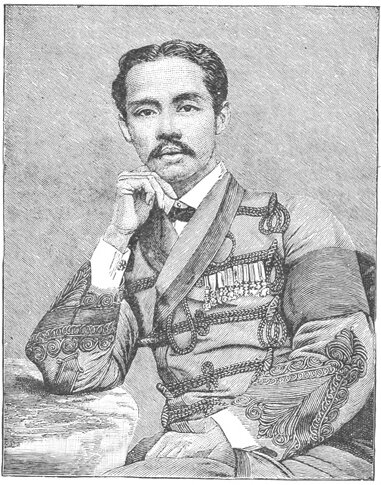
Chulalangkorn I, King of Siam
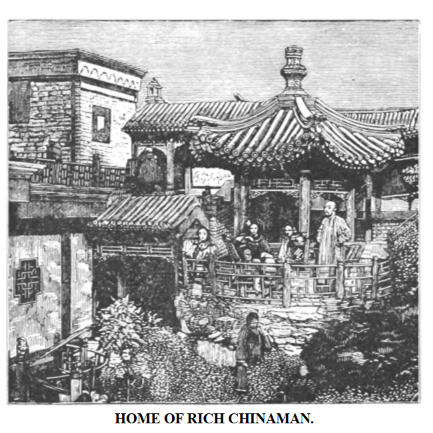
1) “His Supreme Majesty, Chulalangkorn I, King of Siam” [Frontispiece]. 2) “Home of a rich Chinaman.” 3) “Types of Women” [illustrations from the book].
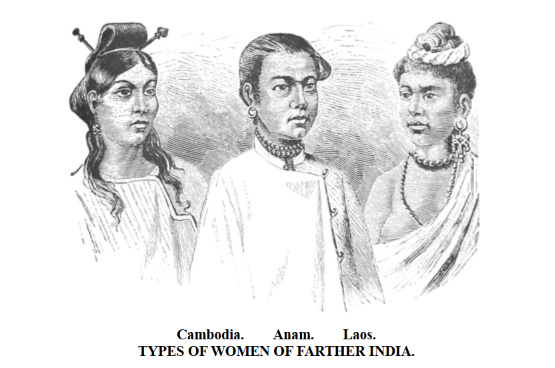
1) “His Supreme Majesty, Chulalangkorn I, King of Siam” [Frontispiece]. 2) “Home of a rich Chinaman.” 3) “Types of Women” [illustrations from the book].
1) “His Supreme Majesty, Chulalangkorn I, King of Siam” [Frontispiece]. 2) “Home of a rich Chinaman.” 3) “Types of Women” [illustrations from the book].
in Chapter I, The Indo-Chinese Peninsula — An Introductory Sketch. Unsigned, with a substantial part devoted to Angkor. It seems that the writer(s) relied on first-hand accounts gathered during conversations with photographer John Thomson, young American explorer David Olyphant King, Bangkok-based British naval surgeon and geographer James Campbell, traveler and business Frank Vincent from New York City, German explorer Adolf Bastian…Note also that there was no display of animosity directed againt ‘papist’ Bishop Pallegoix, a staple of Bangkok expat life who then claimed to be the first European to have set eyes on the Angkorian ruins.
[…] The small tributary kingdom of Korat, north-east of Bangkok, can only be reached through an extensive malarious jungle called, on account of its fatal character, “Dong Phya Phai,” the Forest of the King of Fire. All sorts of wild tales and legends are told of perils from robbers, wild beasts and malarious sickness — supposed to be the curse of evil spirits inflicted on those hardy enough to venture into this lion’s den. Dr. House [Samuel R. House, see below] was the first white man who ever visited Korat, in 1853, while engaged in an extensive missionary tour through the Cambodian valley, and M. Mouhot came several years later. But the whole province is little more than a nest of robbers, largely made up of vagrants, escaped prisoners and slaves. Nine miles east of Korat, the principal town, is a remarkable ruin of the same general style as the Cambodian ruins of Siamrap.
Cambodian Ruins of Siamrap
In Eastern Siam, about fifteen miles north of the great lake of Cambodia, are some of the most extraordinary architectural relics of the world. A trip of several hundred miles through a land where salas bare of furniture are the only inns makes it advisable to carry our own bedding, lay in supplies and provide a cook before leaving Bangkok. A Cambodian servant to act as guide and interpreter is also needed.
A canal-trip due east from Bangkok brings us to the Kabin branch of the Bang Pakong River. Mr. Thomson describes this as “a romantically beautiful little stream, where we seemed to have retired to a region unknown to men, inhabited only by the lower order of animals. Monkeys walked leisurely beside the banks or followed us with merry chattering along the overhanging boughs, while tall wading-birds with tufted heads and snow-white plumage and rose-tipped wings paused in the business of peering for fish to gaze with grave dignity upon the unfamiliar intruders. Some were so near that we could have struck them down with our oars, but to avoid this outrage they marched with a calm and stately stride into the thickets of the adjoining jungle.”
Kabin [ADB: mod. Kabin Buri กบินทร์บุรี, a district in the southeastern part of Prachinburi province, Thailand. Mueang Kabin Buri was an ancient city of the Ayutthaya kingdom] is the entrepôt of trade with the far interior. Chinese merchants here waylay the elephant-trains from Battabong and Laos, exchanging salt and Chinese or European wares for horns, hides, silk, oil and cardamoms. Mines near Kabin are said to furnish the most ductile gold in the world.
Leaving our boats, elephants and a buffalo-cart are engaged. We step from the veranda of the hut perched on poles to the elephant’s head and into the howdah. The driver sits astride his neck, guiding when needful with an iron-pointed staff. A military road from Kabin leads to the borders of Cochin-China. Sesupon, the first Cambodian town, on the frontier of provinces wrested by Siam from Cambodia a century ago, is first reached. Some of the people, including the Siamese governor and officials, speak both languages.
It is possibly harvest-time; in the fields the reapers are among their crops. Some of the plains are covered with tall grass ten feet high. There are perhaps burnt patches or a spark has just started a fire, and the flames, swept on by the wind, are roaring, crackling and sending up dense columns of smoke in their wake. As we pass under the overarching branches of trees in the forest our elephant keeps an eye the while ahead, and when some lower limb would strike the howdah he halts, raises his trunk and breaks it off. We toil up and over the watershed and down a steep bank to the river’s brink through the tall grass and bamboos, our beast sometimes sliding on his haunches, then bracing and feeling the way with his trunk, or plunging into the soft ooze of the river, wading through water so deep that nothing but the howdah and elephant’s head and trunk appear above the surface, and then climbing with slow but sure steps up a bank at least forty-five degrees steep.
Overtaken at night away from a town, we encamp under the trees. Our attendants make an enclosure with the cart and branches of trees, placing the cattle inside. We cook and eat our evening meal, making a great fire and boiling the coffee and rice over the bright coals. Our bivouac is underneath the stars on branches piled high above the malarious surface of the ground. The natives watch in turn, keeping up the fire to drive off wild beasts. Elephants prowl in droves outside the enclosure and cries of jackals disturb our dreams. Possibly in the morning tiger-tracks are pointed out to us.
On the higher waters of the Sesupon River, running south to the lake, are the first traces of the ancient Cambodian civilization in the shape of a ruined shrine buried beneath overgrown jungle; other ruins are found in more than forty different localities up to the confines of China.
Diverging to the north-east, evening finds us sheltered in a sala near the quaint old town of Panomsok. To the north are the first altitudes of the upland steppes of Laos. After such toilsome days and nights of exposure, crossing some sunny eminences and ancient stone bridges, we finally reach Siamrap, situated on a small stream about ten miles from the head of Thalay Sap.
It is a walled city, the teakwood gates thickly studded with large iron nails, the gateways surmounted by curious pointed towers. Houses similar to those of the middle class in Bangkok, the court-house and governor’s residence, are the only substantial buildings. Extensive, straggling suburbs extend southward for several miles on either bank of the river. The province has from eight to ten thousand inhabitants, all Cambodians. Dr. McFarland [1] reports: “We found but two or three persons who understood the Siamese language. The governor was a rather intelligent young Cambodian who had been educated at Bangkok, and of course spoke Siamese. He was pleasant, affable and very fond of foreigners.”
The communication with Panompen, the Cambodian capital, is by boat down the river and crossing to the lower end of the lake, then by the river which connects the lake with the Mekong. From Siamrap to Panompen requires six days by boat.
Half a dozen miles north of Siamrap, in the midst of a lonely forest, we come upon the celebrated ruins of Nagkon Thom, or Angkor the Great, and Nagkon Wat, the City of Monasteries, is a few miles off. The city ruins to-day are little more than piles of stone among the jungles. The outer wall, built of immense volcanic rocks, is best preserved. The natives say an entire day is necessary to circumambulate the walls. A mutilated statue of the traditional leper king is seated on a stone platform near the gate of the inner wall, protected by a grass thatch. The pedestal has an ancient inscription on stone. The ruins are in the charge of a provincial officer, who lives in a lodge near the palace. There are some old towers still standing.
Some thirty miles distant are the Richi Mountains [ADB: for Lychee Mountains, Phnom Kulen], said to contain the quarries from which the supply of stone was obtained. A broad causeway, still in serviceable repair, leads to the foot of these hills. Mr. Thomson tried to go there, but the thick jungle made it impossible to penetrate to the quarries even on elephants, although the officer who accompanied him made a series of offerings at several ruined shrines in order to propitiate the malignant spirits supposed to infest these wilds.
Concerning Angkor the Great ancient tradition speaks in most extravagant terms, as being of “great extent, with miles of royal treasure-houses, thousands of war-elephants, millions of foot-soldiers and innumerable tributary princes.” A road through the forest connects this once royal city with Nagkon Wat. Along this road a side-path leads to an observatory, overgrown with shrubs and vines, standing on a terraced hill and commanding a wide view of the surrounding region.
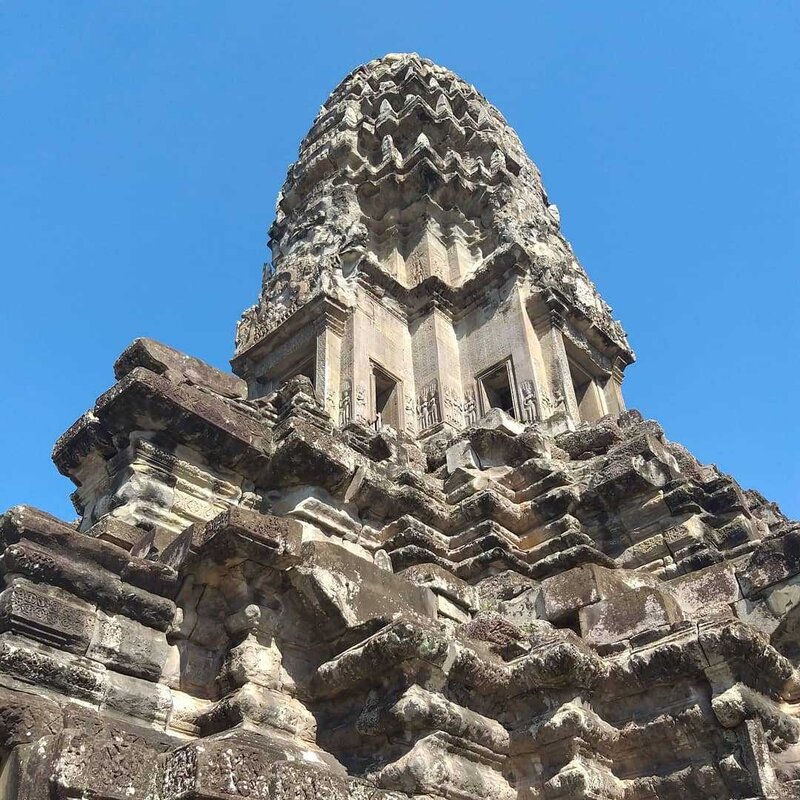
The main entrance approaches the wat on the west, crossing by an immense stone causeway over a deep, wide moat and under a lofty gateway guarded by colossal stone lions hewn, pedestal and all, from a single block. The structure rises in three quadrangular tiers, of thirty feet, one above the other, facing the four points of the compass, on a cruciform platform. Out of the highest central point springs a great tower one hundred and eighty feet high, and four inferior corner-towers rise around. It has been suggested that Mount Meru, the centre of the Buddhist universe, with its sacred rock-circles, is symbolized, the three platforms representing earth, water and wind. Flights of steep stairways, each step a single block and some having fifty or sixty steps, lead from terrace to terrace. Long galleries with stone floors, stone roofs, and walls having a surface smooth as polished marble, covered with elaborately chiseled bas-reliefs, are flanked by rows of monolithic pillars whose girth and height rival noble oaks. The centre compartments are walled in, and the remaining two-thirds of the space consists of open colonnades. The inner walls of these open galleries have blank windows; seven stone bars, uniform in size and beautifully carved with the sacred lotus, form a sort of balcony to each window.
The bas-reliefs have thousands of nearly life-size figures, representing scenes from the great Indian epic Ramayana — battle-scenes, processions of warriors, and the struggle of the angels with the giants for the possession of Phaya Naght, the snake god. The majority of these are executed with care and skill, and form one of the chief attractions of the wat. Specimens of the more beautiful, and also casts of the inscriptions, have been transported to the Cambodian Museum of Paris, but, unfortunately, M. Mohl [2], the celebrated Orientalist entrusted with the task of deciphering these unknown characters, died before reaching any satisfactory conclusion. Scholars seem inclined to regard the inscriptions as derived rather from the Pali or Sanskrit than the Malay or Chinese language.
Mr. Thomson, the English traveler, with his photographs, has best introduced these wonderful ruins to English readers. Mr. Frank Vincent’s very readable account of his visit to these ruins in company with Dr. McFarland, in 1871, also gives us much valuable information and reproduces some of the English photographs. Dr. McFarland states that “this wonderful structure covers an area of over ten acres — that the space enclosed within the temple-grounds is two hundred and eight acres, and the space within the walls of the city is over two thousand acres. The temple is built entirely of stone. These stones were brought a distance of about thirty miles, and must have required the labor of thousands of men for many years. There is no such thing as mortar or cement used in the building, and yet the stones are so closely fitted as in some places to appear without seam. These ruins, together with the beautiful little lakes that dot the plain and the remnants of splendid roads that once traversed the country, show that those formerly inhabiting this valley were a powerful race.”
And as we in turn ponder and gaze on these evidences of an unknown civilization a spell falls upon our imagination. We seem to see these forsaken altars thronged by devotees, and through the valley are busy cities adorned with stately palaces, astir with the human life of a powerful, opulent kingdom. But vainly do we conjecture how ruins of such solidity, so stupendous in scale, of elaborate design and excellent execution, could have lain forgotten through centuries in this lonely forest-district of an almost unknown portion of the globe; nor can the sloth and ignorance of the present semi-civilized inhabitants offer any trustworthy solution of the problem. They reply, “We cannot tell,” “They made themselves,” “The giants built them,” or refer to a vague local tradition of an Egyptian king, turned into a leper for an act of sacrilege, as the reputed founder of the wat.
The present good condition of the ruins of Nagkon Wat is largely due to the late king of Siam, who gave them in charge of the small religious brotherhood now living in little huts under the very shadow of the gray walls.
Travelers describe Nagkon Wat as “a rival of Solomon’s temple” and “grander than anything left us by Greece or Rome,” “occupying a larger space than the ruins of Karnac,” “imposing as Thebes or Memphis, and more mysterious.” But the credit of what might be called the rediscovery of these wonderful remains amidst the forest solitudes of Siamrap is due to M. Mouhot, after these remnants of a lost past had for ages been forgotten by all the world outside of their immediate vicinity. The innumerable idols and thousands of bats hanging from the ceilings would seem to have held undisturbed possession for centuries.
Fergusson’s opinion [ADB: Scottish planter and amateur archaeologist James Fergusson would publish his considerations on Angkor later, in 1891], that this shrine was devoted to the worship of the snake god (see Tree and Serpent Worship), is not in accord with the views of Garnier, Thomson and others, who agree that it must have been erected in honor of Buddha. Dr. Bastian, president of the Berlin Geographical Society, thinks, with Bishop Pallegoix, that the probable date of the building — at least its commencement — was the grand event from which the civil era of Siam dates — viz. the introduction of the sacred Buddhist canon from Ceylon in the seventh century. The general appearance of the worn stairways, and the dilapidated condition of the city, slowly mouldering under the destructive encroachments of a tropical jungle, would seem to indicate great age. Yet the mediæval narrative of Cambodian travel by a Chinese officer, late in the thirteenth century, recently translated by M. Remusat [ADB: Zhou Daguan’s account], contains no allusion to this great temple, which has induced some to conclude that the building belongs to a later period. In 1570 A. D. a Portuguese refugee from Japan refers to these “ruins” and the inscriptions thereon as being in “an unknown tongue.”
[1] Samuel Gamble McFarland (11 Dec. 1830 – 26 April 1897), an American Presbyterian missionary who settled in Phetchaburi (Siam) with his wife, Jane E. Hays in 1860 and later developed the Siamese school system for King Chulalangkorn (Rama V). He traveled to Cambodia with Frank Vincent in 1871 – 1872.
[2] German Orientalist Julius von Mohl (25 Oct. 1800, Stuttgart – 4 Jan. 1876, Paris), nominated to the French Academy of Inscriptions in 1844, was mostly a professor of Persian. Serving as secretary and later president of the Société Asiatique, he never claimed particular knowledge in Sanskrit and Khmer inscriptions from Cambodia, a field explored at the time by epigraphist Auguste Barth (1834−1916).
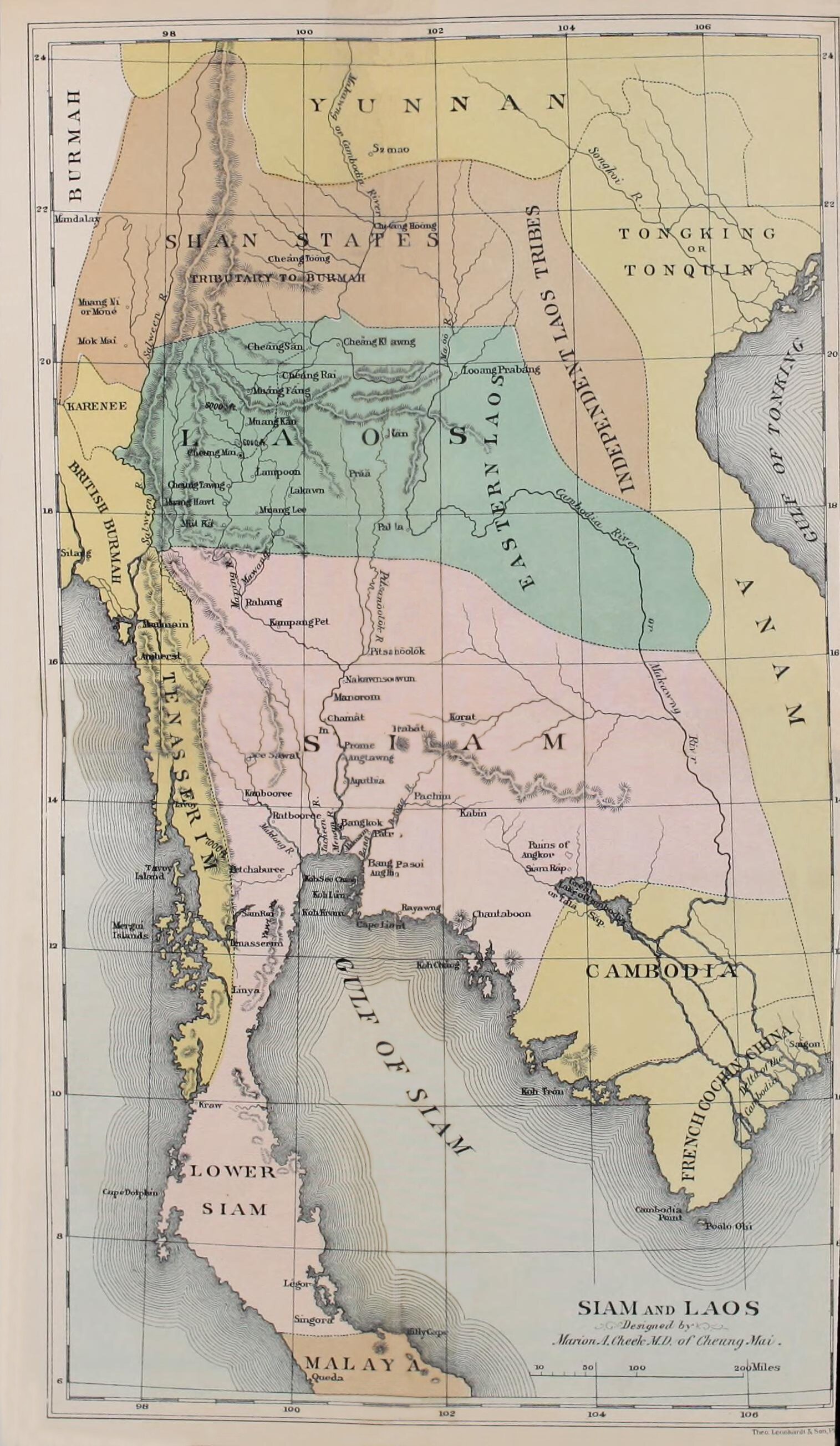
‘Designed by Marion A. Cheek, MD, Cheung Mai’. [from Siam and Laos As Seen by Our Missionaries, 1884].
Map of Siam and Laos designed by Dr. Marion Alonzo Cheek (1853 – 1895), an American medical missionary turned major teak trader, one of the many controversial characters in the Chiang Mai foreign community at the end of the 19th century.
He had arrived in Chiang Mai in 1875 alongside Presbyterian missionary Daniel McGilvary, and over the next two decades evolved from simple community doctor into a timber magnate.
Chapter XXI, titled History of the Missions in Siam and Laos, was attributed to Dr. Samuel Reynolds House. Born in Waterford, New York, on 16 Oct. 1817, House had received his medical degree in 1845, and was appointed that very same year to the Presbyterian Church Siam Mission along with Rev. Stephen Mattoon (1816−1885) and his wife to reopen the mission — they arrived in Bangkok only in March 1847. Giving up his medical careeer in 1852, he became a full-time evangelist and educator, and was ordained as a minister in January 1856. He and Harriet Maria Pettit married on 27 November 1855 in the US, and sailed together to Bangkok, arriving in July 1856. and was ordained as a minister in January 1856. After founding the Presbyterian Church in Chiang Mai in 1868, they stayed in Siam until 1886, having to leave because of Harriet’s poor health. She died in 1893, and Dr. House died on 13 August 1899.
Harriet Pettit House — who wrote several chapters in the present book — was born also in Waterford, New York, Dec. 23, 1820. Her ancestry was Scotch and English. On the mother’s side the line goes back to William Mitchell and his wife, Agnes Buchanan, who emigrated from Glasgow to New England in 1755. The male line in America began with the Englishman Abraham Waterhouse, who came to New England, 1729. Her paternal grandfather, John Pettit, one of the original settlers of Waterford and a member of the first board of village trustees, came from Chester, Conn., whence a few years later he brought his bride, Rebecca Waterhouse. It was in Waterford that the young Harriet met Stephen Mattoon’s future wife, Mary Laurie (1820−1885), and Mattoon himself. She had opened a “Select School for Young Ladies” in Newark, NJ, when she received a marriage proposal from Samuel House in 1855, at the time her father had died.
Harriet Pettit House’s role as an educatress in Siam, mentioned in the following pages, was so remarkable that Samuel’s biographer, George Haws Feltus, dedicated to her the largest part of his 1924 book [Samuel Reynolds House of Siam, Pioneer Medical Missionary (1847−1876), New York, Fleming H. Revell Company, 1924]. In Bangkok, she is still remembered as the founder and first principal of the Wattana Wittaya Academy รงเรียนวัฒนาวิทยาลัย, the first boarding school for girls in Siam-Thailand established initially in the precinct of the Royal Palace. Women were definitely a leading force in the saga of American Christian expansion in Siam here recalled by one of its proganists, Samuel House himself:
The American trading-vessel, commanded by Captain Coffin, which in 1829 brought to this country the famous “Siamese Twins,” brought also an earnest appeal for aid in evangelizing that then almost unknown land of their birth.
The appeal came from the zealous German missionary Gutzlaff and his associate, the Rev. Mr. Tomlin, of the London Missionary Society, who six months before had made their way to Siam, where they found not only an open door, but a large and most inviting field, for missionary labor. Their own societies not encouraging their permanent occupation of this advanced post in heathendom, both these brethren urged the American churches to enter in and possess the land for Christ. In response to the appeal of Gutzlaff, which was specially addressed to them, the American Board of Foreign Missions instructed the Rev. David Abeel, then in China, to visit Siam with a view to its occupancy if he deemed it advisable.
Dr. Abeel reached Singapore just as Mr. Tomlin was on the eve of embarking on a second visit to Bangkok, and arrived with him in Siam on June 30, 1831, a few days after Mr. Gutzlaff, disheartened by the death of his devoted wife, had sailed away in a native junk for Tientsin on the first of his memorable voyages of missionary exploration up the coast of China. He had been in Siam nearly three years in all, and had baptized one Chinese convert, whose name was Boontai.
The new-comers found the people eager for the books and medicines they had brought, and they labored faithfully for the good of the many Siamese and Chinese of high and low degree who came to visit them. In six months, however, Mr. Tomlin was called away, and Dr. Abeel also was obliged to leave Siam on a trip to Singapore to recruit his impaired health. Returning to Siam, he labored on till November 5, 1832, when continued ill-health drove him finally from the field.
Just two months before this the Rev. John Taylor Jones [2], who had been appointed a missionary to Siam by his American Baptist missionary associates in Burmah, to whom also Messrs. Gutzlaff and Tomlin had written, left Maulmain, where he had been stationed, for Singapore, on his way with his family to his new field. Delayed at that port, he did not arrive in Siam till March 25, 1833. Mr. Jones had been designated specially to the Siamese, but took supervision at once of the little company of Chinese worshipers Dr. Abeel and others had gathered, and in December baptized three of them. His Board at home approved the step Mr. Jones had taken, and determined to sustain the new mission, which thus proved to be the first permanently established in Siam.
The next to arrive in the field were two missionaries of the American Board, Messrs. Johnson and Robinson, who, with their wives, had embarked at Boston June 11, 1833, but, detained nine weary months in Singapore for a vessel to Siam, did not reach Bangkok till July 25, 1834, having been more than a year on their way. Mr. Johnson entered at once upon active labors for the Chinese, and Mr. Robinson for the Siamese, part of the population.
During the summer of 1834 the Rev. William Dean and his wife, who had been appointed by the American Baptist Board missionaries to the Chinese of Siam — their first missionaries, in fact, to any speaking the Chinese language — and Daniel B. Bradley, M. D., and wife, whom the American Board sent out to reinforce their mission to the Siamese, sailed from Boston for Singapore. While delayed at Singapore, Mrs. Dean was removed by death, and it was not till July 18, twelve months after leaving Boston, that Drs. Dean and Bradley, with Mrs. Bradley, reached their destined field.
Dr. Bradley soon opened a medical dispensary, and entered with zeal, faith and energy, which neither illness nor tropical heat nor any discouragement could abate, upon a course of medical and preaching, printing, writing and translating labors for the good of the Siamese, which ceased not till he resigned his breath in June, 1873 — thirty-eight years after. Dr. Dean devoted himself to the instruction of the Chinese that thronged the city — a labor of Christian love which this venerable first apostle of the Baptist Church to the Chinese is still (1884) prosecuting in that same heathen city. In December, 1835, he baptized three new converts.
Both missions were now in efficient working order, with each its Chinese department as well as its Siamese, the Baptist mission laboring among the Chinese that spoke the Tachew dialect, who were emigrants from the Swatow district of the Canton province, while the A. B. C. F. M.’s [1] mission looked after those that spoke the Hokien or Amoy dialect — different from that used by the Swatow people, and hardly intelligible to them.
The medical services of the missionaries and their medicines, and the Christian tracts and books they distributed without money and without price, were eagerly sought, and there was free access to the people in their streets, homes, and temples even, for making known the new religion; but none seemed savingly impressed — none of the Siamese. Indeed, while the protracted reign of the bigoted and imperious king who was on the throne when missions were established in Siam continued, it would seem no native could be brought even to entertain the question of forsaking the religion of the land, such was the dread of the king’s wrath and of the stripes, imprisonment, torture, death itself perhaps, that might be the fate of a convert.
The Chinese settlers in Siam were allowed more freedom of conscience; the displeasure of their kinsmen was all they would have to fear from change of religion. So Dr. Dean had the happiness of seeing the number of Chinese believers increase, till in 1837 a church was organized — the first church of Protestant Chinese Christians that was ever gathered in the East. To this, by 1848, sixty names had been added at different times. Mr. Johnson too, of the American Board’s mission, had the pleasure of baptizing his Chinese teacher in 1838, and in 1844 another of his teachers, Quaking, a Chinese of very respectable literary attainments.
Meanwhile, all labored on in hope. Reinforcements were sent from time to time to each mission. To the Baptist came, July, 1836, the Rev. Mr. Davenport and wife and Mr. and Mrs. Reid — Mr. Reid, alas! to die of dysentery in a little over a year. With these brethren came a printing-press. A printing-press was sent out to the American mission also the next year, so that both were now fully equipped for a most important branch of mission-work among this nation of readers. Before the year (1836) came to a close the first tract was printed, containing an account of the giving of the Law, a summary of the Ten Commandments, a short prayer and a few hymns. This is supposed to be the first printing ever executed in Siam. They had also secured more comfortable quarters on the west bank of the river, in the heart of the city, in houses built for them and leased to them by the Praklang, the minister of foreign affairs.
In March 1838, Mrs. Eliza G. Jones died of cholera. She was a lady of many gifts and graces. A little tract from her pen, The Burmese Village, is one of the most vivid and touching pictures of heathenism in all missionary literature. In April the Rev. Mr. Robbins and Dr. Tracy arrived to join the A. B. C. F. M. mission, but both left the following year.
This year (1838) was one memorable in the history of the Presbyterian mission, as in it occurred the visit of the Rev. R. W. Dee, who had been directed by the Presbyterian Board to proceed to Bangkok and report upon its eligibility as a station for the missionary operations they were about entering upon for the Chinese, so difficult of access in their own country. During his month’s stay in Siam, Mr. Dee found so large a field unoccupied, where laborers from our branch of the Church would be gladly welcomed, that he urged upon the Board the establishment of a mission in that land, not only to the Chinese there, but to the Siamese also. November 5, 1838, Dr. Bradley was ordained a minister of the gospel by his congregational associates.
In 1839 the Siamese government availed itself of one of the mission printing-presses to multiply copies of a royal proclamation against opium, and had an edition of nine thousand copies struck off. In August of this year the Rev. Mr. and Mrs. Slaftee of the Baptist mission arrived.
In 1840 vaccination was successfully introduced into Siam by Dr. Bradley, — a great boon to the people, among whom small-pox often committed fearful ravages.
The American Board’s mission was strongly reinforced in its Siamese departments early in the year by the arrival of the Rev. Messrs. Jesse Caswell, Asa Hemenway, N. S. Benham and their wives, with Miss Pierce — Mr. Benham to lose his life in one short month by drowning, his boat capsizing in the Menam when returning from an evening prayer-meeting. The Rev. Messrs. French and Peet, with their wives, also arrived in May. To the Chinese department of the Baptist mission came the Rev. Josiah Goddard and his wife in October.
It was in August of this same year that the Rev. William Buell and wife, the first missionaries of the Presbyterian Board to the Siamese, arrived in Bangkok. There were then in Siam no less than twenty-four adult male and female missionaries.
But the next year Mr. Slaftee died of dysentery and Mrs. Johnson of brain fever, and the widowed Mrs. Benham returned to the United States. In 1842, Mr. French died of consumption, and the following year his widow left Siam for the United States.
In 1842, by the treaty made at the close of the war between England and China, the island of Hong Kong was ceded to the English and five important seaports thrown open to foreign residence and trade. Dr. Dean, under instruction from his Board, who hastened to enter the now unbarred gates of access to the Chinese empire, removed early in the year to Hong Kong, leaving the Chinese church in Bangkok in charge of Mr. Goddard.
In 1843, Mr. and Mrs. J. H. Chandler arrived from Burmah, where, as a type-founder and lay missionary, he had been employed for three years. Being a practical machinist, he did much to introduce a knowledge of the useful arts among some of the leading men of the kingdom. Prince Chow Fah Noi, who subsequently, in 1851, was made the second king, became a pupil of his, and constructed a well-appointed machine-shop under his supervision, as did also an intelligent young Siamese nobleman of progressive ideas who afterward became master of the mint.
In 1844 the first steamer ever seen in Siam made its appearance, and greatly astonished the natives. On leaving, it took as passengers to Singapore the Rev. Mr. and Mrs. Buell, the only missionaries of the Presbyterian Board, who were now, after only three and a half years’ residence, most reluctantly obliged to abandon their work, Mrs. Buell having been stricken with paralysis. With their departure (February 24th) the Presbyterian mission in Siam died out, or rather was suspended, and more than three years elapsed before it was resumed. It had from the first been the intention of the Board to establish and maintain a Chinese department, but those sent out for this purpose, on reaching Singapore and learning there how fully open China proper was to the gospel, felt themselves called to proceed to that land, whose claims seemed so much greater. Miss Pierce of the American Board, who had come out as a missionary teacher, but failed to gather a school, died of consumption in September of this year.
The year 1845 witnessed quite a reduction in the number of the American missionaries in Siam. The Rev. Mr. Davenport and wife (now Mrs. Fanny Feudge) of the Baptist mission left for the United States, to return no more, and Dr. Jones, also, on a visit. The Rev. Charles Robinson and family of the A. B. C. F. M. also left Siam (Mr. R. to die at St. Helena on his passage home), while Mrs. Dr. Bradley died at Bangkok in the triumphs of faith after years of efficient and loving service for her Saviour — a most valuable helper in her husband’s work.
It was in this year that Prince Chow Fah Mongkut (Chow Fa Yai), who afterward became king, then head-priest of a royal monastery within the city-walls, invited one of the American missionaries, the Rev. Jesse Caswell, to become his private tutor. So anxious was this priest-prince for instruction that he offered an inducement which he knew would weigh heavily with a missionary — the use of a room in a building on the temple-grounds, where, after his hour for teaching was over, he could preach and distribute Christian tracts. The arrangement was made and carried out for over a year and a half. So much of the future of Siam in providence was to hinge on those hours of intimate intercourse between the faithful teacher and his illustrious and most diligent pupil that all the particulars are of interest. The prince was then about forty years of age — his teacher a graduate of Lane Theological Seminary, a member of the Presbytery of Cincinnati, and in the service of the A. B. C. F. M.
In 1846 the American Board, rightly deeming China proper a wider and more promising field for the labors of their Chinese-speaking missionaries, decided to give up their Chinese department in Siam, instructing Messrs. Johnson and Peet to proceed to China and establish a new mission at Fuh-Chow-fuh. With the close of the year came the Rev. Mr. Jenks to assist Mr. Goddard of the Baptist mission, only to leave, however, before the close of the next year, in consequence of the failure of Mrs. Jenks’s health.
In February, 1847, Dr. Bradley, with his three motherless children, left on a visit to the United States, his ship passing in the Gulf of Siam the vessel in which newly-appointed missionaries of the Presbyterian Board, Rev. Stephen Mattoon and wife and Samuel R. House, M. D., were on their way to recommence the mission-work of that Board in Siam, which had been so long discontinued.
These brethren had sailed from New York for China in the ship Grafton in July, 1846, arriving at Macao, after a five months’ voyage, on Christmas Day. No opportunity thence direct to Siam presenting, they were constrained to proceed viâ Singapore. There they were most hospitably entertained by the Rev. B. P. Keasberry, a missionary to the Malays, then of the London Missionary Society. Finding in the harbor a native-built trading-ship belonging to the king of Siam, commanded by a European, they secured a passage in it to Bangkok, which, after a tedious voyage of twenty-four days, they reached March 22, 1847, eight months after they left New York. The journey from New York to Bangkok can now be made by transcontinental railways and Pacific mail-steamers, or by English steamers and the Suez Canal, according as one goes west or east, in six or seven weeks only.
Upon arriving the new-comers were most cordially received by the brethren of the A. B. C. F. M. and the American Baptist mission, and welcomed to the homes of Messrs. Caswell and Hemenway, the only remaining members of the A. B. C. F. M., till the vacant houses on their premises could be prepared for their reception. They were soon visited by many of the nobles and princes, and took an early opportunity to pay their respects to the Praklang, Prince T. Mourfanoi (Chow Fah Noi), and his elder brother, T. Y. Chow Fah Mongkut, the prince-priest, at his residence in a beautiful monastery in the city. By both these princes they were most kindly received — by the last-named with marked regard, which they ever retained.
The tidings spreading that a new foreign physician had come to Siam, patients of every description and of all classes crowded for relief, till Dr. House was compelled to reopen the dispensary, which had long been sustained by Dr. Bradley in a floating-house moored in front of the mission premises. During the first eighteen months he had prescribed for three thousand one hundred and seventeen patients. Mr. Mattoon applied himself successfully to the study of the language, and soon entered upon the work of tract-distribution, visiting for this purpose the wats or Buddhist monasteries of the city, none being more ready to receive Christian books than the priests — or monks, rather — themselves.
In the ensuing cool season many tours were made with the brethren of other missions. Petchaburee, Ayuthia, Prabat and Petrui were visited, and everywhere they found a ready reception for the books and tracts they carried with them.
In 1848 the Rev. John Taylor Jones, D. D., returned with Mrs. S. S. Jones and Miss Harriet Morse, a missionary teacher, but Mr. Goddard of the same mission was obliged to remove to a more invigorating climate, and left for Ningpo, China. In September of this year the mission cause sustained an irreparable loss in the death of Jesse Caswell. He was a man of most earnest purpose and rare fitness for the missionary work. His qualifications as a teacher were appreciated by the Prince Chow Fah Mongkut, who chose him as his instructor in the English language and science, and derived from him, chiefly during the eighteen months’ continuous instruction he received, those enlarged and liberal ideas in government and religion which, when he succeeded to the throne, led him to open Siam to commerce and improvement. No wonder that after he became king he erected a handsome tomb over his esteemed teacher’s remains and sent to his widow in the United States a gift of one thousand dollars, and subsequently five hundred dollars more, as tokens of regard for his memory. In February, 1849, Mrs. Caswell and family returned to America.
Mr. Caswell’s death and Mr. Hemenway’s illness threw now upon Mr. Mattoon, though he had been but eighteen months in the field, the Sabbath preaching-service at the station and a tri-weekly service at a hired room used as a chapel in the bazaar. There were, too, many applicants for books daily at the houses of the missionaries, and they had to be instructed and supplied.
In 1849 the Presbyterian missionaries were made glad by the arrival in April of the Rev. Stephen Bush and wife, as were the Baptists by the Rev. Samuel J. Smith’s arrival in June. When a lad Mr. Smith had been taken into the family of Dr. Jones, came on with him to Siam, had been sent by him thence to the United States to be educated, and now came out to assist that veteran missionary in his work.
The newly-arrived missionaries were busy in the acquisition of the language when suddenly the pestilence like a thunderbolt burst upon the inhabitants of Bangkok, sweeping to destruction in less than one month full thirty-five thousand, or about one-tenth, of its population. For days together, when this epidemic of Asiatic cholera was at its height, there were two thousand deaths in the twenty-four hours in Bangkok alone. The mission families were graciously permitted to abide in peace and safety. As may be imagined, the whole time of the missionary-physician was engrossed by attendance on the sick and the dying in princes’ palaces and in bamboo huts, and, through the blessing of Providence on remedies to which he was directed, many lives were saved and many lifelong friends secured to himself and the religion he professed. Of all those thousands that perished, alas! but one died in hope — an old man from a far-distant up-country home, who from the reading of Christian tracts alone, without ever seeing the living teacher, had joyfully received the truth, and, finding his way to Bangkok and to the Baptist mission to be instructed more perfectly, got there just in time (so it was strangely ordered) to become one of the earliest victims of the epidemic. He died without fear, trusting in the Saviour he had found.
August 29, 1849, witnessed the organization of the first Presbyterian church in Siam. Earnest prayer went up that day that the little vine there planted might flourish and increase, and at last overshadow the land. To this church, made up of the mission families, a worthy native brother was added by certificate from the church in connection with mission of the A. B. C. F. M. — Quakieng, who, it will be remembered, had been baptized by Mr. Johnson in 1844.
With the last week of the year 1849 the Rev. Asa Hemenway, the sole remaining missionary of the A. B. C. F. M., after just ten years of faithful service on mission-ground, embarked with his family for the United States, and the operations of that Board in Siam closed. For fifteen years its missionaries had cultivated this interesting and inviting, but as to visible results most barren, field. From none of the native races of the land had they gathered one reliable convert. Their missionaries had labored, and labored well, but others were to enter into their labor. The “set time” for Siam’s visitation had not yet come. It would seem that “he that letteth must let, till he be taken out of the way” of this man-fearing people before gospel truth could have “free course, run and be glorified.” The books that they prepared, translated and distributed, the favor won by their gratuitous healing of the sick, and the introduction, first, of inoculation and afterward of vaccination for the small-pox, the training given in habits of industry and order and in knowledge of the Christian Scriptures to those employed by them in their printing-office and in their families, were not lost, nor the high opinion the natives learned to entertain of the truthfulness, benevolence and goodness of American Christian men derived from them and their worthy Baptist associates. And we must not forget how largely the career of progress on which Siam has since entered is traceable to the influence of one member of this mission.
In the spring of 1850 the Rev. Dr. Bradley, who had, while in the United States, transferred his relations to the American Missionary Association, returned with Mrs. Sarah B. Bradley and his children, and with him came as associates the Rev. L. B. Lane, M. D., and Prof. J. Silsby. To the A. M. A. had been made over the dwelling-houses, chapel, printing-press, etc. of the A. B. C. F. M.; the ground on which they stood had been only leased.
It was now imperatively necessary that the Presbyterian mission should have a home of its own, but all attempts to procure one failed. The knowledge of the unwillingness of the government to give foreigners any foothold upon the soil deterred the owners of suitable locations from selling to the missionaries. And when at last one, braver than the rest, was found willing to part with land enough for a station in the upper part of the city, and permission to purchase obtained from the proper official, and the money had been paid over, and one of the missionaries with his family had removed in a floating house to the spot to commence building, a peremptory order from one of the highest grandees revoked the permission given, and compelled the return of the mission family and the payment back of the purchase-money by the seller. No other reason was given than that “the residence of foreigners there was contrary to the custom of the country.” Nor could any eligible site be rented even.
The king, who had always been a zealous and bigoted Buddhist, had now become more despotic and selfish and averse to foreign intercourse than ever, monopolized himself what little trade there was, and settled down into a narrow policy that would exclude all nations but China from the products of his dominion. Neither of the friendly embassies which visited Siam this year — that from America in March or that from England in August — could obtain an audience even, much less gain any concessions in matters of trade or residence or protection of the interests of their people.
The English ambassador, the celebrated Sir James Brooke (“Rajah Brooke”), mortified and insulted by the reception given him, withdrew, threatening to return with a fleet and force that should compel respect. War seemed so imminent that the proposition kindly made to the mission families to retire with the ships of the embassy, lest hostile measures entered upon should subject not English residents only, but all speaking the English tongue, to a fate like that of Dr. Judson when the war broke out with Burmah, was seriously considered, though not accepted.
Very dark were the prospects of all the missions now. The native teachers were arrested and imprisoned, and threatened with the ratan and with fetters; the Siamese servants left in a panic; none came to hear preaching or applied for books.
But the darkest hour is just before day. Just then, in the overruling providence of God, a mortal though lingering illness seized the king, and for months all things were in suspense till, in April, 1851, his long reign ended and he “entered into Nipan,” as the Siamese say when royalty expires.
Upon the throne, as his successor, was now placed, by the concurrent voice of the grand council of princes and nobles, the Prince Chow Fah Mongkut, and Siam entered upon a new era in her history; for this remarkable man by his devotion to study during the twenty-seven years of his seclusion from public affairs in a monastery, while his inferior half-brother, who had artfully supplanted him, reigned with so strong a hand, and by his intimate association with the American missionaries, and especially by his having been long under the almost daily tutelage of one of them, had become emancipated from many of the prejudices of his countrymen, and prepared to set the wheels of progress in motion.
Bright now were the prospects of the missionaries. Their teachers and their old servants returned, and, as the sovereign was known to be personally friendly to the missionaries, they were treated with respect by all ranks, and had everywhere a civil hearing for the message they brought. Indeed, they were assured from the throne on the day of the coronation, when they were invited to the palace, that they should be unmolested in their work. Lest, however, they should be too exultant in their new hopes, Providence was pleased to order trials and bereavements to each of the missions. Mrs. Bush had an attack of hemorrhage from the lungs, that on the 22d of July, after six short weeks of illness, resulted in her death. No, it was not death, but a translation. To those who witnessed her triumphant departure it seemed as if her spirit, when it reached the threshold of the gate of the heavenly city, turned to tell them what she saw. “Beautiful!” she said — “beautiful! Heaven is one great beauty.”
Early in January, in the midst of the other discouragements, the Baptist mission had suffered a great calamity. A fire in the night, doubtless of incendiary origin, had destroyed their dwelling-houses, chapel, printing-press — including a large edition just completed of the New Testament in Siamese — and nearly all their personal effects. Their loss amounted to ten or twelve thousand dollars. A temporary house of bamboo and thatch was hastily thrown up, but new dwellings must be erected, and from exposure to the sun and fatigue in procuring timber for the rebuilding Dr. Jones was taken ill, and, his constitution being impaired by a score of years spent in the tropics, he succumbed to disease on the 13th of September, and passed peacefully away — an irreparable loss to his mission and to Siam. He was a man of excellent judgment, piety and culture, and had a rare mastery of the Siamese language with its curious idioms that made him most acceptable to the natives as a preacher and writer. His translation of the New Testament and several tracts that he prepared attest his scholarship in Siamese and his ability.
Just before this sad event the Rev. William Ashmore and wife, who had been sent out by the Baptist Board to take charge of the Chinese department, arrived in Bangkok.
And now the Presbyterian mission obtained at last what it had so many years sought in vain. An eligible location was tendered them near the centre of the city, not far below the palace, adjoining one of the largest wats and in the neighborhood of several others.
About this time the king, with a singular appreciation for an Oriental monarch of the importance of female education, in a note in which he says he “desires several ladies who live with him to acquire knowledge in English,” invited the wives of the missionaries to visit his palace and alternate in giving regular instruction to his numerous family. Gladly and with much interest did Mrs. Mattoon, Mrs. Dr. Bradley and Mrs. Dr. Jones, representing the three missions in the field, enter upon their work — the first zenana-teaching ever attempted in the East. Twenty-one of the thirty young wives of the king, and several of his royal sisters, composed the class. During the three years these labors continued much Christian as well as secular knowledge was imparted to these secluded ones — saving knowledge, it was hoped, in the case of one at least, a princess of the highest rank.
As soon as the rains were over and possession was given of their new premises, Messrs. Mattoon and Bush proceeded to enclose the ground, dig trenches for the foundations, purchase rafts of teak-wood logs and superintend their sawing by hand into the timber and planks required to put up two plain but convenient brick dwelling-houses. Mr. Bush’s experience and practical skill here proved of great value. Before the rains fairly set in, early in June, one house was finished, and Mrs. Mattoon and family removed into it from the floating house on the river, lent to them by a friendly prince, which had been their temporary home while the new building was going up. They had found it not an undesirable residence, though one memorable dark night, having been detached from its moorings that it might slip away from a fire that was raging on a river-bank near, through the carelessness of a servant it got adrift and carried its inmates off against their will, with a rapid tide, seven or eight miles down the river before its progress could be arrested. The truant dwelling, however, with all its contents undisturbed, with the turn of the tide was brought back to its old moorings safe and sound.
The other dwelling-house was soon completed and occupied. The mission having now a home of its own and ample room, in October, 1852, a boarding-school for Siamo-Chinese boys was opened, and Quakieng, who was an experienced Chinese teacher, put in charge — the free tuition the lads would receive half of each day in their father-tongue being, it was hoped, an inducement that would attract such pupils within the reach of Christian instruction.
Before the first year ended twenty-seven had been enrolled. All attempts to gather Siamese boys in a school had failed thus far, though some individual scholars had been taught, as the wats gave free tuition to all, and merit was made by providing the priests with their pupil-attendants.
An interesting, amiable young Hainan Chinese, See Teug by name, had the year previous been baptized by Mr. Mattoon, in whose family he long had lived — the first of that people to become a Protestant Christian — and gave pleasing evidence of his love to his Saviour by the interest he manifested in bringing his fellow-countrymen to the knowledge of the gospel. A Sabbath evening-service was held for their benefit, the new convert acting as Bible-reader and interpreter. Afterward a Hainan teacher was secured, and for many years a Hainan-Chinese department of the boarding-school maintained, in the hope of bringing under saving Christian influences some of the many Chinese in Siam from the island of Hainan, which had been hitherto entirely unreached by Protestant missionary effort. A day-school for the Peguan girls in the neighborhood was started by Mrs. Mattoon, who had also two or three native girls in her own family under Christian training.
About this time great numbers came to the houses of the missionaries for books and conversation on religious matters, fifty or sixty in a day, attendance upon whom required the whole time of one of the brethren. Over a thousand Christian books a month were thus put into the hands of intelligent readers. Young priests and boys from the neighboring wats were frequent visitors, and as no second volume was given until they had been questioned on the contents of the first, and many thus received the whole series of the publications of the mission, much Scripture truth must have been imparted. So eager were some of these lads for books that they would swim across the river to get one, and then swim back with but one hand, holding up the prize high and dry with the other.
And now followed a time of great outward prosperity — the government friendly, the missionaries enjoying the respect of all classes, their schools flourishing, their books eagerly sought. The mission of the American Missionary Association, as a special token of the king’s regard for its senior member, Dr. Bradley, was permitted to occupy a very desirable location at the mouth of the principal canal of the city, the chief channel of travel west.
In December, 1852, Mr. Bush, whose health required a change, left for the United States.
The next year Dr. House made a tour of great interest, partly on foot, partly on elephants, to Korat, an important inland town north-east of Bangkok, over in the great valley of the Cambodia River, returning by Kabin, and distributing many books and making known to many a surprised listener in a wide district of country never before visited by a missionary, or a white man even, the strange doctrine — strange to them — of the being of a living God and salvation without personal merit freely granted for another’s sake. Much of Mr. Mattoon’s time was now given to the work of making a revised translation of the New Testament into Siamese.
In 1854 a Mormon missionary found his way to Siam, but, meeting no encouragement, soon withdrew. The Siamese did not need any urging to the practice of polygamy.
Prof. Silsby left Siam in May of this year, and Mr. J. H. Chandler and wife returned, and with them came the Rev. Robert Telford and wife to assist in the Chinese department of the Baptist mission.
In January, 1855, Dr. Lane of the A. M. A., on account of the health of his family, and Miss Morse of the Baptist mission, took their final leave of Siam.
The time was now at hand when Siam, so long secluded and almost unknown, was to enter more fully into the family of nations by treaties of commerce and friendship with the great powers of the West. Sir John Bowring, then governor of Hong Kong, arrived March, 1855, as British ambassador to the court of Siam, and was cordially welcomed by the king, with whom he had previously been in friendly correspondence. Aided by his able secretary of legation, Consul Parkes (now Sir Harry Parkes, British minister to Pekin), in one short month, in one week of actual negotiation, he overturned the customs and prejudices of centuries, and had conceded to him by the enlightened ruler of the land and his ministers of state the abolition of all the government monopolies of articles of trade, the removal of the old foolish prohibition of the export of rice and teak-wood, moderate duties on imports, the residence of consuls to protect the interests of their countrymen, and liberty for British subjects to travel and take up land in the country. This treaty opened the way for all subsequent treaties with other nations, and so opened Siam to the commerce of the world.
Dr. House availed himself, when the embassy left Siam, of the courteous offer of a free passage to Singapore, to make a brief visit to his native land to seek for the reinforcements his mission so greatly needed. While at home he was ordained and married, and, re-embarking with Mrs. House and the Rev. A. B. Morse and wife, reached Bangkok again in July, 1856, greatly to the joy of the solitary mission family that with faith and patience unwearied had been “holding the fort.”
Meanwhile, a month or two before, our United States government had by its ambassador, Townsend Harris, Esq., negotiated a treaty almost identical with the British, and, to the great satisfaction of the Siamese, Mr. Mattoon was appointed consul. Dr. William M. Wood, late surgeon-general U. S. Navy, who accompanied the embassy, testifies in his book, Fankwei, that the “unselfish kindness of the American missionaries, their patience, sincerity and truthfulness, have won the confidence and esteem of the natives, and in some degree transferred those sentiments to the nation represented by the missions, and prepared the way for the free national intercourse now commencing. It was very evident that much of the apprehension they felt in taking upon themselves the responsibilities of a treaty with us would be diminished if they could have the Rev. Mr. Mattoon as the first U. S. consul to set the treaty in motion.” Mr. Mattoon accepted the office, however, only till a successor should be appointed at Washington. Meanwhile, his mission-work — preaching, translating, etc. — was not intermitted.
In 1856 the schools reported forty-seven in attendance, and every department of the work was in successful operation.
Another station in Bangkok being thought desirable, and a large lot with broad frontage on the river on its west bank in the lower suburbs of the city becoming available, it was secured, and Mr. Morse (a bamboo cottage being put up for his temporary residence) removed there and commenced building a brick dwelling-house. Ere its walls were half up he was completely prostrated by disease, and forced, to the great regret of his associates, to leave the field and the work he loved, and for which he was so well qualified. Previous to his leaving, Mrs. Mattoon, finding an American ship loading at Bangkok to sail direct for the United States in March of this year, had availed herself of the opportunity to make a visit home for rest and to recruit her strength, exhausted by ten years’ toil in a tropical climate.
It being necessary to go on and complete the building begun by Mr. Morse, and the new premises there having the advantage of carrying on some departments of missionary work, and not being subject to ground-rent, as was the other place, it was deemed best to give up the upper station, dispose of the buildings there and establish the Presbyterian mission permanently on the newly-purchased ground. The removal of the mission to the new station, four miles below, was made in November, 1857, and another dwelling-house immediately commenced.
This was nearly completed when, June 20, 1858, the Rev. Jonathan Wilson and wife and the Rev. Daniel McGilvary arrived. Messrs. W. and McG. had been room-mates at Princeton Seminary; while there had both felt the claims upon them of missionary work, and had become much interested in Siam; but after graduating Mr. McGilvary was called to become pastor over a church in North Carolina, and Mr. Wilson had gone out as a missionary to the Choctaw Indians. Years passed, and each had been led by the pressing needs of the field to offer himself to the Board for service there, and most gratifying was it to find that they were to be sent out together.
The number of ordained ministers now warranted the formation of a Presbytery, and the Presbytery of Siam was duly constituted September 1, 1858.
In the study of the language, aiding in the instruction of the pupils in the boarding-school and in tract-distribution the new brethren found enough to busy them.
In January, 1859, the Rev. S. Mattoon, who had then for some twelve years without intermission borne the burden and heat of the day, returned to the United States for the much-needed change, rejoining his family there.
Signs of more than usual religious interest appeared about this time, and one of the native teachers, Nai Chune, applied for Christian baptism. So deep, however, was the duplicity of this people generally, and so many who professed interest in the teachings of the gospel had proved to be influenced by purely selfish motives, that when this case of genuine conviction of the truth occurred, just what they had been hoping and praying for so long, the brethren distrusted the sincerity of the man, and put him off from week to week until fairly compelled to admit that the miracle of converting grace had actually been wrought even in a Siamese, and they could no longer forbid water that he should be baptized. The day of Nai Chune’s baptism (August 7, 1859) was to them a jubilee indeed. With tears of joy they gathered in at last, after more than twelve years of toil unblest, the first-fruits of their labor among the Siamese.
It was singular that this same year (in December) the mission should lose its first church-member — Quakieng, the faithful, consistent Chinese native assistant. He was attacked by cholera and died, commending his departing spirit to his heavenly Father. With his death the Hokien-Chinese instruction in the mission-school ceased, and soon after the teaching of the Hainan Chinese in their native tongue. The school was too well established now to need to hold out this inducement to attract pupils.
The cholera was quite prevalent in April, and Mrs. Wilson nearly became a victim. Other diseases set in, and she lingered on the borders of the spirit-land till July 10th, when she closed a blameless Christian life and entered into the home of the blessed with words of rapture on her lips.
The stricken band in the Presbyterian mission were greatly cheered and strengthened two months after by the return (September 15th) of Mr. Mattoon and family, and with them the Rev. N. A. McDonald and the Rev. S. G. McFarland and their wives.
Up to this time the Presbyterian mission had been dependent for its printing upon sister-missions, but now a press of its own, sent out by the Board, was set up and soon in successful operation. A year or two later it reported an issue of more than half a million of pages annually.
In December, Mr. McGilvary was married to Miss Sophia R. Bradley, eldest daughter of Rev. D. B. Bradley, M. D., of the American Missionary Association. This cool season Messrs. Wilson and McFarland accompanied Mr. Telford of the Baptist Board on a trip for distribution of Siamese and Chinese tracts down the east coast of the gulf as far as Chantaboon.
With such an accession to the members of the Presbyterian mission as they had lately received, it was now deemed that the time had come for them to establish a new station somewhere outside of Bangkok, and Petchaburee was fixed upon as its location. This is an important inland town, some eighty-five miles south-west from the capital city, situated in the midst of charming scenery in a fertile and populous district of country. The acting governor of the province favored the having a station there, and offered every assistance; and this in a place where the authorities treated very uncivilly the first missionaries who visited it, and arrested those who received books at their hands. Ground having been purchased and the house they had secured made ready for them, in June, 1861, Messrs. McGilvary and McFarland, with their families, removed to Petchaburee. Another dwelling-house was soon under way, and a school opened on the premises, with the sons of the governor and lieutenant-governor enrolled among the pupils.
The name Petchaburee signifies the “city of diamonds,” and soon after their arrival the missionaries found there, in the midst of the rubbish of heathen superstition and idolatry, a gem, a living stone of priceless value, that has since been taken to shine doubtless in the Redeemer’s crown. It was a native Siamese, Nai Kawn by name, from a village near, who called upon them to place his son under their instruction. The lad already knew the Ten Commandments and the Lord’s Prayer. The father himself surprised them by his facility in quoting Scripture, repeating whole chapters of Romans; and on conversing with him it appeared that, though he had never seen a missionary, from some two or three portions of the Scripture and a few Christian tracts that had fallen in his hands, taught by the Spirit of God, he had gained, and accepted too, a wonderfully clear view of salvation by faith in the Lord Jesus Christ. Gladly he received other portions of the New and Old Testament, and, further instructed, he became a fearless and efficient witness for the truth before his countrymen of high and low degree.
The brethren at Petchaburee, with the freest access to the Siamese everywhere, found a peculiarly inviting field of labor among a colony of Laos numbering ten thousand or so, settled near them. These people, adherents of a prince who had failed in his struggle for the throne, had fled in a body from their own land in the far north-east some eighty years before, and, seeking refuge in the dominion of the king of Siam, had been assigned a home and lands in this fertile province. They were made serfs of the king, however, and much of the time had to work for their new royal master. A preaching-place was secured in one of their villages, and these toiling exiles seemed to be interested hearers of the word.
But to return to Bangkok. In December, 1861, Esther, a young native woman who had been brought up in the family of Mrs. Mattoon, was baptized, — the first native female member of the Presbyterian mission-church of Siam.
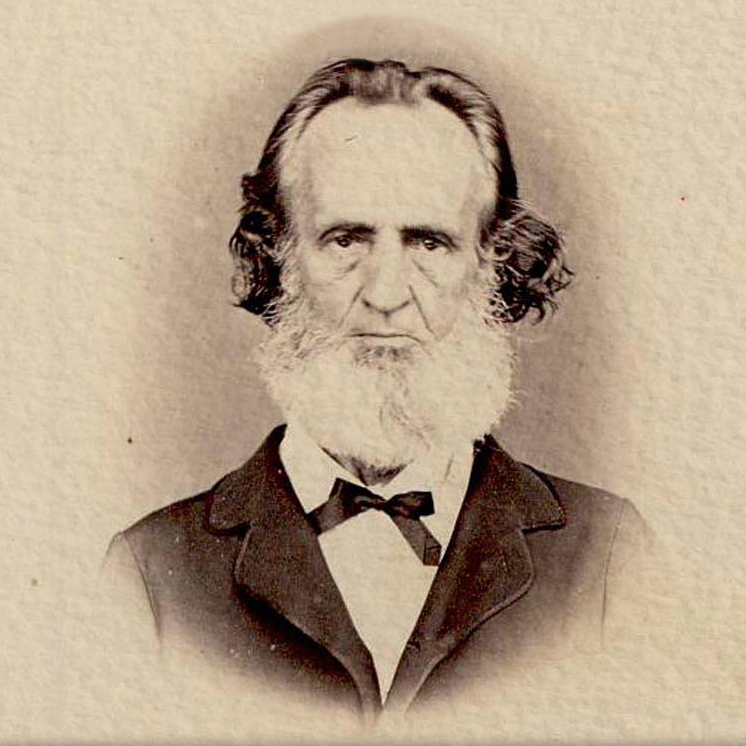
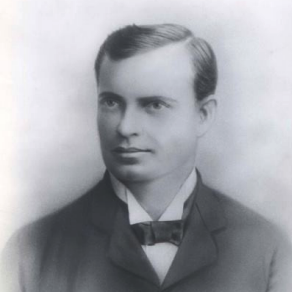
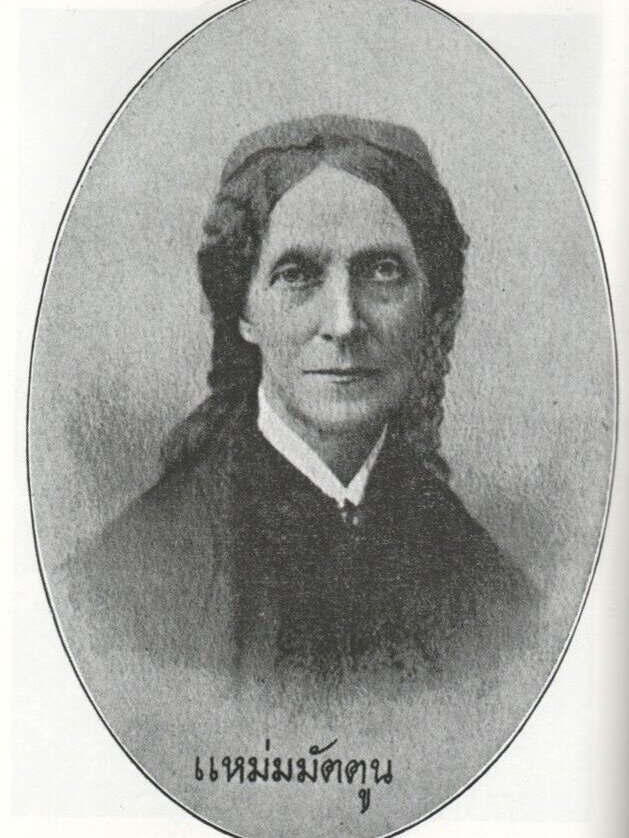
Portrait Gallery: 1) Dan Beach Bradley. 2) Marion A. Cheek. 3) Mary L. Mattoon. 4) Samuel R. House [photos from DCBA; Samuel Reynolds House, 1924, op. cit.].
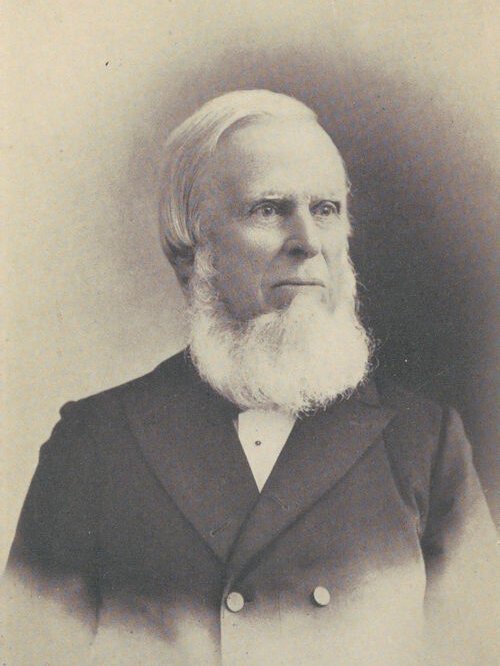
Portrait Gallery: 1) Dan Beach Bradley. 2) Marion A. Cheek. 3) Mary L. Mattoon. 4) Samuel R. House [photos from DCBA; Samuel Reynolds House, 1924, op. cit.].
Portrait Gallery: 1) Dan Beach Bradley. 2) Marion A. Cheek. 3) Mary L. Mattoon. 4) Samuel R. House [photos from DCBA; Samuel Reynolds House, 1924, op. cit.].
On February, 2, 1862, the Rev. S. C. George and wife, who had been sent out by the Presbyterian Board, arrived in Bangkok. Mrs. George was a sister of Mrs. Johnson, one of the noble company of martyred missionaries put to death by Nana Sahib’s orders at Cawnpore. Much faithful colporteur work in the city and suburbs was done this year by Mr. Wilson, and mission-tours were made to Camburi and Prabat by him and other missionaries. A neat mission-chapel which had been built on the mission premises without drawing upon the funds of the Board was opened for divine service in May. In December, Messrs. McDonald and House, with Mr. Telford of the Baptist mission, made a coasting-trip to Chantaboon, distributing many Siamese and Chinese books and tracts there and at other places visited on the way.
The first fruit of the labor of the Petchaburee missionaries was gathered in February, 1863, when Kao, a young Siamese of much promise, was baptized. He had entered Mr. McFarland’s service that he might acquire a knowledge of English, but he was instructed also in the way of life, and learned that which made him wise unto salvation. One short month, and he left his dying testimony to the excellence of the new religion he had embraced. Called away by sudden and severe illness, his last words were, “Why do you weep? I am not afraid to die. I love the Lord Jesus. I am going to heaven. My heart is happy.” There were others in Petchaburee who soon after had the courage to renounce Buddhism and publicly avow themselves Christians. May 10, 1863, a Siamese man and his wife, who had been long in Mr. McGilvary’s employ, and a young Siamo-Chinese in Mr. McFarland’s, were baptized and a church organized in Petchaburee. It was an occasion of great and joyful interest to the brethren there.
In May the Rev. Robert Telford and wife of the Baptist mission, after nine years’ labor among the Chinese of Siam, were obliged to leave Siam in quest of health, embarking for China.
Mr. McGilvary, in his labors for their spiritual good, had become so much interested in the Laos people settled near him in Petchaburee that he was anxious to learn if something could not be done for the evangelization of the hundreds of thousands of Laos in the tributary states to the north, as yet unreached by the gospel. Accordingly, with the consent of the mission, he made in that cool season, with Mr. Wilson, an exploring-tour to the hitherto unvisited North Laos country, journeying partly by boat, partly on elephants, as far as Cheung Mai, the capital. The travelers were well received by the authorities, and after an absence of eleven weeks returned strongly impressed with the practicability and desirableness of establishing a mission among that interesting people.
The varied work of the mission at the two stations was carried on as in former years, some engaged in the boys’ school, others having charge of the printing-press or translating the Scriptures or preparing tracts and catechisms, maintaining the preaching-services, conversing with visitors, distributing tracts or medicines, vaccinating native children, studying the language with native teachers, or conducting the daily morning service, which all on the mission premises or in mission employ were required to attend, and when, with the brief exposition of the Scripture read, much religious instruction was given. The wives of the missionaries also did much for the instruction of the native females in their families and neighborhoods in reading and sewing and in Bible-classes on the Sabbath.
In February, 1864, Dr. and Mrs. House left on a visit to the United States, the state of Mrs. House’s health requiring it; and a few months later Mrs. Mattoon, whose asthmatic trouble had returned, was compelled to take her final leave of Siam. Her husband remained to finish the important work on which he had long been engaged of making a revised translation of the New Testament into Siamese. Mr. Wilson, whose health had become impaired, accompanied Mrs. Mattoon and her children to America.
In December, 1864, the Rev. Dr. Dean, whose shattered constitution had been restored by eleven years’ sojourn in his native land, gladly returned (with Mrs. Dean, Miss F. Dean and the Rev. C. H. Chilcott) to take charge again of the Baptist Board’s mission-work for the Chinese and of the Chinese church in Bangkok, which he had founded. Mr. Chilcott was removed by death before he had entered on the second year of his missionary life.
In December, 1865, the Rev. S. Mattoon took his final and regretful leave of the land and the people for whose good he had labored so long and so faithfully — a loss to the community as well as to the mission. From the date of his embarkation for the field to that of his arrival in the United States on his return was just twenty years.
April 4, 1866, the Rev. P. L. Carden and wife arrived to join the Presbyterian mission, and in July the Rev. J. Wilson returned with Mrs. Kate M. Wilson. In July also came Miss A. M. Fielde, to be connected with the Chinese department of the Baptist mission. Dr. and Mrs. House returned in December from their visit home, with health renewed.
The industrial school for girls in Petchaburee, which has since brought so many of the women and girls of that city under daily Christian instruction and training in habits of neatness and industry, commenced by Mrs. McFarland the year previous, was now an established success. The boys’ boarding-school at Bangkok prospered under Mr. George’s superintendence. The fall of 1866 was a season of marked religious interest at the Bangkok station; there were several decided cases of conversion, and a daily prayer-meeting instituted by the converts was well sustained.
In 1867 (October 1) the missionaries write: “During the past twelve months more additions have been made to the native church than in all the previous years of its history.” Eleven had been received at Bangkok and four at Petchaburee — nine of the number pupils of the mission-schools.
This year (1867) was memorable as witnessing the commencement of the Presbyterian mission in North Laos. On the 3d of January its pioneer missionary, the Rev. Daniel McGilvary, with his family, embarked on what was to prove a three months’ voyage up the Menam. Having, besides the strong current of the river, no less than thirty-two decided rapids to surmount in their boats, it was not till the 1st of April that Cheung Mai, their destination, was reached. The king gave them a friendly reception and provided them with a temporary home. Numbers visited them daily, and gradually they acquired the confidence of the people, who heard them gladly. The year following the Rev. Jonathan Wilson and wife undertook the formidable journey, and left Bangkok to join the McGilvarys at Cheung Mai. Not long after their arrival, during a visit of Dr. House to the new mission, a church was organized in that remote heathen city, with many an earnest prayer that the “little one might become a thousand.” On his way thither over the Laos Mountains, Dr. House had a narrow escape from death. The elephant on which he had been riding unexpectedly turned upon him, struck him down with its trunk and then wounded him severely whilst attempting to transfix him with its tusks.
In May, 1868, the Rev. P. L. Carden, who had lastly been stationed at Petchaburee, was obliged to withdraw from the field on account of the serious illness of his wife. This year the Rev. Samuel J. Smith and wife (formerly Mrs. Dr. Jones), who had been so long connected with the American Baptist Board, became self-supporting, Mr. Smith having charge of a large printing-establishment and a weekly English newspaper, but maintaining Sabbath preaching and other services in Siamese, and Mrs. Smith, able and indefatigable as a teacher and writer, doing much in the work of instruction and in other ways for the good of Siam.
As Mr. Chandler’s connection with the Board had been severed some ten years before, the Siamese department of the Baptist mission ceased now to exist.
An unusually protracted total eclipse of the sun was to occur this year in August, and the Siamese dominions afforded the very best place in the world to observe it. His Majesty the king of Siam, himself a practical astronomer and very fond of the science, generously invited the French astronomical expedition to be his guests on the occasion — the governor of Singapore also, and the foreigners in Bangkok generally, including the missionaries. He went himself with his entire court, with quite a fleet of steamers, down the west coast of the gulf, some two hundred miles, to Hua Wan, the point selected, where the jungle had been cleared and a bamboo palace with other buildings had been put up, expending upon his right royal hospitalities in the whole affair about ninety-six thousand dollars. A malarial fever taken there brought on, not long after his return to his capital, the death of this martyr to science, the most enlightened of all the sovereigns of Asia. He died with Buddha’s last words as the last upon his lips: “All that exists is unreliable.” He used to say to the missionaries, “The sciences I receive, astronomy, geology, chemistry, — these I receive; the Christian religion I do not receive; many of your countrymen do not receive it.” And now he died as the philosopher dieth, stepping out into the darkness beyond, on which neither science nor Buddhism shed a ray-of light or gleam of comfort. As he had chosen to live without God in the world, so he died without hope — the blessed hope of eternal life which sustains the dying Christian, and might have been his. In the death of the king the missionaries lost, some of them, a kind personal friend and “well-wisher,” as he used to sign himself, and all a friendly-disposed, liberal-minded sovereign, who put no obstacles in the way of their evangelizing his people.
The king’s eldest son, Prince Chulalongkorn, then a youth of fifteen years only, was made his successor by the unanimous choice of the grandees of the realm. His royal father prized too highly the knowledge and all that came to him through the study of English not to have his heir-apparent taught that tongue. So from his early boyhood an English governess had been provided for him and his numerous brothers and sisters. From this accomplished lady he doubtless derived many excellent ideas and principles, though by the terms of her engagement she was expressly forbidden to teach Christianity to any in the palace. After she left Siam he was for several months under the tuition of Mr. Chandler.
The young king won golden opinions from the missionaries — who sought an early audience to express their condolence, congratulations and best wishes — by his prepossessing manners, his intelligence and the evident sincerity of his assurances of good-will.
During his minority the affairs of the kingdom were successfully administered by the regent, the one who had been prime minister during the late reign — a man of great executive ability. The conservatism of this ablest and wisest statesman of Siam was perhaps a needful check upon what were possibly too strong tendencies toward reform in the youthful sovereign, who would fain have abolished slavery for debt and suppressed gambling by an immediate decree. But his minority was well improved. He was the first ruler of Siam to break over the superstition that would prevent his setting foot outside of his own dominions, and before he was twenty had visited other countries — the first year Singapore and Java; in a subsequent one, British Burmah, Calcutta, Bombay, and other cities of British India — intelligently observing everything, and returning with many ideas of improvements to be made at home.
In January, 1869, the missionaries were reinforced by the addition of the Rev. James W. Van Dyke and the Rev. John Carrington and their wives to the Presbyterian mission, and Rev. S. B. Partridge to the Baptist. Mr. Van Dyke was assigned at once to the Petchaburee station as a colleague to Mr. McFarland, then laboring alone. Mr. Carrington remained at Bangkok, and while acquiring the language gave valuable assistance in the school.
At the Laos mission the brethren had much to encourage them. The king of Cheung Mai had granted them a spacious lot of ground on the river-bank for their homes; the gospel truth they preached was working in the hearts of those who heard it, and one, whose heart had been won before, when the falsity of his own sacred books’ scientific teachings had been shown by the fulfillment of the foreign teachers’ prediction of the great eclipse, was brave enough to renounce Buddhism and receive Christian baptism. The name of this first convert was Nan Intah. Others too were brought out of darkness into light, till in the first seven months of the year 1869 seven converts were baptized.
But a storm was gathering, soon to burst upon them. The king, a brave warrior, but a narrow-minded, arbitrary, superstitious ruler, who had never comprehended their true errand, though apparently friendly, when he saw they were beginning to draw his people over to the new faith determined to uproot it from his dominions. He first attempted to get rid of the missionaries themselves, forwarding a complaint against them to the authorities at Bangkok and requesting their removal. The nature of the charge so illustrates the superstition of the people and the character of the man that the story of it must be given.
On the 31st of March, 1869, there was received at the U. S. consulate a communication of which the following is a literal translation: “Chow Phya Pooterapai, Minister of the Interior, begs to inform the acting consul of the United States of America that Pra Chow Kawilorot, the king of Cheung Mai, has sent down letters to Prince Hluang Hluang and the Prime Minister and myself, the purport of all being the same — viz. that whereas in former times the principalities of Cheung Mai and Lampang and Lampoon had never been subject to visitation of famine, now for two years — the year of the Tiger [1866 – 67] and the year of the Rabbit [1867 – 68] — there has been a scarcity of rice. It is evident that what has befallen the country is because in these lands, where no foreigner ever before had come to live permanently, now at this time the missionary McGilvary, who has come as a teacher of religion, had taken up his residence in Cheung Mai. Hence these calamities have come upon them. He, the king of Cheung Mai, begs that the consul be made to issue an order withdrawing [lit. “pulling up”] the missionary McGilvary and requiring his return. What is proper to be done in this matter? You are requested to take the subject into consideration.”
To this letter Mr. McDonald, who, singularly enough, happened to be acting U. S. consul at that time, under date of April 1st replied substantially as follows: “He has received the communication of His Excellency the Minister of Foreign Affairs forwarding the complaint of the king of Cheung Mai, alleging Mr. McGilvary to be the cause of the famine in his dominions and requesting his removal. In reply he begs to say that it strikes him as rather singular to attribute the famine during the year of the Tiger [1866 – 67] to Mr. McG.’s taking up his residence in Cheung Mai, inasmuch as the scant harvest of that year had already been reaped before Mr. McG. had arrived, or even left Bangkok to go up to Cheung Mai, for it was not till Jan. 3, 1867, that he set out on his journey. And this year [1868 – 69], though Mr. McG. is still at Cheung Mai, we have tidings of an abundant harvest there. Moreover, in 1865 – 66, Korat and other towns in that quarter experienced a severe famine, and yet no foreigner had ever resided in that region of country. Orders will be given to Mr. McGilvary so to deport himself that no famine can be attributed to him hereafter; but as to his (the consul’s) being required to withdraw Mr. McG. and constrain him to return, it would be manifestly wrong. His Excellency (the Minister of the Interior) and the Siamese government gave consent to Mr. McG.’s going up to Cheung Mai, and he went on the invitation of the king of Cheung Mai himself also. Moreover, he has expended on the removal of his family and goods no small amount of money. That he (the consul) should be asked to recall Mr. McG., and constrain him to return, without any transgression of the laws alleged against him — in fact, without any reason whatever — would not be right. The consul trusts His Excellency will duly consider this matter, and that his views may accord with what is just and right in the case.”
The Minister of the Interior in his reply, dated April 3d, states that “his views coincide with the consul’s. Mr. McG. had in no respect offended against any of the laws of the country. His Excellency has some solicitude about the matter, however, inasmuch as the king of Cheung Mai is a difficult man to deal with, being often arbitrary and unscrupulous. He is constrained to say this much, that the consul may be apprised of the true state of things.”
The warning was kindly given, but at Cheung Mai the king, failing in this attempt to have the foreign teachers expelled, concealed his hostility to them and their work, and outwardly all went on as usual. Meanwhile, the truth was working in the hearts of not a few who heard it, and the truth made them brave to confess their newfound Lord and Saviour. In seven months from the time when Nan Intah had been received six more Laos men had professed themselves Christians and been baptized. Then suddenly the storm that had been long gathering burst upon the infant church. On the 12th Sept., 1869, two of the newly-made converts were seized by orders from the king on some false pretext, painfully pinioned, and after a night’s imprisonment, without trial, barbarously put to death, being beaten with clubs on the neck, one of them pierced also with a spear. “Faithful unto death,” who can doubt they have received from the Lord Jesus, to whom dying they commended their departing spirits, the crown of life, the martyr’s crown, for they were as true martyrs as any who were slain in the cruel Nero’s day? The other five church-members, taking flight, contrived to secrete themselves from those who “sought their lives to destroy them.”
The situation of the missionaries themselves was now perilous in the extreme. They and their wives and their little ones were in the hands of a merciless, self-willed, reckless, bigoted despot, who hated them and their doctrines, and were five hundred miles away from consular or other aid. Succeeding at last in getting a letter to their friends at Bangkok, the brethren of the mission, startled by the tidings, and not knowing indeed if the Laos missionaries were yet in the land of the living, hastened to lay the matter before the regent. He kindly promised to despatch a special commissioner to Cheung Mai at once with any missionaries that might go, with stringent orders that the missionaries there and their families receive from the Laos authorities the protection the treaty between Siam and the United States guaranteed them. He declined, however, to interfere in behalf of the native Christians.
Messrs. McDonald and George bravely volunteered on behalf of the mission to go to the comfort and aid of their brethren in peril, and set out on the long journey, proceeding by boat to Rahang, thence traveling over the Laos mountains on elephants with the Siamese commissioner and his attendants. In a stormy interview which the missionaries had with the king in the presence of the commissioner he was forced to admit that the two men had been put to death because they had become Christians, and he avowed his set purpose “to kill all his people who should do the same.” As to the missionaries, “they might remain, as the Siamese government had so ordered, but they must not teach religion nor make Christians.”
The future of the Laos misson did indeed look dark, and there seemed to be no alternative but to withdraw from the land while this king reigned. But he who was thus “breathing out threatenings and slaughter” speedily had his power for evil taken from him and was called to his account by a higher Power. Soon after, during a visit he made early in the year 1870 to Bangkok to attend the imposing ceremonies at the cremation of his late suzerain, the king of Siam, he was taken ill. His sickness increasing, he hastened home, but did not live to enter again the walls of his capital, and the supreme power passed into the hands of the second king, his son-in-law, who from the first, with his truly noble queen, had been kindly disposed to the missionaries.
In February, 1870, Mr. McDonald, whose health had become seriously impaired, found it necessary to visit the United States, and left Siam with his family. A young Siamese who accompanied them, giving evidence of true conversion, was baptized by Mr. McDonald during his sojourn in America.
In April, 1871, Mrs. House was obliged to make a trip for a season to the more temperate clime of the United States, and, leaving her husband at his post, returned alone. This year C. W. Vrooman, M. D., was sent out as a medical missionary to the Laos. Proceeding to Cheung Mai after the rains, during his stay of a year and a half he accomplished a good work for the mission. Oct. 11, 1871, Miss Fielde of the Baptist mission to the Chinese left Siam, eventually to join the mission of the Board in Swatow, China.
Toward the close of this year Mr. McDonald and family returned to Siam, and with them the Rev. R. Arthur and wife, the Rev. J. Culbertson and Miss E. S. Dickey. Miss Dickey proved a most efficient and acceptable teacher in the mission-school at Bangkok, and subsequently at Petchaburee. The last day of 1871 brought back to Siam, his native land, the Rev. Cornelius Bradley and wife, to be associated with his father in the mission-work of the American Missionary Association.
In June, 1872, Ayuthia, the ancient capital of Siam, and still a town of considerable importance, was occupied as a missionary station by the Rev. J. Carrington and family, Mr. and Mrs. Arthur joining them before the expiration of the year. At Petchaburee their new chapel was dedicated with interesting services in August. In October, 1872, twenty church-members were reported at Petchaburee, and eighteen at Bangkok. In December, Mrs. House returned from her health-trip to America, accompanied by Miss Arabella Anderson.
The women of the Presbyterian Church at home were now waking up to realize their special privilege and duty to work and give and pray for the women and children of benighted heathen lands. The ladies of the Troy branch of the Albany Synodical Missionary Society, from which two laborers had gone out to Siam, becoming thus particularly interested in that country, had undertaken to establish a female boarding-school at Bangkok, and raised three thousand dollars for that purpose. A little before this a lot of ground on the west bank of the river, nearly opposite the palace of the second king, some five miles above the lower station, had been secured by the mission, and a dwelling-house partially completed on it. Mr. and Mrs. George, who were to have occupied it as a new station, having to return to the home-land, Mrs. George’s health failing, the Board tendered the place and the building to the Troy ladies for their school purposes, on condition of their investing their own funds in the building and completing it. They accordingly took possession, Dr. and Mrs. House and Miss Anderson occupying it in December, 1873. The school was opened in May, 1874, in charge of Mrs. House and Miss Anderson, and by the close of the year had a large number of boarding pupils, some of them noblemen’s daughters.
The year 1873 witnessed a great diminution of the number of the missionaries of the Presbyterian Board. In January the Rev. S. C. George, after eleven years’ service as teacher, preacher and translator, left with Mrs. George, as has been already stated. February 8th the Rev. S. G. McFarland and his wife, after twelve and a half years of faithful and exhausting but successful labor for this heathen people’s good, sought their much-needed and well-earned rest in their native land. April 19th the Rev. D. McGilvary of the Laos mission, who had been nearly fifteen years in the field, sailed from Bangkok with his family to revisit his friends and the churches in the United States. By the same steamer Miss Dickey also left, to find in the North China mission a more congenial climate. Aug. 12th, Dr. Vrooman sailed, having withdrawn from the Laos mission in June. Aug. 25th the Arthurs embarked for the United States, Mrs. Arthur’s health having failed entirely.
But the great loss to Siam this year was by the death of the missionary of longest service in the field — the Rev. D. B. Bradley, M. D., who rested from his unceasing and varied labors for Siam and the Siamese, continued for thirty-nine years with undiminished faith and zeal, on the 23d of June.
During the months of June and July the cholera prevailed, carrying off in twenty days over five thousand victims, among them the eldest son of Mr. McDonald. In November, Maa Tuan, the eldest daughter of Quakieng, the former Chinese assistant, was received to church membership; two of his sons were afterward admitted. A translation of Pilgrim’s Progress, made by the native elder of the Bangkok church, was printed this year and was in large demand.
The recoronation of the king took place in November, he having now obtained his majority. On taking the reins of government into his own hands, prompted by his own noble instincts, his inherited love of progress and sincere desire for the good of his people, he boldly ventured upon reforms that were startling to his old courtiers, and indeed to all who had known Old Siam. His coronation-day was marked by the abolition of the degrading custom practiced for centuries of requiring those of inferior rank to crouch and crawl on all fours like spaniels in the presence of their superiors. A still more remarkable change he sought to introduce was the giving up of some of his absolute power as sovereign, by creating a council of state and also a privy council, before whom all public measures were to be brought and discussed and approved before they could be decreed by the king as laws. In carrying out these and other well-planned reforms he received, however, but little sympathy from the old ex-regent and his party.
In 1874, to the great regret of all, the Rev. C. B. Bradley was compelled to leave the, to him, debilitating climate of Siam. With his family he embarked for California March 8th. Upon his departure the American Missionary Association withdrew altogether from the field, making over to the family of Dr. Bradley the mission premises and the printing-establishment. This last, in fact, had been built up by the energy and skill and labor of Dr. Bradley, and its earnings had for many years more than paid all the expenses of the mission.
The Presbyterian Board was now the only Board left to provide for the spiritual needs of the Siamese people. Would that the Church whose agent that Board is could be made to realize the blessedness of the privilege committed to her if improved, and the responsibility she incurs if unfaithful to her duty to these myriads of dying men and women!
Mr. Carrington too was forced by protracted illness in his family to take his final leave of Siam.
In the fall of 1874, Mr. and Mrs. McGilvary of the Laos mission, returning from their visit to America, arrived in Bangkok, and, being joined by Marion A. Cheek, M. D., the newly-appointed medical missionary to these people, who came out by a later steamer early in 1875, embarked for their remote post at Cheung Mai.
Under Dr. Cheek’s escort Miss Mary L. Cort and Miss Susie D. Grimstead had come to join the Siam mission. Both were assigned to the station at Petchaburee. There Miss Cort has remained ever since, in labors abundant and manifold and with zeal and courage untiring.
Among the converts reported in 1875 was one long in the employ of the different missions as a printer, who had hardened his heart against the truths he had through the press helped make known to others, and grown old in sin, now constrained to yield to those truths and enter on a Christian life. Two sons of the old native Chinese assistant, Quakieng, who died in 1859, were also received, and the younger became a candidate for the ministry.
In April, Mrs. McDonald embarked for the United States with her children, to provide for their education there, her husband remaining at his post, preaching, superintending the press and translating the Scriptures of the Old Testament.
Oct. 19, 1875, the Rev. S. G. McFarland and Mrs. McFarland returned to Siam, and with them came the Rev. Eugene P. Dunlap and wife. On their way down the China Sea they encountered a typhoon and for many hours were in imminent danger.
Dr. Cheek was married in December to Miss Sarah A. Bradley, daughter of the late Rev. D. B. Bradley, M. D., and in February, 1876, Miss Arabella Anderson was married to the Rev. Henry V. Noyes of the Presbyterian mission in Canton, and left with him, to return to Siam no more. The place she had so well filled in the girls’ boarding-school at Bangkok was taken by Miss Grimstead. The number of pupils then in attendance was twenty.
The health of Mrs. House had now become so seriously impaired by eight months’ continuance of severe attacks of asthma that her longer stay in Siam was out of the question, and she was reluctantly obliged to hand over to others her cherished work of female education and the school for girls, now in successful operation. With like regret did her husband leave the people and the country for whose good nearly thirty years of his life had been given. Dr. and Mrs. H. left for home in March, 1876, taking with them two Siamese lads of eleven to be educated in the United States under their care.
Their departure made necessary the coming over of Mr. and Mrs. Van Dyke from Petchaburee to take charge of the upper station at Bangkok and assist Miss Grimstead in the management of the girls’ school. This same year, in June, Mr. and Mrs. Wilson, with health quite broken by exhausting labor in their Laos mission, had to go to the United States to rest and recover strength. Mr. W. improved the opportunity to procure in America the casting of a font of Laos type — no easy task. At Cheung Mai this year the widow of one of the martyrs was baptized with her two daughters, and Nan Intah, the first Laos convert, had the happiness of seeing his wife and son-in-law received to the church, and not long after two daughters and a son.
In 1877 the first Siamese convert baptized in the Presbyterian mission, Nai Chune, was called to depart. He died as one who “knew in whom he believed,” and said in parting from the missionary friend who visited him, “I must go first, but I will be waiting at the gate to welcome the rest of you when you come.” This year Mr. McDonald rejoined his family in the United States, returning with them the year following. The state of Miss Grimstead’s health compelled her return to America and the severance of her connection with the Board. The native churches received large accessions during the year, thirteen being added to the Bangkok church, twenty to the Petchaburee and ten to the church at Cheung Mai, making the total number of communicants in Siam one hundred and four, and in Laos nineteen. The king of Siam manifested his interest in the work of female education by the generous gift of a thousand dollars toward the building for this purpose the mission was erecting at Petchaburee. This sum was handsomely supplemented by twelve hundred and sixty dollars more, contributed by some of the higher princes and nobles.
Early in the year 1878 the Rev. J. M. McCanby arrived, and Miss Jennie Korsen — the last to take Miss Grimstead’s place in the girls’ boarding-school. The Rev. S. G. McFarland, D. D., withdrew this year from his connection with the mission, having been invited by His Majesty to take the presidency of the newly-planned King’s College at Bangkok. The mission press during the twelve months, under Mr. Culbertson’s energetic supervision, issued over a million pages of Scripture and other truth.
In October, 1878, Mr. Wilson, leaving Mrs. W. in America, as her health did not admit of her accompanying him, embarked on his return, and under his escort three lady missionary teachers — Miss Belle Caldwell for Siam, and Miss Edna S. Cole and Miss Mary Campbell for the Laos. Miss Korsen becoming Mrs. McCauley and removing to the lower station to assist her husband in charge of the boys’ school, Miss Caldwell took her place at the school for girls. The boys’ school under the McCauleys had a membership of fifty-five, and good progress was made in study.
An appeal having been made to the king of Siam by the missionaries to the Laos in behalf of certain oppressed native Christians, he was graciously pleased to issue (Sept. 29, 1878) a proclamation establishing religious toleration in Laos, and by implication throughout all his dominions.
Under the direction of the Presbytery of Siam two new churches were organized this year — one at the upper station of Bangkok, the other at Bangkaboon, a fishing-village near Petchaburee. The native Christians at Bangkok by their contributions provided for the erection of a house for the native preacher at Ayuthia, and the entire support of another assistant there. The total church-membership in Siam now was one hundred and thirty-three, and in Laos thirty-one.
Miss Mary E. Hartwell, who arrived with the McDonalds early in 1879, assisted Miss Caldwell in the girls’ boarding-school, and Miss Hattie H. McDonald, who was now under appointment as a missionary teacher, taught in the boys’ school, which came under her father’s supervision when the McCauleys, who had been in charge, were compelled to remove to Petchaburee by the departure thence, in consequence of their failing health, of Mr. and Mrs. Dunlap, who had been there of late. The Dunlaps returned to the United States in November.
The lady teachers at Petchaburee, Misses Coffman and Cort, had then under their care seven different schools in and near that city, numbering nearly two hundred pupils. At Cheung Mai the new missionary teachers soon had in the school there, which Mrs. McGilvary had commenced, twenty-five girls, eighteen of whom were boarding pupils. Eighteen Laotian converts were reported this year. The Laos king, finding the premises of the mission too limited, bought an adjacent lot and generously presented it to the mission.
In February, 1880, Mr. Culbertson was married to Miss Caldwell. In August, Ernest A. Sturge, M. D., sailed for Siam as a medical missionary, to be stationed at Petchaburee, and later in the year the Board sent out to the Siam mission the Rev. Mr. and Mrs. C. S. McClelland, with Miss Laura A. Olmstead. Miss Olmstead became Miss Hartwell’s associate in the girls’ school, and the McClellands went to Petchaburee. Mr. McCauley’s constitution not enduring a tropical climate, he had, with his wife, to be transferred this year to the mission of the Presbyterian Board in Japan. The state of Mrs. McGilvary’s health made a visit to the United States necessary for her, and at the close of the year Mr. and Mrs. Van Dyke and family, all seriously ill, after nearly twelve years’ residence in the tropics, made their first visit home.
The boys’ school, under Miss H. H. McDonald, numbered sixty-seven, of whom forty were boarding scholars. Notwithstanding the sad defection of the native elder in the First Church, Bangkok, and the absence for a while of any ordained missionary at Petchaburee, twenty-five new converts were reported in Siam this year. To the church in Laos thirty-nine were added, and in July a new church was constituted in the midst of a cluster of villages about nine miles from Cheung Mai. The Laos school, under Miss Cole’s care chiefly, now numbered thirty-five, of whom twenty-two were boarders. Dr. McGilvary spent several months this year at the frontier town of Rahang, where two professed conversion, and in October he baptized six adults and organized a church in Lakon, one of the chief cities of North Laos, one hundred miles east of Cheung Mai.
In 1881, Mr. and Mrs. Culbertson left the field, Mrs. C. having lost her health, and Dr. McGilvary in March left Cheung Mai to rejoin his family in the United States. But one ordained missionary able to preach in the native language was now left in Siam, and one in Laos. Nor were any reinforcements sent out this year from home, though one in the field, Miss Mary McDonald, the second daughter of the Rev. N. A. McDonald, D. D., was appointed a missionary teacher. The new missionaries at Petchaburee and the lady teachers there were greatly tried by the contumacy and unchristian conduct of their oldest native helper and other church-members, and they suffered severely at the station from cholera, which prevailed as an epidemic. No less than thirty-two pupils and others on the mission premises were attacked by it. Dr. Sturge was the means of saving many lives in the town and vicinity.
The untimely death of Miss Mary Campbell of the Laos mission, by drowning in the Menam River, in February of this year, on her return from a brief health-trip to Bangkok, brought sadness to many hearts in America as well as in Siam.
And yet the year was not devoid of blessings. The schools prospered. Two useful Christian tracts in Siamese, composed by native church-members, were put in circulation. Dr. Sturge in September was married to Miss Turner, who became a valuable accession to the station at Petchaburee. One new church was formed in the Laos country, and no less than fifty adults received Christian baptism there.
In 1882 the Laos mission were called to part with their first Laos convert, long a model ruling elder, good old Nan Intah. Faithful and true, with a beautiful, loving trust in his Saviour, he bade his children and grandchildren a cheerful farewell, and went to be with Christ. Dr. Cheek’s medical practice was this year greatly enlarged and very successful. About thirteen thousand patients were prescribed for, and thus much was done to break up their confidence in spirit-doctors and their superstitious fears. Twenty-three were added to the Laos churches.
In the Siam mission the Rev. Mr. and Mrs. McClelland were, by reason of his continued illness, forced to give up their mission-work and return to the United States. Miss Coffman and Miss Hattie McDonald also were obliged to return in consequence of ill-health. The whole burden of the schools in Petchaburee fell now upon Miss Cort. Dr. Sturge treated four thousand five hundred and fifty-two cases — twice the number of the previous year — and with the funds raised, mostly by himself, had built a small hospital. The girls’ school, Bangkok, had thirty-seven names on its roll. An exhibit of their skill and industry, prepared for the Royal Centennial Exposition that came off this year in commemoration of the founding of Bangkok, so pleased His Majesty the king that he became the purchaser of the whole.
The greatly-needed reinforcements to the missions came this year, and several who had been home to recruit their health returned. Mr. Van Dyke sailed in July, leaving his wife with her children. In October, Mr. and Mrs. Dunlap gladly went back to their work in Siam, and with them, for the Siam mission, the Rev. C. D. and Mrs. McLaren and Miss Lillian M. Luinell. By the same Pacific mail-steamer went Rev. Dr. McGilvary and wife on their return to Laos, and as new recruits for that field the Rev. J. Hearst and wife, the Rev. S. G. Peoples and the Misses Griffin, Wirt, Wishard and Warner. On reaching Bangkok, the whole party were very graciously received by the king, of whom they obtained, through the U. S. minister to Siam, General Halderman, an audience, and on December 13th the large company for Cheung Mai was on its way up the river. The Baptist mission to the Chinese, that had now for years been maintained in successful operation by the veteran missionaries Dr. and Mrs. Dean, unaided save by native helpers, was at last reinforced by the arrival of the Rev. L. A. Eaton, Dec. 15, 1882. Mrs. Maria M. Dean, who for the benefit of her feeble health had been constrained to leave her husband alone and visit the States in the spring of 1881, was on the eve of returning to Siam when she was suddenly called (January 16, 1883) to exchange earth for heaven.
The joy of those in the field at such a welcome addition to their number as the opening year had brought them was, however, soon diminished. In March, only four months after his arrival in Bangkok, Mr. McLaren was snatched away by death, to the great regret of all, for he was a man of unusual promise. The Laos party suffered greatly from sickness after they reached Cheung Mai. Mr. Hearst was so prostrated by malarial fever that he was obliged to leave the Laos country, and, before the year was out, Siam itself for China and Japan. In the latter country his health so greatly improved that he hopes to remain and labor there. Dr. Cheek, with strength exhausted by his long and arduous labors, greatly needed change and rest, and with his family and Miss Edna Cole, whose health had become quite impaired, left Siam for a visit to the United States, arriving in New York in September, 1883.
Rev. Mr. Fulton of the Presbyterian mission in Canton was married to Miss Wishard, and toward the close of the year 1883, Mr. Peoples of Cheung Mai to Miss Wirt, and Miss Luinell to Mr. S. Gross, a layman in the employ of the Petchaburee mission.
The number of the communicants reported in the four churches connected with the Siam mission at the close of 1882 was 148; in the five connected with the Laos mission, 144, of whom 23 were received during the year; total, 292. There were many additions to this number during the year 1883. Petchaburee especially was favored with quite a revival of interest in spiritual matters. The faithful discipline that had been exercised in the church there the year previous, and the zealous labors of Mr. Dunlap, who returned followed and upheld by the prayers of many of the Christian women of America whom his earnest words had interested in his work while at home, resulted in the penitential return of many wanderers and in the addition of 56 communicants during the ten months preceding October 1st.
One more mission family was sent out during the year 1883 — the Rev. Chalmers Martin and wife, who, embarking for the East from New York Sept. 29th, re-embarked in January, 1884, at Bangkok, on a native river-boat for the distant station at Cheung Mai.
In reviewing the history of the mission-work in the kingdom of Siam well may the Christian Church — the Presbyterian Church in particular — “thank God and take courage.” Buried in the deepest shadows of heathenish night, it long seemed as if the day of Siam’s awaking to welcome the light of the gospel would never dawn. But it came at last. The Lord had a people there whom he would call to the knowledge of himself, and there were men and women “willing to endure all things for the elect’s sake,” assured through all those years of almost utter barrenness that they or some one would yet “reap if they fainted not;” and then the Board, with everything to discourage it, never gave up, and so reinforcements were sent out and new fields opened and manned, and schools for girls as well as boys established and maintained, and the translation of the Bible carried on to completion, and Christian hymnals prepared, and catechisms and tracts, and the printing-press kept busy, and its issues distributed far and wide in city and hamlet, along the many rivers and canals, and the gospel message preached in mission-chapels and idol-temples and by the wayside, till now (1884) the truth has taken root in the land, and there are in the nine Christian churches in Siam and Laos, as we have seen, more than three hundred and fifty men and women, once idolaters and without hope in the world, who know the true God and love and try to serve him, and who rejoice, as we do, in hope of eternal life through Jesus Christ his Son.
[1] A.B.C.F.M.: “The American Board of Commissioners for Foreign Missions (ABCFM) was the first American Christian missionary organization, launched in 1810 by recent graduates of Williams College. In the 19th century it was the largest and most important of American missionary organizations and consisted of participants from Protestant Reformed traditions such as Presbyterians, Congregationalists, and German Reformed churches. Before 1870, the ABCFM consisted of Protestants of several denominations, including Congregationalists and Presbyterians. However, due to secessions caused by the issue of slavery and by the fact that New School Presbyterian-affiliated missionaries had begun to support the Presbyterian Board of Foreign Missions, after 1870 the ABCFM became a Congregationalist body.[source: Wikipedia].
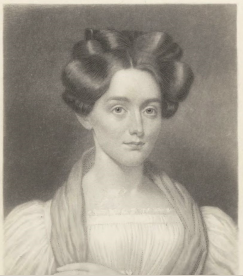
1) Eliza Grew Jones, a prolific writer and researcher of Thai language, who succumbed to cholera in 1838. [photo DCBA]. 2) Front cover of a Christian brochure in Thai language published by her husband John Taylor Jones in 1839. The American missionaries introduced printing machines in Bangkok around that time. Earlier, their religious material had to be printed in Singapore [photo of a document housed at London British Library posted on social media by Jana Igunma, 8 Sept. 2026].
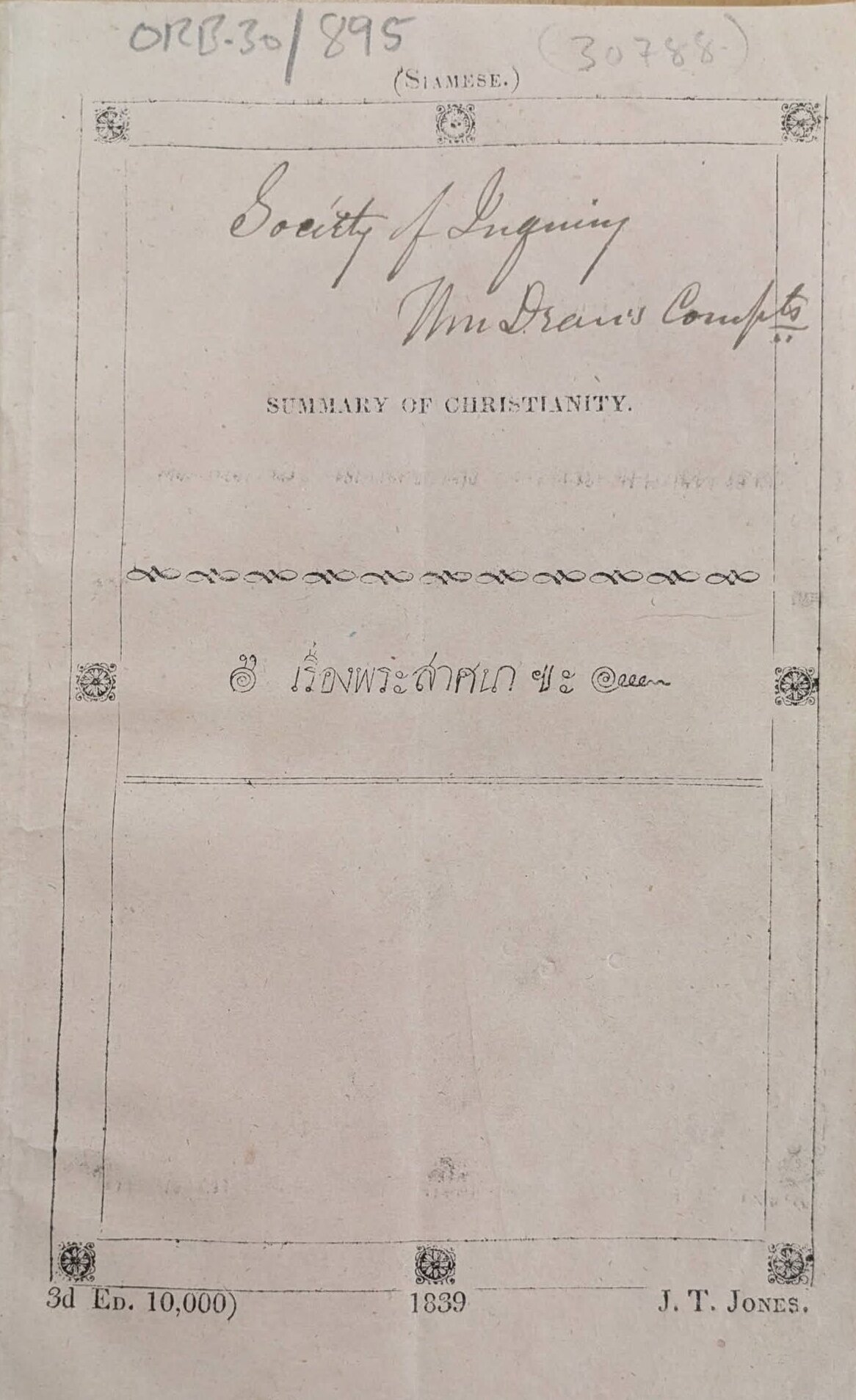
1) Eliza Grew Jones, a prolific writer and researcher of Thai language, who succumbed to cholera in 1838. [photo DCBA]. 2) Front cover of a Christian brochure in Thai language published by her husband John Taylor Jones in 1839. The American missionaries introduced printing machines in Bangkok around that time. Earlier, their religious material had to be printed in Singapore [photo of a document housed at London British Library posted on social media by Jana Igunma, 8 Sept. 2026].
1) Eliza Grew Jones, a prolific writer and researcher of Thai language, who succumbed to cholera in 1838. [photo DCBA]. 2) Front cover of a Christian brochure in Thai language published by her husband John Taylor Jones in 1839. The American missionaries introduced printing machines in Bangkok around that time. Earlier, their religious material had to be printed in Singapore [photo of a document housed at London British Library posted on social media by Jana Igunma, 8 Sept. 2026].
[2] John Taylor Jones’s wife, Eliza Coltman Grew Jones, was as formidable a woman as Mrs House or Mrs Mattoon. Born on 30 March 1803, in Providence, Rhode Island, Eliza was the eldest child of Rev Henry and Susan Grew. Before marrying John Taylor Jones (1802−1851) on 14 July 1830, Eliza served as a teacher and showed a propensity for learning languages through her study of Greek without a tutor. “The newlyleds were immediately sent by American Baptist Missionary Union first to Amherst Burma [Myanmar] then to Yangon from July 1831 to February 1832, and lastly to Bangkok, where they stayed from March 1833 to Eliza’s premature death (from cholera) on 28 March 1938,. During this short assignment, John Taylor developed the printing and distribution of Christian texts in Siamese language, while Eliza mothered three daughters — the youngest one died of cholera with Eliza -, educated in Christianity Peguan and Burman women living on the outskirts, established a day school, copied and developed a Siamese-English dictionary (most likely from the work of Gutzlaff and Tomlin) and even worked on a romanized script for Siamese.” [from Austin House, “Jones, Eliza Grew (1803−1838)”, Dictionary of Christian Biography in Asia].
Note: Eliza Grew’s handwritten copy of what is the first consistent Thai-English dictionary manuscript is indeed kept at the British Library and has been digitized in the 2010s (thanks to curator Jana Igunma for sharing this information.
in Chapter XIII, A Gambling Establishment, “by the late D. Bradley, M. D., Bangkok” [Daniel ‘Dan’ Beach Bradley (18 July 1804 – 23 June 1873), called ‘Dr Pladley’ in Thai, was the longest-serving American Protestant missionary to Siam — from 1835 until his death in 1873. Twice married, he had numerous daughters [see below]. Associated with the AMA (American Missionary Association) from 1850, he was instrumental in organizing English language courses dispensed to new King Mongkut’s wives and concubines by Eliza Jones, his second wife Sarah B. Bradley and Mary L. Mattoon, a two-day a week assignment that the King ended abruptly in 1854. Note that the issue of gambling remains a thorny one in Thailand some 150 years after these lines were written.]
I have just now returned from exploring a celebrated gambling establishment near my house. It is a floating house occupied by a Chinaman. Chinamen are the master-gamblers of Siam.
All the front of the room in which the gamblers are seated is open to the river. As you pass along you may see them in a brilliant light, sitting in two parties on the floor, and most interested in their bewitching games. Just in front is a little recess on a float, which is occupied by the musicians and play-actors. Here you will at one time hear the deafening peals of the gong, the horns through which they speak making unearthly sounds, then the grating notes of their various stringed instruments, then all together with human voices the most unmusical imaginable.
Between these play-actors and the gamblers there is a paper screen, with lamplight on the side of the performers, where a man is employed in making shadow puppet-shows for the amusement of the spectators, and no doubt contributing to the fascinating power of the gambling-shop.
There are many gambling establishments down the river, and probably many hundred in Bangkok, which are licensed by government. They afford no small amount of revenue, but they are, single-handed, undermining the pillars of this kingdom. Three days in the year the people are allowed to gamble as they please. This sin will assuredly be the ruin of this nation unless there is a speedy reformation.
Note. — “Play usually begins late in the afternoon, and lasts half the night. At one end of a Chinese gambling-saloon is often an altar, and on it a figure of the god of luck. When tired of gambling the Siamese adjourn to the neighboring theatre, where they spend an hour or two watching the Lakons’ theatrical performances, in which only girls, as a rule, take part.”
in chapter XXIII, From Bangkok to Cheung Mai, “by Mrs. Jonathan Wilson, Cheung Mai”. [Mary Wilkin Wilson, Rev. Jonathan Wilson’s wife, had arrived in Bangkok along with her husband and his mentor, Rev. Dr. Daniel McGilvary, on 20 June 1858. They started to prospect Northen Thailand and started the first Christian mission in the city of Chiang Mai in 1867, called “The Lao Mission”. [from Damrongthai Up-ngern, “Mission Journey of the Church of Christ in Thailand”, McGilvary College of Divinity in Payap University, Chiang Mai, Thailand.]
The great need of Laos is a better outlet for trade. At present these little kingdoms are practically shut in from the outside nations. There are parts of this country which can only be reached by elephant-traveling, so dense are the jungles and so difficult the passage. Missionaries laboring here are more isolated from the rest of the world than at most stations, as will appear from the following statements: There is no established line of boats going and coming, as upon our own waters, but all transporting is done by private individuals, and is only an occasional or incidental occurrence. For this reason our inland missionaries have to wait sometimes from three to five months before receiving any mail-matter from Bangkok, and in one instance Cheung Mai had no mail for eight months. At Rahang gentlemen may leave the river and complete the journey to Cheung Mai by elephant, but ladies could not endure the ride, it is such a very tiresome mode of travel. The elephant is a faithful and indispensable servant in that land of mountains. All overland transportation throughout Laos is carried on by means of elephants and oxen. Large droves of oxen are frequently seen traveling single file behind a leader decked with a mask fancifully made out of shells covering his whole face, while from between his horns a large peacock tail rises and sweeps gracefully, though comically, over his back. Each ox is laden with an immense pair of baskets thrown over saddle-bag fashion, and in these are placed the articles for transportation. Sometimes every ox is covered nearly all over with strings of little bells, which add some life to the scene. The peddlers from the north do a large trade with Siam and Laos, and the Shan caravans are almost entirely composed of these oxen, which give warning of their approach by a musical sound of tinkling bells echoing through the forest glades and from the steep mountainsides. The object of the mask upon the leader is to protect the caravan from the assaults of evil spirits. The Yunnan caravans are composed of small ponies and mules. To prevent delay from grazing along the road, a ratan muzzle is provided. Elephants also are decorated with bells to give notice of their approach to caravans coming from an opposite direction. As they tramp steadily along they regale themselves with the tender shoots of overhanging trees. When crossing a stream they generally take a trunkful of water whether thirsty or not.
In Chapter XXVII, Superstitions of the Laos, “by Dr and Mrs Cheek, Cheung Mai.” [Dr. Marion Alonzo [or Alphonso] Cheek (1853 – 1895), American medical missionary turned major teak trader based in Chiang Mai, had married on 30 Nov. 1875 Sarah Adorna Bradley (1850−1933), the daughter of early American missionaries Rev. Dr. Daniel Beach Bradley and Sarah Blachly Bradley, as well as the half-sister of Sophia McGilvary…Here again, we can see the endogamy dynamics at work amongst the closed world of American missionaries in 19th century Siam. [1]
One ceremony which was originally peculiar to the Peguans (descendants of war-captives), but has been to a considerable extent adopted by the Laos, is observed at this season. All the family connections join in having a spirit-festival. A booth is built; food and drink are provided in abundance for those who participate in the ceremony; the booth is canopied with white muslin supported by light bamboo posts, and is open all around, with arches made of cocoanut-leaves; at one side of the booth is a space partially enclosed with gay screens, in which the offerings to the spirits are placed on a table. These offerings consist of food and drink, also clothing. From the centre of the canopy is suspended a white cotton sheet. The ceremony is a dance performed only by women, who enter the enclosure, and, after partaking freely of the food — these spirits have a special weakness for pork and whiskey — bury their faces in the suspended sheet mentioned above, waiting for the descent of the spirit. The dancers do not have to wait long for the entrance of the spirit, for the whiskey has made them very sensitive to the spirit-influence; when the spirit has entered the medium begins to sway her body to and fro and to gesticulate with the hands and arms, after the fashion of Laos dancing, to the music of a Laos orchestra. Laos music is appropriate to such an occasion, for it is a combination of agonizing sounds which for harshness cannot perhaps be excelled. The spirits seem to have thirsted for a year, for the fair dancers make frequent visits to the whiskey, and even affectionately take a bottle in each hand and dance around with them, never neglecting to administer to the insatiable thirst of the spirit. After attaining to an advanced stage of intoxication the dancers array themselves in the costumes provided for the spirits — usually articles of men’s clothing — and, arming themselves with swords and spears, they stagger after intruders or acquaintances, who, if caught, must engage in the dance. This unseemly revelry continues from early morn until dark, the Laos band rendering the one favorite air without ceasing, except to take an occasional draught of the beverage sacred to the spirits.
[1] A useful repository of Christian biographical profiles in Asia: Dictionary of Christian Biography in Asia (DCBA).
Tags: American missionaries, American travelers, 1870s, 1850s, 1880s, 1890s, Bangkok, Siam, Siamese occupation, Laos, Burmese emigration, women, dancers, theater, puppet theater, gambling, Christianism, proselytism, religious propaganda, dictionaries, Thai language
![TH10C/N: Nakhon Wat. Gateway in center of Western gallery, 1866 [AC] (horizontally flipped)](https://cdn.angkordatabase.asia/imager/images/photography/photos/visions-of-angkor-by-john-thomson/20745/thomson-central-gateway-western-entrance-angkor-wat2_5ae402c9837860cd6e4f65e304b3a5fa.jpg)
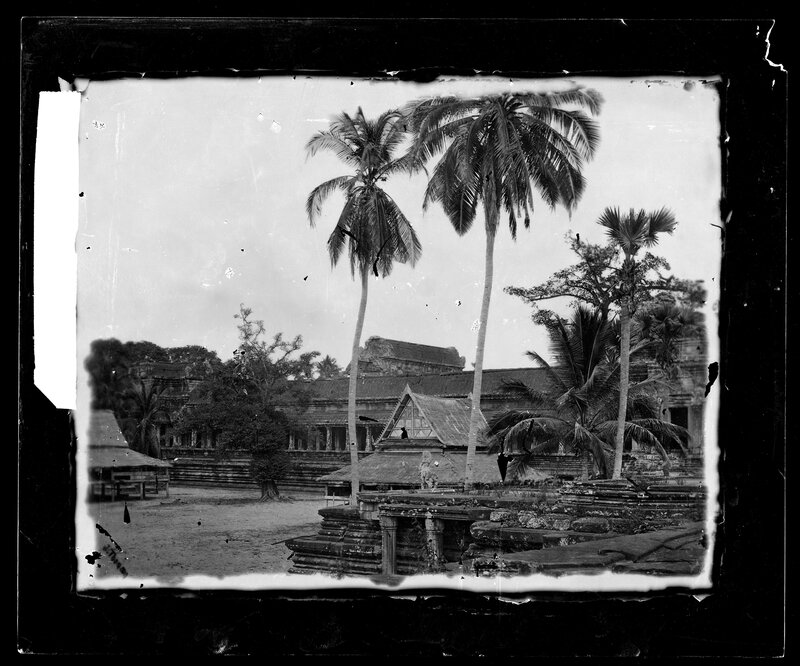

th. อยุธยา
The Ayutthaya Kingdom or Empire was a Mon and later Siamese kingdom existed in Southeast Asia from 1351 to 1767, with its center Ayutthaya city, in Siam [nowadays Thailand]. Considered as the precursor of modern Thailand.
According to traditions, the kingdom was founded by King Uthong, but the latter's origin is unclear, as he is depicted as "a Northern Thai prince, a fugitive Chinese prince from the sea, a Khmer noble from Angkor, a ruler from one of the gulf cities, or a Chola dignitary."
chs 洞 dong, "cave" | 峒 tong, "dong"
Dong is an ancient Chinese term for a mountain valley community, especially in the southern and soutwestern regions abutting to 'historic' mainland China.
In Korea, dong 동 has come to refer to a neighborhood or an administrative sub-district.
persian زنانه zanana "of the women", "pertaining to women" | urdu زنانہ | bengali জেনানা | hindi ज़नाना
A zenana is the part of a house belonging to a Muslim family in the Indian subcontinent which is reserved for the women of the household. The term zenana, a product of Indo-Islamic culture, referred to 'women's quarters' in a royal or princely palace, or in a wealthy family compound.
Western travelers applied the term to the palatial women's quarters in Southeast Asian kingdoms, along with harem. That usage didn't reflect the specific status of women in non-Muslim traditional societies of the region, where polygamy combined with matriarchal legacy.
Niṣkuṭa (sk निष्कुट) referred to either a pleasure-grove near a house or the women's apartments or housing in a royal palace.
