

Books
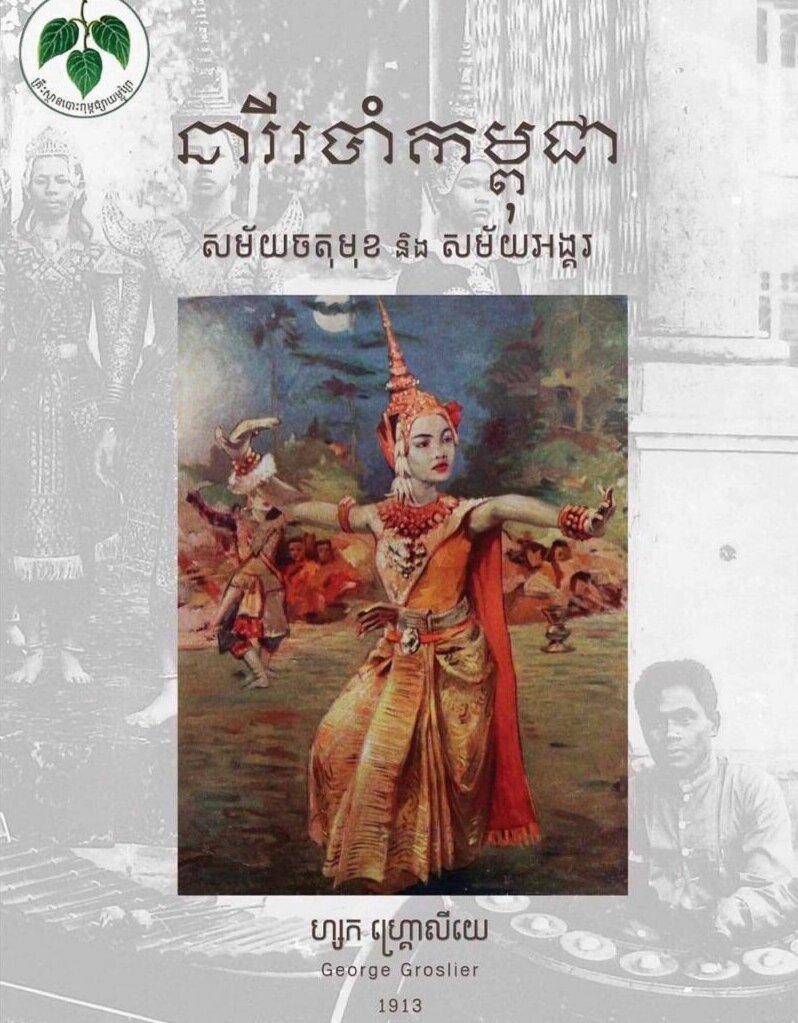
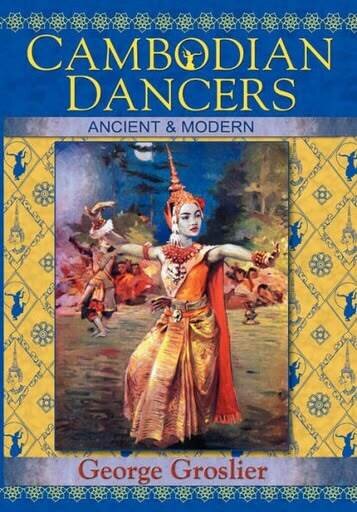
នារីរបាំកម្ពុជា សម័យចតុមុខ និង សម័យអង្គរ [Cambodian Dancers from Chatomuk and Angkor Periods, translated from George Groslier, 1913]
by Phoeurng Sackona & George Groslier
by George Groslier
A poetic yet highly informative study on the Cambodian Royal Ballet dancers written when the author, still in his prime, was discovering the cultural intricacy.

pdf 58.0 MB
The essay on Cambodian dance from Angkor to modern times was published in 1913 “sous le Haut Patronage de S. M. SISOWATH, Roi du Cambodge, de M. le Ministre des Colonies, de M. Outrey, Résident Supérieur au Cambodge, et a été honoré d’une Souscription du Ministère des Colonies” [“under the High Patronage of His Majesty Sisowath, King of Cambodia; the Minister of Colonies; Mr. Outrey, Resident Superior in Cambodia, and was honored with a Subscription from the Ministry of Colonies”. The author, initially a budding visual artist, gathered his material before and after 1910, when he went to France after being shortlisted for the Grand Prix de Rome.
Even if he was cordial with EFEO pioneer archaeologists in Cambodia such as Jean Commaille and Henri Marchal, George Groslier had started to study the Khmer inscriptions and the literature on the Indian influence in arts on his own, and to compare notes on the Angkorian temples with his friend Charles Gravelle, who was to marry Royal Ballet dancer Ratt Pos (pictured as The Golden Dancer in the book frontispiece. Gravelle, a banker, philanthropist and writer would would launch at the same period the Societe des Amis d’Angkor, wrote the preface to a volume dedicated to Groslier’s artistic mentor, Albert Maignan (1845−1908).
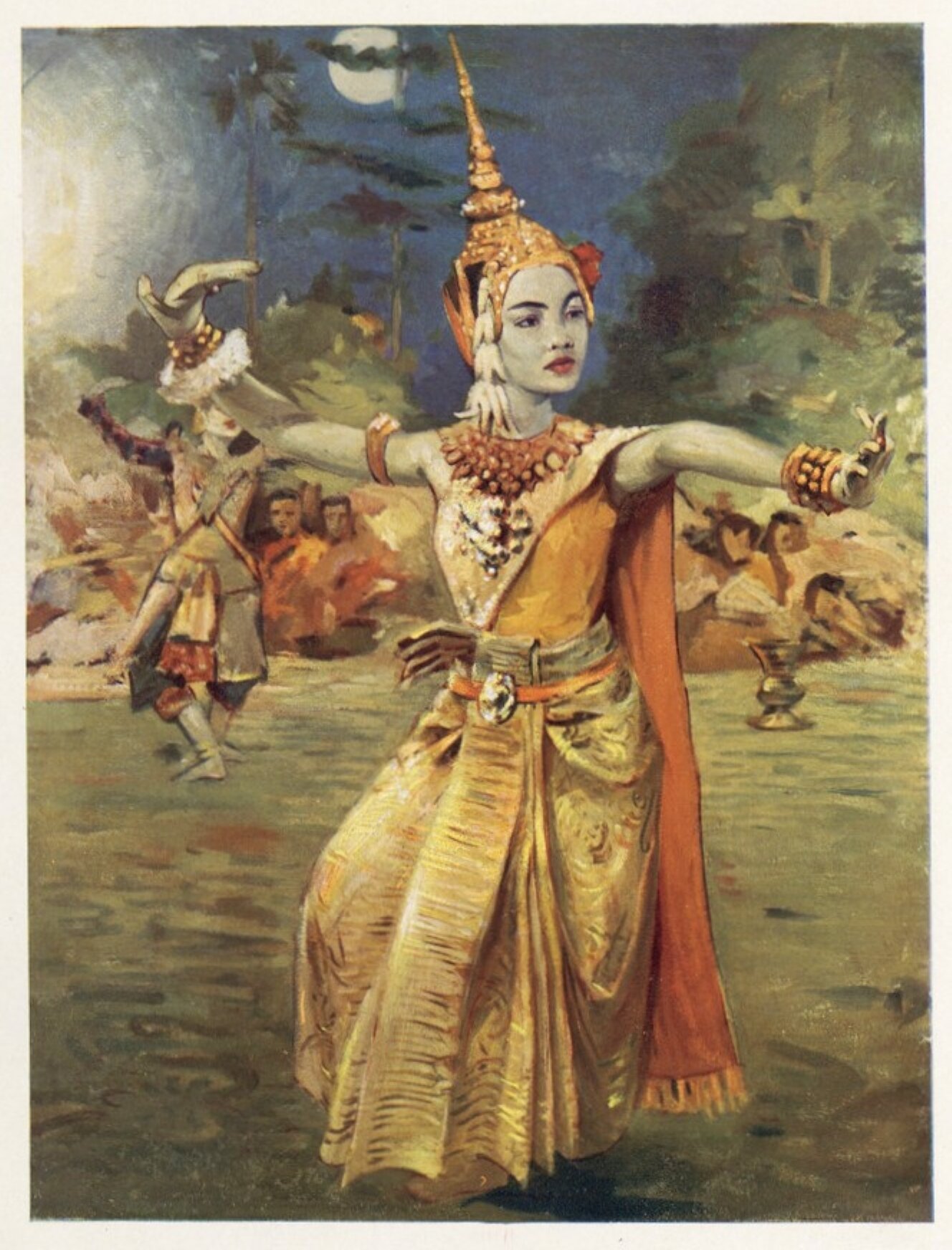
“Danseuse dorée (rôle religieux). [Golden Dancer (religious part)]. Color plate in George Groslier’s Danseuses cambodgiennes anciennes et modernes, 1913, p. 8]. George Groslier’s painting depicted Royal Ballet dancer Ratt Pos (also known as Malee ម្លិះ, 1890 – 1959) under a full moon in 1911. Ratt Pos married Charles Gravelle’s, a friend of George Groslier, in 1913.
“Danseuse dorée (rôle religieux). Hors-texte en couleurs” [Golden Dancer (religious part). Color plate, p.8]. George Groslier’s painting depicted Royal Ballet dancer Ratt Pos (also known as Malee ម្លិះ, 1890 – 1959) under a full moon in 1911. He took this painting to France in 1913 and reproduced it without any more detail in the book.
It is only in 2010 that the model’s identity came to light thanks to researcher Kent Davis who inquired with Groslier’s and Charles Gravelle’s descendants. Banker and Khmerophile Gravelle had married Ratt Pos (then 21 years of age) on 14 Jan. 1923 in Phnom Penh.
Apart from some notations in his 1921 sum on Cambodian culture, his 1928 article and his 1930 communication, that was the only occasion the author dealt extensively with the history and prospects of Khmer royal dance, accompanying his text with his own drawings. In his review, EFEO director Henri Parmentier [“G. Groslier : Danseuses cambodgiennes anciennes et modernes”, BEFEO 14, 1914. pp. 54 – 57] gently rebuked the author for his too vague references — for instance, the mere mention of “De Bellouène” when he discussed the devadasi in Angkor p. 138 -, and summed up his recension with the following admonestation: “Que M. G. serre davantage son dessin et substitue une documentation plus précise à ces épanchements poétiques qui trop souvent né nous apprennent pas grand’chose, et nous pouvons espérer que son nouvel ouvrage sera excellent”. [““If only Mr. G. tightens up his drawings and substitutes more precise documentation to these poetic outpourings which too often do not teach us much, we can hope that his new work will be excellent.”
The significance of this work — translated into English in 2012 and into Khmer in 2020 — is still obvious. Not only the book gave a sociological presentation of the centrality of dance art form at the Royal Palace at the turn of the century but it also managed to bring the actual artists, dancers, singers and actresses, to the attention of the general public. Its limitation, however, resulted more visible as the research on Khmer court dance history developed. In particular, while his demonstration is mostly aimed at showing the direct link between Angkor bas-reliefs and the aesthetics of court dance at the start of King Sisowath’s reign, thus stressing their intrinsic ‘Cambodianess’, the only piece from the Royal Ballet repertoire mentioned at length was the tale of Enao (or Inav] and Bosseba អុីណាវបុស្បា, a Javanese tale adapted as a Siamese theater-dance which was brought to Cambodia during the time of King Ang Duong — Jean Moura was the first to give an extensive translation of the plot in his book Le Royaume du Cambodge (1883).
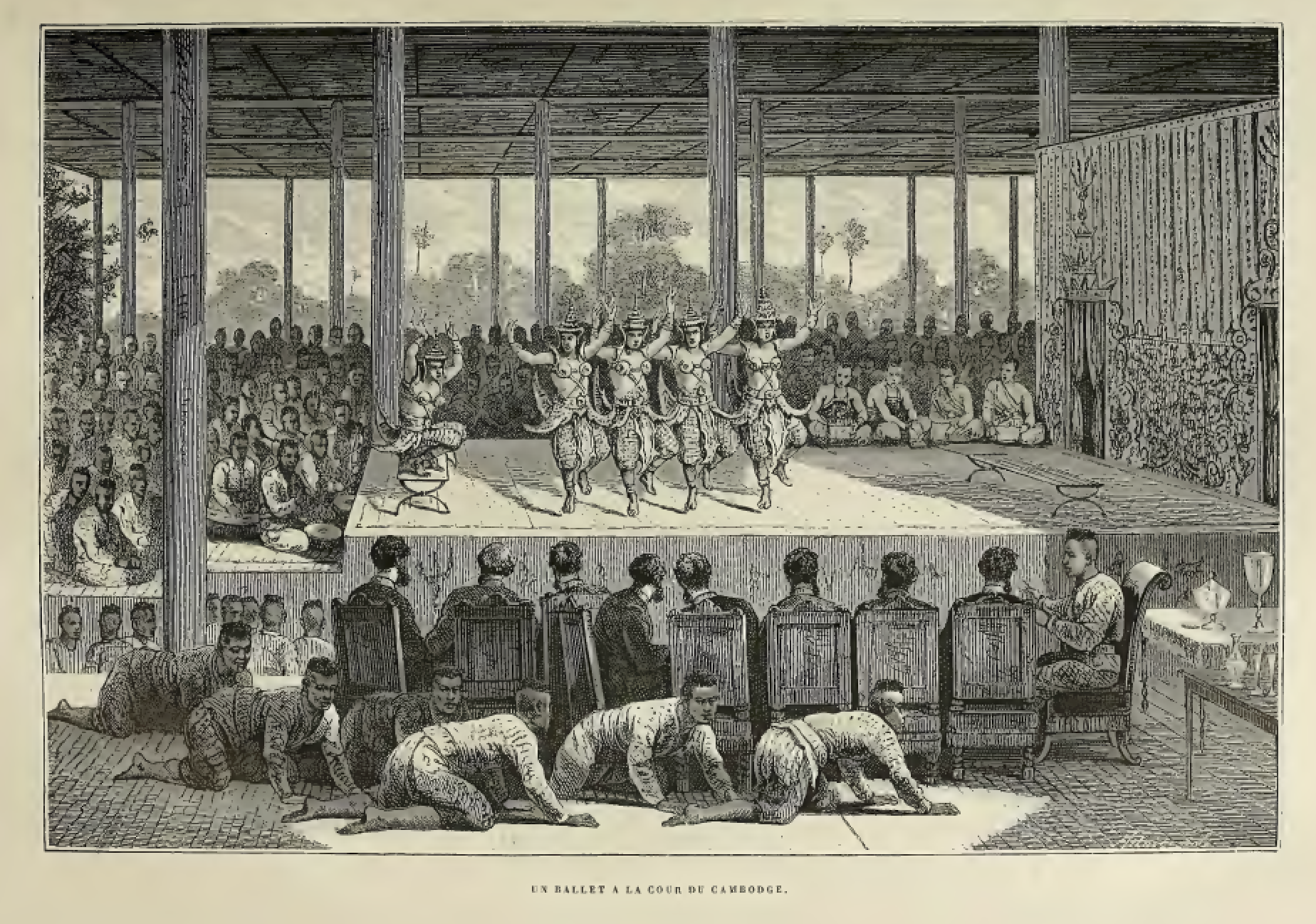
From Francis Garnier, Voyage d’exploration en Indochine, 1873.
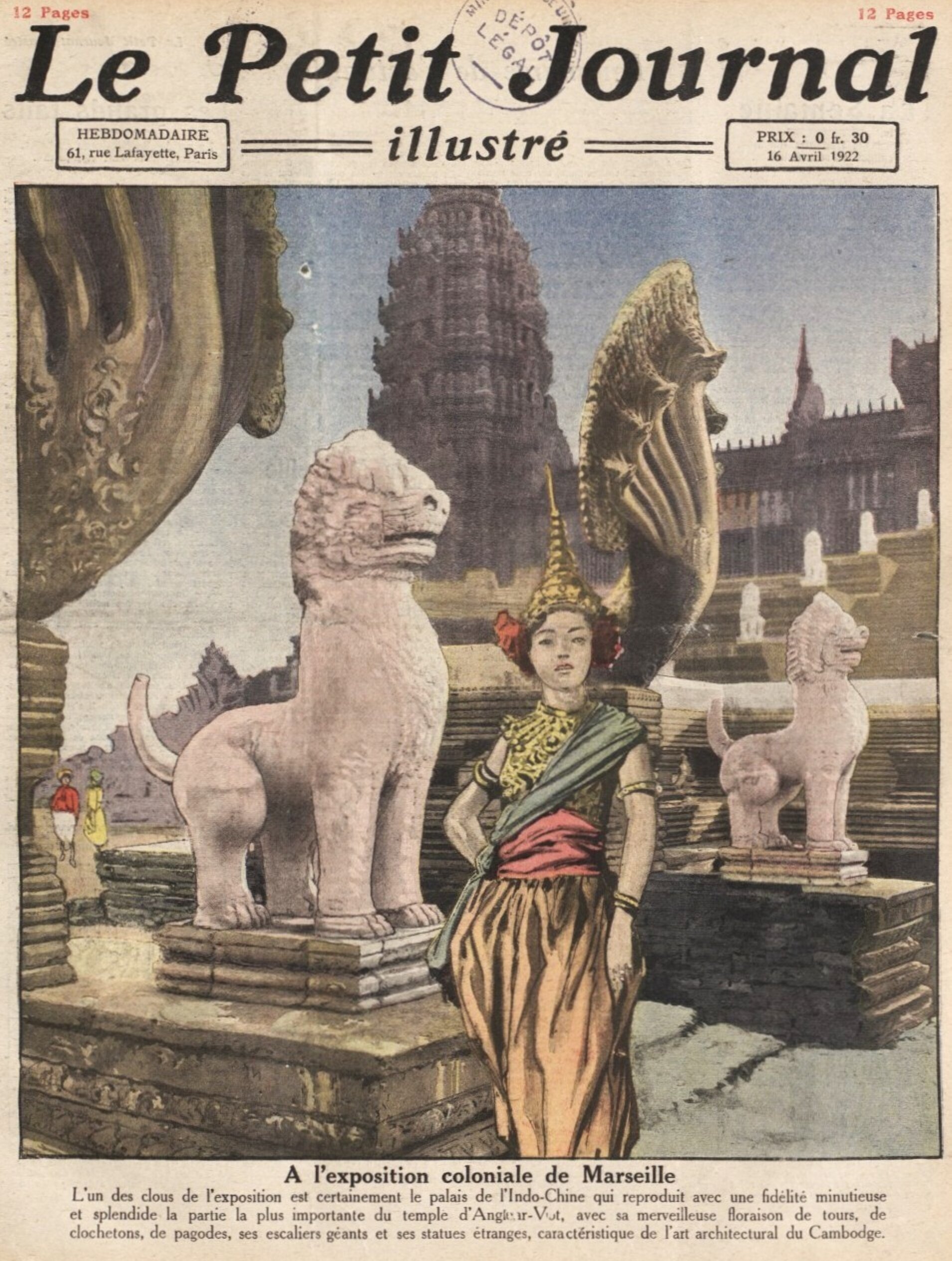
Cover of Le Petit Journal Illustré, 16 Apr. 1922, related to the Cambodian dancers at Marseille Colonial Exhibition, 1922. [via gallica.bnf.fr].
French approaches to the sacred dances of Cambodia, from gawking to romanticizing: 1) The dance hall in the newly built Phnom Penh Royal Palace as it was seen by French explorers Doudart de Lagrée and Francis Garnier in 1867 (illustration from Francis Garnier, Voyage d’exploration en Indochine, 1873). 2) Cover of Le Petit Journal Illustré, 16 Apr. 1922, related to the Cambodian dancers at Marseille Colonial Exhibition [via gallica.bnf.fr].
While studying the costumes of the royal dancers, reported an anecdot illustrating how his juvenile passion for ‘Angkorian authenticity’ clashed with the customs of Cambodian women in modern times:
Il faut connaître la pudibonderie farouche des Siamoises et des Cambodgiennes pour comprendre la répugnance qu’elles devaient avoir à paraître nues en public.[1] […] Le « mokot » khmer, celui que nous voyons sur les bas-reliefs, ornant le front des rois, est épais et lourd. Les Siamois l’effilent, l’allongent, l’étagent à l’image de leurs élégants stupa (tours). La jupe khmère des sculptures du Bayon, retournée devant, est conservée ; mais le « sampot » fait son apparition. Il né faut pas oublier que le « sampot » n’est pas le costume de la femme cambodgienne, pas plus que la petite veste blanche que nous lui voyons maintenant, qui est, elle aussi, siamoise. Le véritable vêtement khmer est le « sarong », l’écharpe ou « commin ». Quant à la longue tunique qu’elles mettent si souvent, elle est d’importation malaise. Enfin, dès 1600, date à laquelle ils étaient même au Cambodge, les Portugais introduisent au Siam les dentelles, les velours, les franges, les petits disques de métal, et ajoutent ainsi aux étoffes du pays et aux ornements rituels, les clinquants espagnols.
[1] Je né vais citerqu’un exemple. Lorsque le Résident supérieur au Cambodge organisa, en l’honneur de la visite de M. Sarraut, Gouverneur général, un défilé historique et ethnique du Cambodge, il me confia la reconstitution de quatre danseuses d’Angkor. Je n’ai pu trouver, dans tout Phnom Penh, même parmi les femmes de bas étage, quatre figurantes qui consentissentà paraître nues jusqu’à la ceinture, ainsi quelles sont représentéessur les monuments.Nous dûmes les revêtir de maillots. [P 150]
[One must be familiar with the fierce prudishness of Siamese and Cambodian women to understand their reluctance to appear naked in public.[1] […] The Khmer “mokot,” the one we see on bas-reliefs, adorning the foreheads of kings, is thick and heavy. The Siamese taper it, lengthen it, and layer it like their elegant stupas (towers). The Khmer skirt of the Bayon sculptures, turned up in front, is retained; but the “sampot” makes its appearance. It should not be forgotten that the “sampot” is not the Cambodian woman’s traditional garment, any more than the small white jacket we see on them now, which is also Siamese. The true Khmer garment is the “sarong,” and the scarf, or “commin.” As for the long tunic they so often wear, it is of Malay origin. Finally, as early as 1600, when they were even in Cambodia, the Portuguese introduced lace, velvet, fringe, and small metal discs to Siam, thus adding Spanish tinsel to the local fabrics and ritual ornaments.
[1] I will cite only one example. When the Resident Superior in Cambodia organized a historical and ethnic parade of Cambodia in honor of the visit of Mr. Sarraut, Governor-General, he entrusted me with the reconstruction of four dancers from Angkor. I could not find, in all of Phnom Penh, even among the lower-class women, four women willing to appear naked to the waist, as they are depicted on the monuments. We had to dress them in leotards. [P 150]
Le corps de ballet est placé sous la direction de la princesse, première femme du Roi. Elle en est la maîtresse absolue, ordonne les punitions, règle la discipline, surveille les répétitions, paye les soldes et assure la régularité du service de Sa Majesté. Sous Norodom, ses cinq cents lokhon étaient divisées en trois troupes. La plus belle, la plus stylée, la plus richement parée, était sous les ordres de la femme première : la princesse Khoun Tanh. Puis venait la deuxième troupe, de valeur moindre, dirigée par la femme deuxième, Khoun Préa Nieth. Enfin, la dernière, celle des élèves, avait à sa tête la princesse Man Soun.
Sous un chef tel que la princesse Khoun Tanh, une discipline de fer régnait. Le quartier des femmes que Sa Majesté visitait chaque jour, était tenu d’une propreté rigoureuse. Il y avait, dans les jardins, de grandes piscines parementées. Le corps de ballet actuel de S. M. Sisowath se compose de huit premières danseuses; de soixante-six à soixante-dix sujets et d’une quarantaine de fillettes élèves.
Une première danseuse touché trente-cinq piastres par mois ; la danseuse ordinaire, de dix à quinze piastres selon son rôle. Quant aux fillettes, leurs soldes varient de trois à six piastres. Sur ses appointements, chaque actrice prélève quatre piastres pour sa nourriture. Lorsqu’il y a séance de danse, elle touché un supplément. Il est d’une piastre pour la première danseuse; pour les rôles pénibles, les porteuses de masques, de cinquante à quatre-vingt-dix cents ; pour les sujets ordinaires, vingt-cinq cents et pour chaque fillette, vingt cents. Que de chiffres et de chiffres modestes!… Mais, à la fin de l’année, tout ce petit monde, musiciens, femmes des choeurs, habilleuses, coûte, avec les costumes, au budget royal, trente à trente-cinq mille piastres. [p. 95 – 6]
[The ballet corps was placed under the direction of the princess, the King’s first wife. She was its absolute mistress, ordering punishments, regulating discipline, overseeing rehearsals, paying salaries, and ensuring the regularity of His Majesty’s service. Under Norodom, his five hundred lokhon (female dancers) were divided into three troupes. The most beautiful, the most stylish, and the most richly adorned was under the command of the first wife: Princess Khun Tanh. Then came the second troupe, of lesser stature, directed by the second wife, Khun Preah Nieth. Finally, the last, the students’ troupe, was headed by Princess Man Soun.
Under a leader such as Princess Khoun Tanh, an iron discipline reigned. The women’s quarters, which His Majesty visited daily, were kept rigorously clean. There were large, ornately decorated pools in the gardens. The current ballet corps of His Majesty Sisowath consists of eight principal dancers; From sixty-six to seventy male actors and about forty young female students.
A principal dancer earns thirty-five piastres a month; an ordinary dancer, ten to fifteen piastres depending on her role. As for the young girls, their salaries vary from three to six piastres. From her pay, each actress deducts four piastres for food. When there is a dance performance, she receives a supplement. It is one piastre for the principal dancer; for the more demanding roles, the mask bearers, from fifty to ninety cents; for the ordinary actors, twenty-five cents; and for each young girl, twenty cents. What figures, and modest figures at that!… But, at the end of the year, this whole little world — musicians, chorus members, dressers — costs the royal budget, with the costumes, thirty to thirty-five thousand piastres.]
ADB: Here, the politics of arts combined with the art of politics, as Khun Than — Khun Than was the honorific title of Queen Nuon (1835÷1840 — after 1915), often called The Tiger Lady -, who had ceased to live on the Royal Palace premises after King Norodom’s passing in 1994, had opted to distance herself from the princes and princesses who were hostile to the tightening of French control over the Palace and the country in general. Shortly before the King’s death she succeeded in having Mam-Phiyam banished from the Palace [reported in Roland Meyer, Saramani, 1919, p. 85.]
As for Khun Preah Nheat (1844-July 1919), also known as Po Khun Prangeak, or Nhek, or Khun Gneat Youvong, another wife of King Norodom’s, she had quarreled with Khun Than over her daughter’s banishment from the Royal family when Princess Chavivann (3 Sept. 1870 — after 1942) had married in 1906 a “commoner” — yet the Minister of War and Public Education, Samdech Chakrei Pech Ponn (1867 or 1871 — 22 Nov. 1932), in 1906. [see Marie Aberdam, Élites cambodgiennes en situation coloniale, essai d’histoire sociale des réseaux de pouvoir dans l’administration cambodgienne sous le protectorat français (1860−1953), 2019.]
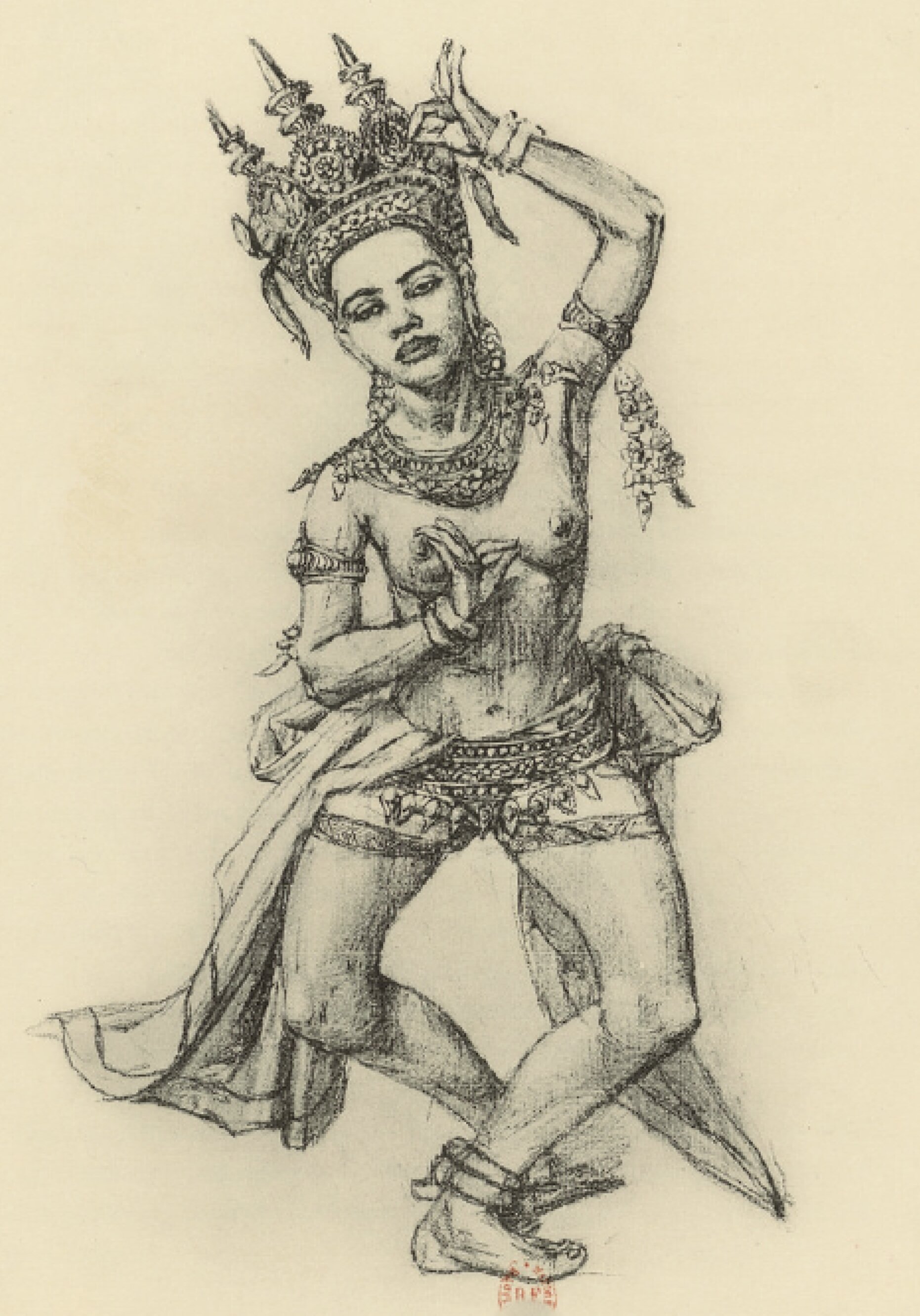
1) ‘Une Tèvada dansant. Copie et réalisation
d’un bas-relief d’Angkor Vat.’[Dancing Tevoda, copy and drawing from an Angkor Wat bas-relief’ [plate p. 132 in the book]. 2) ‘Malika. Petite princesse de légende.’ [Malika, little legendary princess] [plate p. 100].
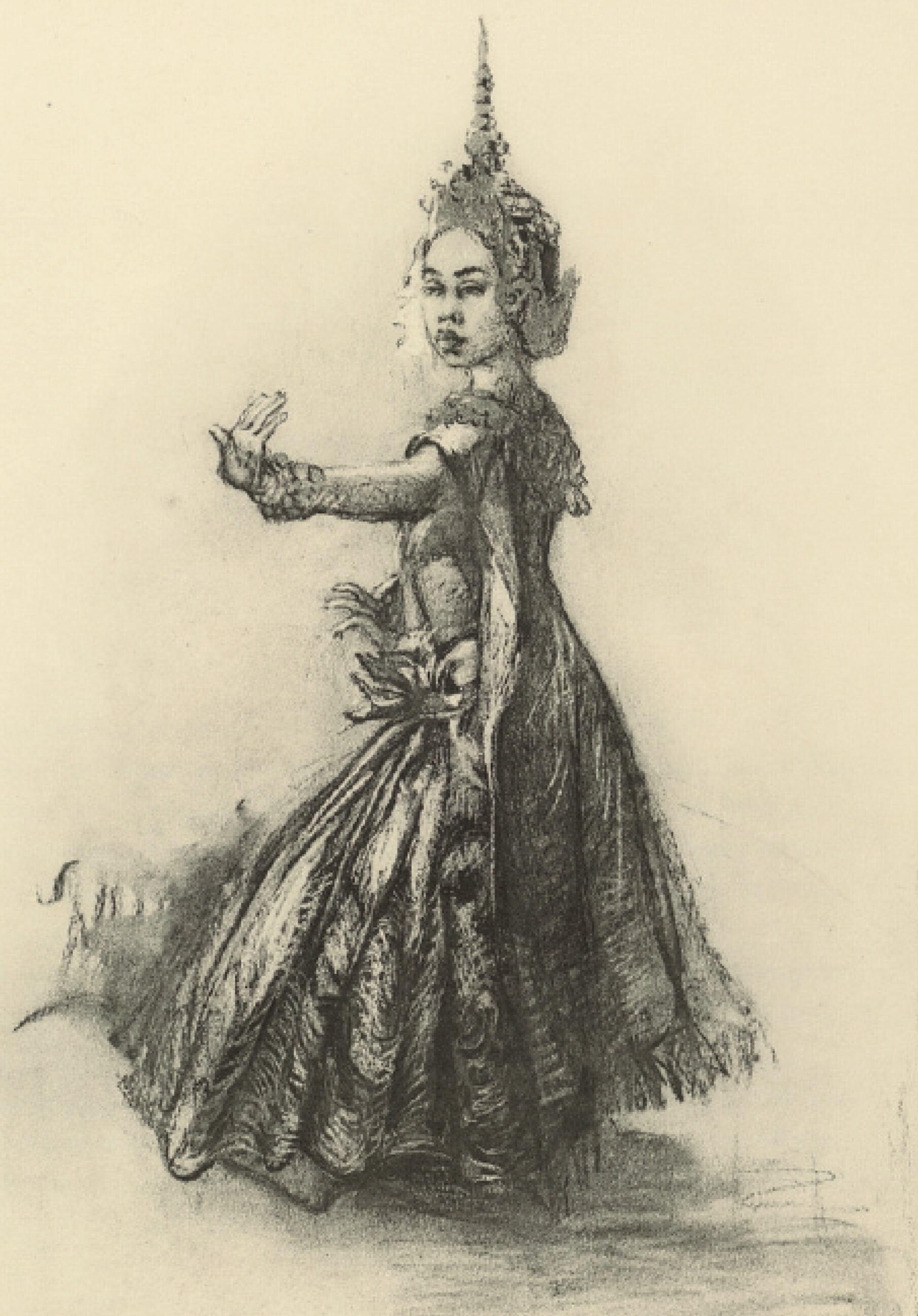
1) ‘Une Tèvada dansant. Copie et réalisation
d’un bas-relief d’Angkor Vat.’[Dancing Tevoda, copy and drawing from an Angkor Wat bas-relief’ [plate p. 132 in the book]. 2) ‘Malika. Petite princesse de légende.’ [Malika, little legendary princess] [plate p. 100].
1) ‘Une Tèvada dansant. Copie et réalisation
d’un bas-relief d’Angkor Vat.’[Dancing Tevoda, copy and drawing from an Angkor Wat bas-relief’ [plate p. 132 in the book]. 2) ‘Malika. Petite princesse de légende.’ [Malika, little legendary princess] [plate p. 100].
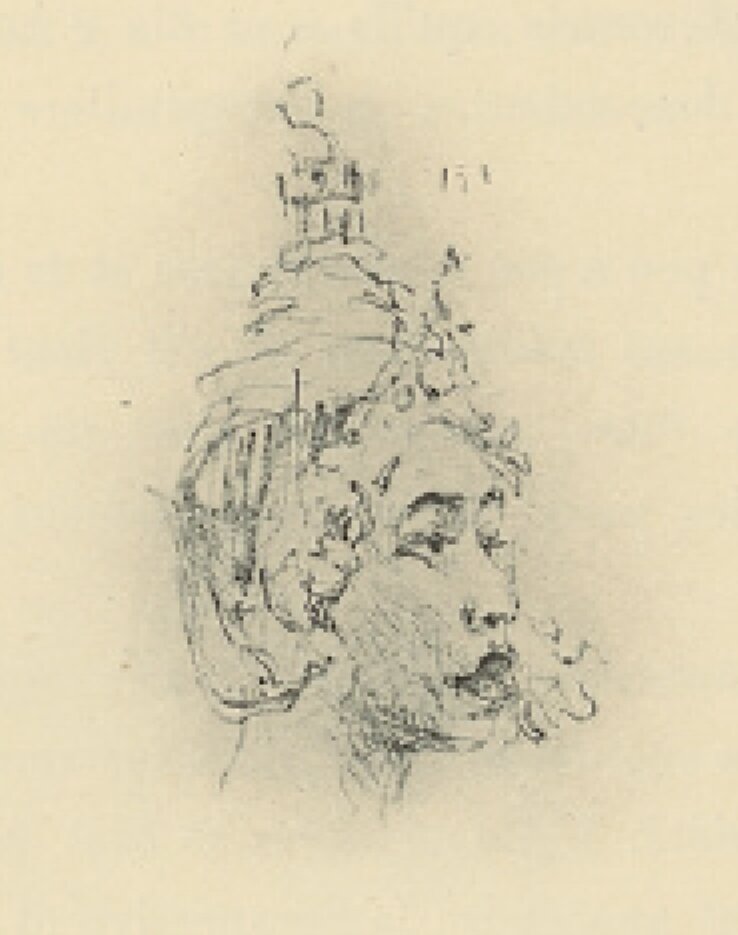
1) ‘Nou-Nham, première danseuse’ [Nou-Nam, first dancer.] The only dancer of the Royal Ballet to be namely mentioned [p 119]. 2) Another portrait of unnamed dancer, possibly Nou-Nham also. [p. 38]
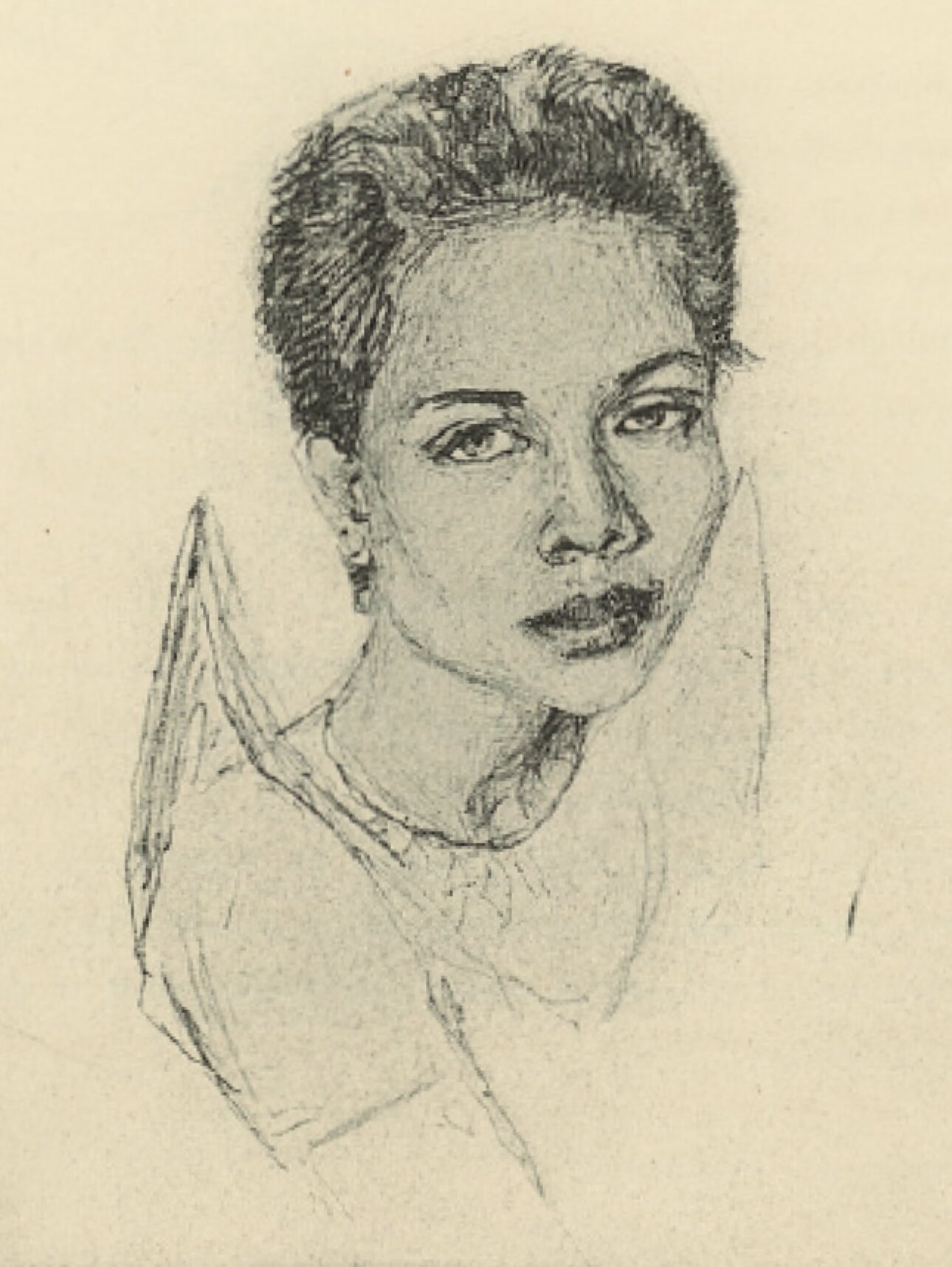
1) ‘Nou-Nham, première danseuse’ [Nou-Nam, first dancer.] The only dancer of the Royal Ballet to be namely mentioned [p 119]. 2) Another portrait of unnamed dancer, possibly Nou-Nham also. [p. 38]
1) ‘Nou-Nham, première danseuse’ [Nou-Nam, first dancer.] The only dancer of the Royal Ballet to be namely mentioned [p 119]. 2) Another portrait of unnamed dancer, possibly Nou-Nham also. [p. 38]
We also get a brief description of the Dance Hall at the Royal Palace in the 1910s, a time-honored wooden structure that would be replaced with an entirely new structure, the Phochani Pavilion or “banqueting pavilion”, built in a few months and inaugurated on 10 Sept. 1912 by Resident Superior Outrey in presence of the King, Oknha Veang (Palace Minister) Thiounn and Governor-General Albert Sarraut, who came especially from Saigon. Venerable hardwood pillars substituted by reinforced concrete provided by (André) Richaud & (Dimitri) Papa’s Société cochinchinoise de béton armé — that was another reason for the author to lament modernity’s brutal march forward…
La salle n’est qu’un toit léger supporté par de hautes colonnes ornées de guirlandes. La nuit lunaire, la belle nuit du Cambodge, douce, parfumée et translucide, est la seule muraille qui l’entoure. Et c’est de cette nuit ineffable qu’elles vont surgir, les actrices casquées d’or, comme d’un rêve, d’un passé mystérieux, du pays lointain où nos imaginations vont chercher les plus belles de leurs illusions…[p. 21].
[The hall is nothing more than a light roof supported by tall columns adorned with garlands. The moonlit night, the beautiful Cambodian night, soft, fragrant, and translucent, is the only wall that surrounds it. And it is from this ineffable night that they will emerge, the actresses in their golden helmets, as if from a dream, from a mysterious past, from the distant land where our imaginations seek their most beautiful illusions…]
The inauguration, described in detail by Ernest Ménétrier, took place during the seven days of celebrations marking King Sisowath’s 73th birthday in September 1912, with dances in both dance halls (the inner one and the ‘exterior’ one, Chanchaya Pavilion) every evening “from eight o’clock to midnight and with crowds in attendance.” Ménétrier’s article mentioned one performance in particular, “The Tale of Prince Vongsovan from the Ramayana, when the Khmer name of this piece is Rung Preah Chenavong រឿងព្រះជិនវង្ស and comes from the Khmer version of an ancient jataka [see E. Ménétrier, “La Fête du Tang-Tok à Phnom Penh”, Revue Indochinoise XVIII-10, Oct. 1912 : 334 – 45.]
Much later, while visiting Pailin circa 1925, Roland Meyer, literary portraitist of Royal Ballet dancer Saramani, would remark that “la salle du théâtre adossée à la montagne, rappelle par ses dispositions la vieille salle de danses du palais de Norodom à Phnom-Penh, démolie en 1912.” [“the theater-dance hall, built against a hill slope, reminds in its structure the ancien Dance Hall at Norodom Palace in Phnom Penh, the one that was demolished in 1912. [“Au royaume des Saphirs”, L’Eveil économique de l’Indochine, 22 Feb. 1925, p. 9]
The present author, who did not directly witness the ‘ritual dances in Angkor’ held in September 1909 during King Sisowath’s 69th birthday and his visit to the temples recently restituted to Cambodia thanks to the French-Siamese 1907 Treaty, an event reflect in the poem Niras Nokor Wat, mentioned the performance on the evening of 9 Sept. 1912 [see below]. At the Royal Palace one year earlier, he attempted to distinguish between what he thought to be the ‘religious, sacred’ aspect of dance - supposedly coming directly from Angkorian ceremonies — and court dance as entertainment:
Cette reconstitution a été faite d’après une scène de danse religieuse qui eut lieu au palais, dans la salle du trône, au mois de janvier 1911. Seize lokhon offrirent aux génies des huit points cardinaux, par leurs gestes rythmés, des fruits déposés sur des compotiers. Ayant assisté à cette danse qui s’est renouvelée trois jours de suite, au coucher du soleil, j’ai pu constater que tous les gestes des lokhon, qu’aucune parole né réglait, étaient à peu près tous semblables et dérivaient, sans exception, des trois grands gestes venus du passé. Je trouvais ainsi la vérification péremptoire de mes hypothèses.
Cette cérémonie s’est divisée en trois parties : 1° Grand salut, successivement à tous les points cardinaux; 2° offrande des fruits, successivement à tous les points cardinaux; 3° une série de gestes faits successivement face à tous les points cardinaux, et dont la signification était encore l’offrande, mais cette fois-ci sans accessoires. Tandis que cette scène se déroulait dans la salle du trône, en présence du Roi, du chef suprême des bonzes, des ministres, et de prêtres bouddhiques et brahmaniques, dans les cours, huit groupes de quatre danseuses, aux pieds de huit autels disposés aux huit points cardinaux, exécutèrent la même danse, au son de la musique commune. (Note: Une foule de Cambodgiens qui avaient apporté des offrandes étaient présents.) [p. 173]
[This reconstruction was based on a religious dance that took place in the palace, in the throne room, in January 1911. Sixteen lokhon offered fruit, placed on fruit bowls, to the spirits of the eight cardinal directions through rhythmic gestures. Having witnessed this dance, which was repeated for three consecutive days at sunset, I observed that all the lokhon’s gestures, undirected by words, were almost identical and derived, without exception, from the three main gestures of the past. This provided conclusive confirmation of my hypotheses.
This ceremony was divided into three parts: 1. A grand salute, successively to all the cardinal directions; 2. The offering of fruit, successively to all the cardinal directions; 3. A series of gestures performed successively facing all the cardinal directions, the meaning of which was again offering, but this time without props. While this scene unfolded in the throne room, in the presence of the King, the supreme leader, the monks, the ministers, and Buddhist and Brahmanic priests, in the courtyards, eight groups of four dancers, at the foot of eight altars arranged at the eight cardinal points, performed the same dance to the sound of the common music. (Note: A crowd of Cambodians who had brought offerings were present.) [p. 173]]
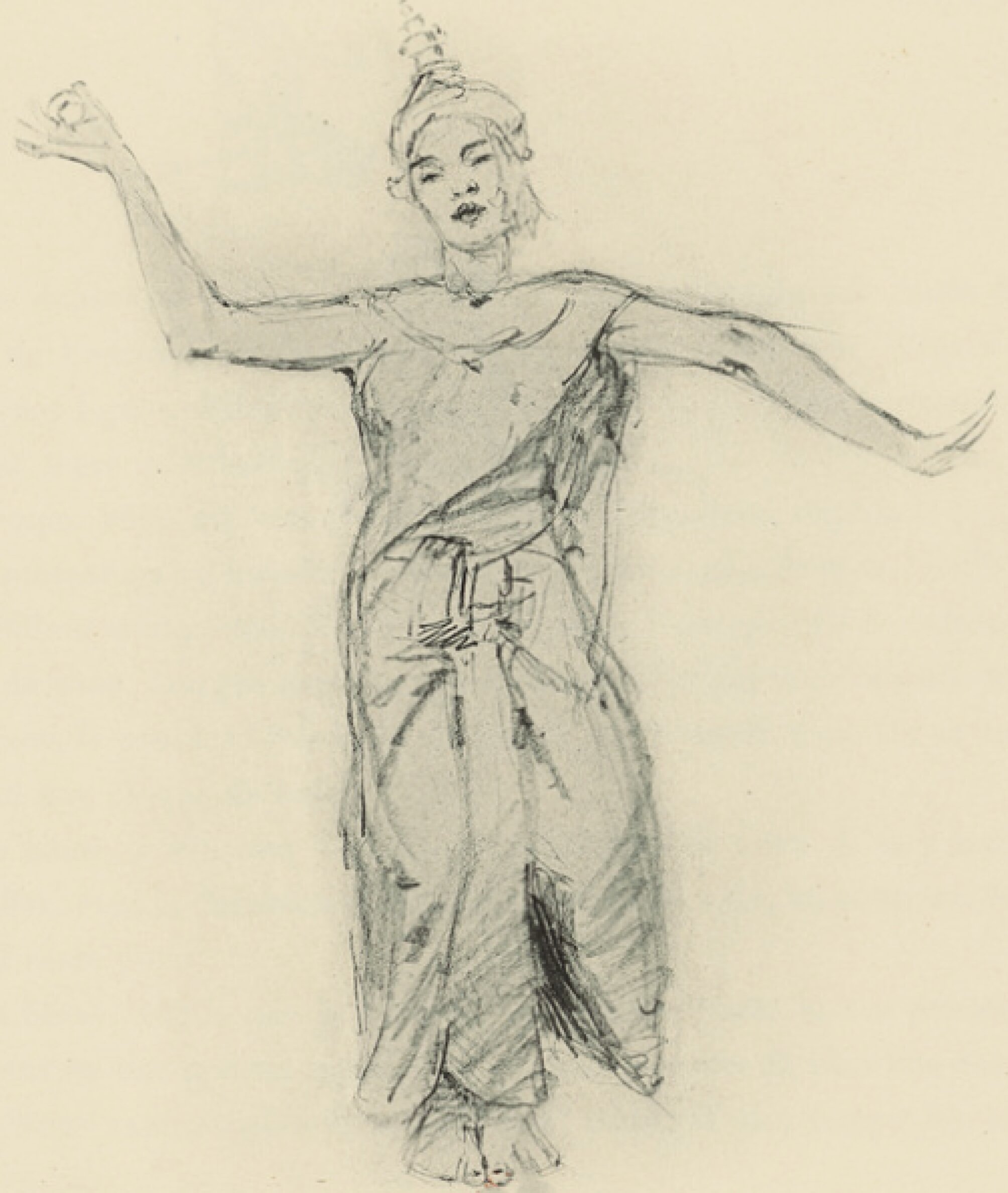
1) ‘L’ondulation du corps’ [Wavelike body] [p. 83 in the book]. 2) ‘Attitude successive au grand salut’ [Sequential gesture of the grand salute’] [plate p. 118].
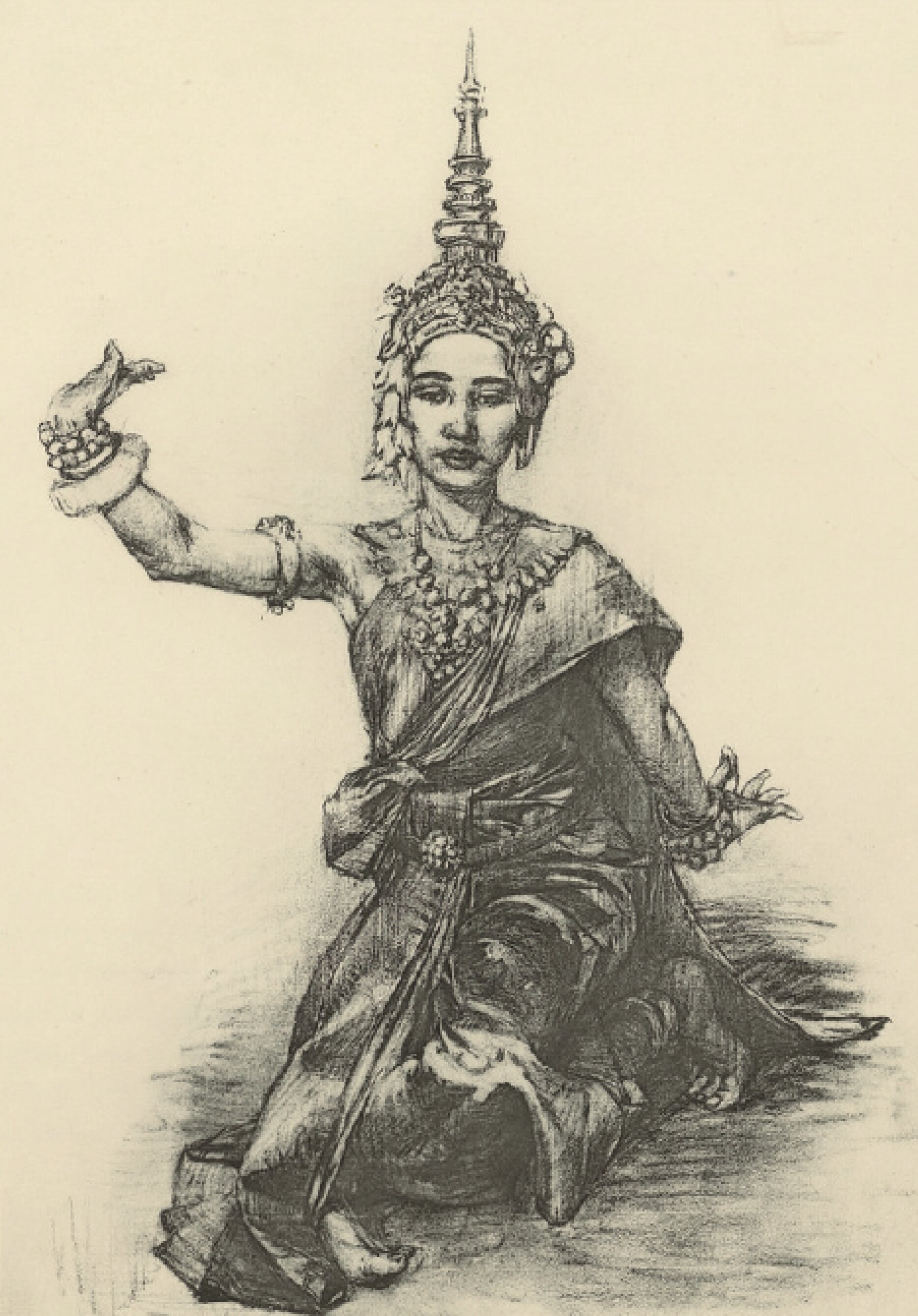
1) ‘L’ondulation du corps’ [Wavelike body] [p. 83 in the book]. 2) ‘Attitude successive au grand salut’ [Sequential gesture of the grand salute’] [plate p. 118].
1) ‘L’ondulation du corps’ [Wavelike body] [p. 83 in the book]. 2) ‘Attitude successive au grand salut’ [Sequential gesture of the grand salute’] [plate p. 118].
After mentioning Ngos [Ngoh], “l’homme laid physiquement, mais possédant toutes les qualités morales” [a man physically unattractive yet in possession of all moral virtues] [p 64], the author also stressed the essential feminity of the court dance:
La danseuse khmère est une actrice, une mime. Elle représente un personnage de légende. Elle exprime les sentiments et représente les actions que chante le choeur des femmes, assises le long d’un des côtés de la salle. Chaque phrase des chanteuses sollicite un geste ou détermine une attitude de la danseuse, toujours muette. Ces attitudes, ces gestes sont rituels, uniques et se sont transmis de génération en génération sans qu’il en existe une didactique, un modèle écrit et précis. Par exemple, chaque fois que Bosséba, déchirée du départ d’Enao, dit sa douleur de pauvre petite princesse, sa tête se penche en avant, sa main ouverte et caressante comme une aile de colombe va sécher, au coin interne de l oeil, le pleur imaginaire. Si le chagrin augmente et rend douloureux le front de l’héroïne, la main expressive passera sur ce front pour l’aider à en
contenir le tourment. [p 35]La femme-oiseau fixe sur ses hanches deux ailes rigides. Derrière elle, attachée à ses reins, s’élève une queue d’oiseau dentelée comme une flamme. Elle n’a pas d’écharpe comme la princesse, mais un maillot de couleur ardente. Sur ses seins, bombent deux petits boucliers d’or ciselés. Une courte jupe bouffe sur son sampot et un empennage garnit ses jambes. La sirène à la queue d’un poisson où des disques brillent comme des écailles. Le général, l’officier, l’émissaire subtil est couronné d’une légère et charmante couronne. Il a chaque épaule ornée d’une demi-lune d’or. Selon la circonstance, il tient un glaive ou un poignard. La suivante préférée est coiffée de petites ailes. Les esclaves ont une écharpe qui leur couvre les deux épaules, et les guerriers d’Enao, prince javanais, des turbans écarlates. A part deux bouffons qui très rarement prennent part aux ballets royaux, jamais un homme né joue de concert avec les actrices. Des présences masculines détruiraient la charmante et gracieuse harmonie. [p 66]
[The Khmer dancer is an actress, a mime. She represents a legendary figure. She expresses the feelings and embodies the actions sung by the chorus of women, seated along one side of the room. Each phrase sung by the singers calls for a gesture or determines an attitude in the dancer, who remains silent. These attitudes, these gestures are ritualistic, unique, and have been passed down from generation to generation without any didactic, written, or precise model. For example, each time Bosséba, heartbroken by Enao’s departure, expresses her pain as a poor little princess, her head bows forward, her open, caressing hand, like a dove’s wing, dries the imagined tears in the inner corner of her eye. If the sorrow intensifies and makes the heroine’s forehead ache, the expressive hand will pass over it to help her contain the torment. [p. 35]
The bird-woman fixes two rigid wings to her hips. Behind her, attached to her waist, rises a bird’s tail, its serrations like a flame. She wears no scarf like the princess, but a brightly colored leotard. On her breasts, two small, intricately carved gold shields bulge. A short, puffed skirt over her sampot, and feathers adorn her legs. The mermaid has a fish tail where discs gleam like scales. The general, the officer, the subtle emissary, is crowned with a light and charming crown. Each shoulder is adorned with a golden crescent. Depending on the occasion, he carries a sword or a dagger. The favorite attendant wears small wings. The slaves have scarves that cover both shoulders, and the warriors of Enao, the Javanese prince, wear scarlet turbans. Apart from two jesters who very rarely participate in the royal ballets, no man ever acts alongside the actresses. Male presences would destroy the charming and graceful harmony. [p 66]]
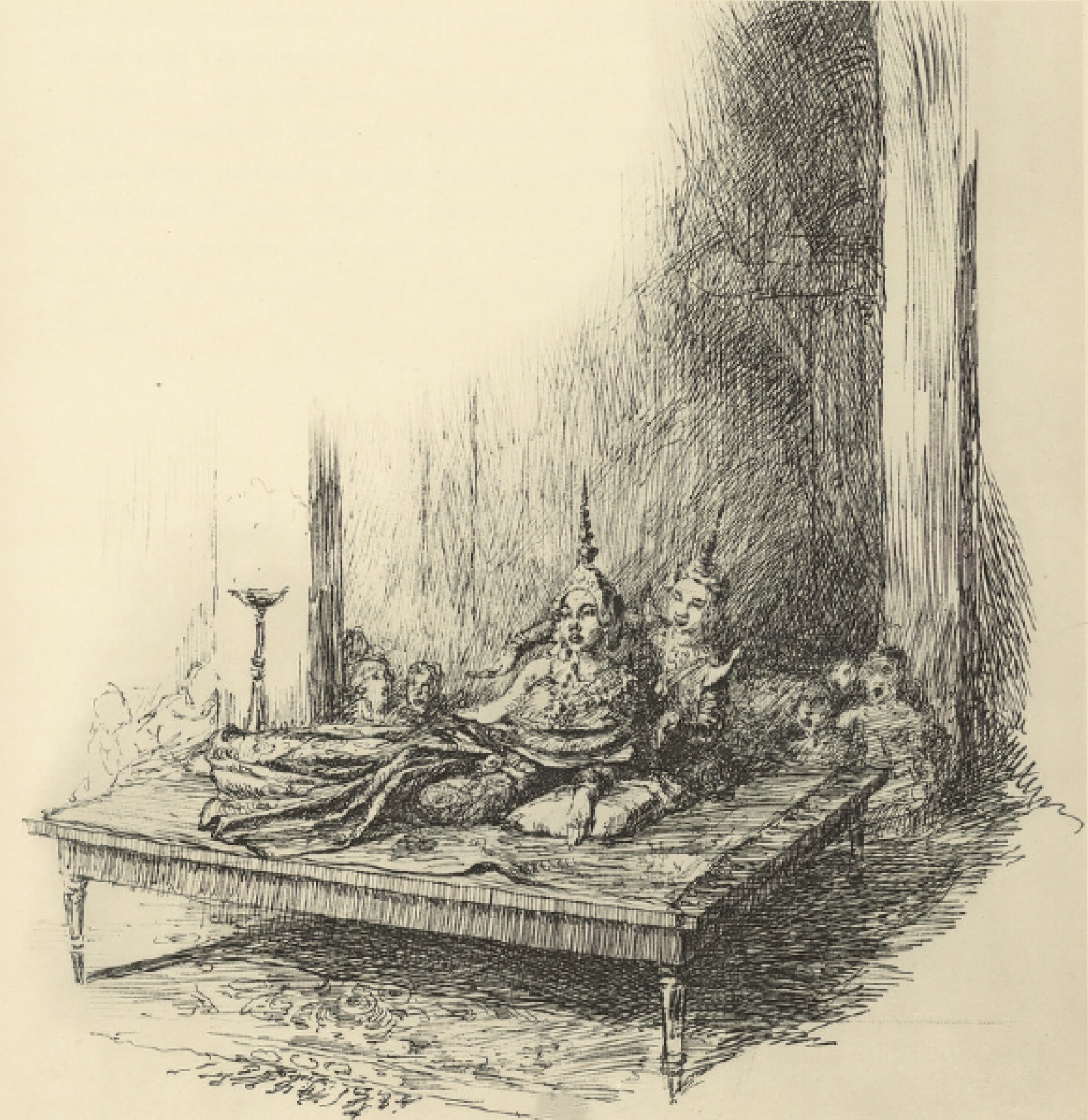
Etching by George Groslier, 1912, in Danseues cambodgiennes anciennes et modernes, 1913, p. 58.
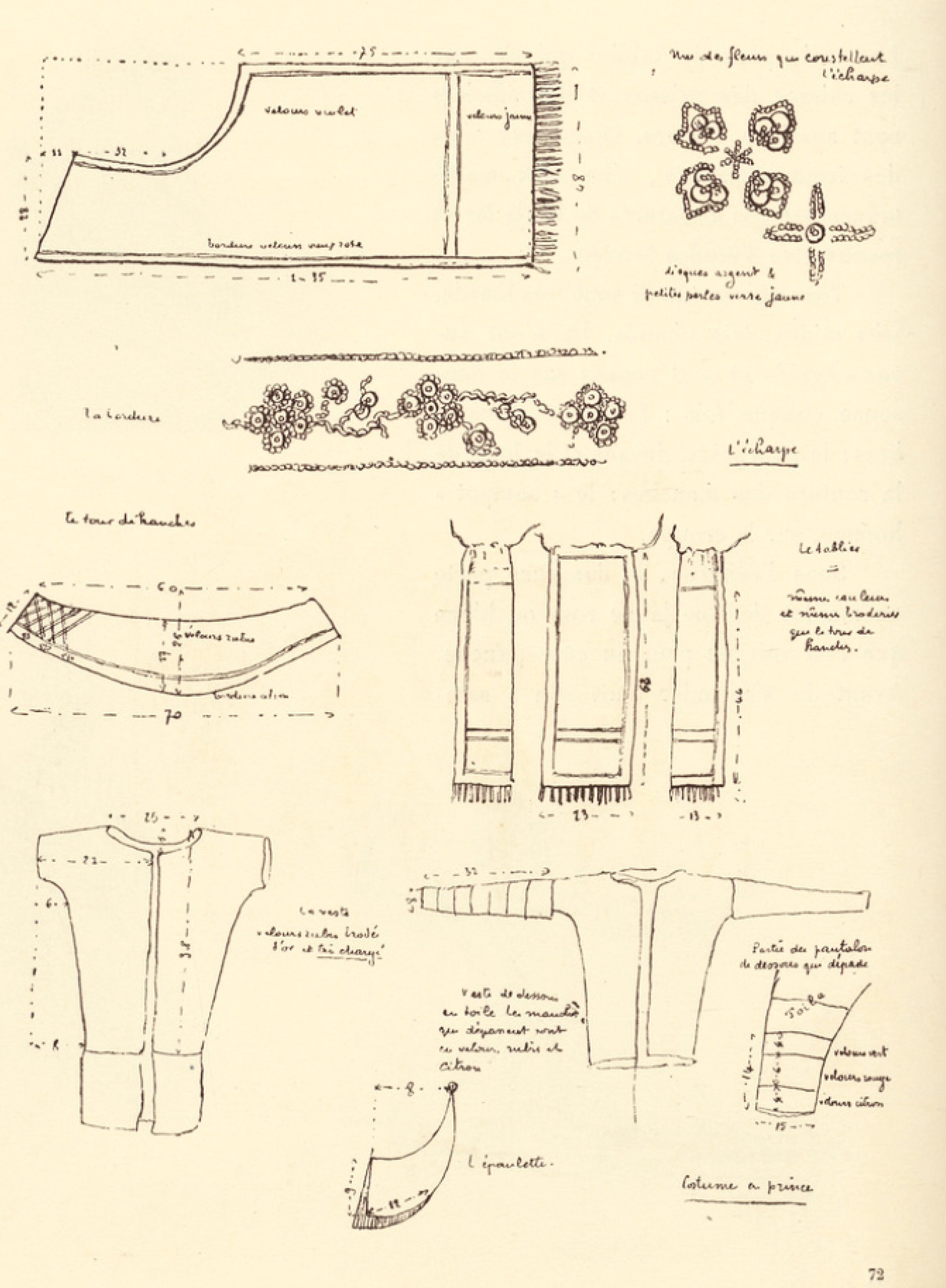
1) ‘Enao et Bosseba’ [Inav and Bosseba], etching by G. Groslier [plate p. 58 in the book]. The scene possibly came from a performance watched by the author on 9 Sept. 1912. 2) ‘Patrons de costumes et leurs mesures moyennes’ [Costume templates and their average measurements] [p. 72 in the book].
1) ‘Enao et Bosseba’ [Inav and Bosseba], etching by G. Groslier [plate p. 58 in the book]. The scene possibly came from a performance watched by the author on 9 Sept. 1912. 2) ‘Patrons de costumes et leurs mesures moyennes’ [Costume templates and their average measurements] [p. 72 in the book].
Modern historians have blamed author George Groslier for expressing a highly pessimistic, passeist view on the future of Cambodian arts, dance in particular. With hindsight, it has to be noted that the Cambodian Royal Palace at that time was going through not only architectural mutations but also social adjustements, notably in the status of women within the royal family. In addition, the colonial logics of the French Protectorate pushed for a lessening of the royal authority, and a dissociation of the sovereign from the people. The following lines have to be read through this prism:
Elles agonisent les danseuses khmères! Elles né sont plus que des ombres. Elles usent leurs derniers costumes. Les princesses vendent leurs bijoux, ou les portent au mont-de-piété. Les sculpteurs se font de plus en plus rares, les peintres royaux veulent apprendre la perspective et la peinture à l’huile ; et les femmes, sous leurs cases, à l’ombré des bananiers, né tissent plus les beaux « sampot » d’autrefois. Lorsqu’elles né seront plus, avec quoi la mariée pauvre s’habillera-t-elle, le jour de ses noces, puisque l’écharpe brodée de la danseuse que, suivant une touchante coutume, le palais prête pour la circonstance, n’existera plus? La mariée né s’habillera plus en princesse légendaire, il n’y aura plus de fête, plus rien, et ce sera très triste.
Elles meurent! Elles meurent, les traditions charmantes et les poésies de jadis!… Nos paquebots, nos automobiles apportent une fumée où se flétrissent les fleurs du champa. Bientôt, dans les nuits de fête, on né vous verra plus, actrices mystérieuses, recueillir les antiques poésies et les beautés perdues, flottantes dans l’air embaumé… Toutes les harmonies errantes depuis autrefois, et que seules vous aviez le pouvoir de retrouver et de redire, vont se perdre dans le chaos…Que vont faire l’artiste et le poète, demain, sur cette terre d’élection ? On leur dira qu’il y avait, hier encore, cent vingt vestales en qui tout le passé et tous les rites étaient déposés ; on leur dira qu’on les voyait parfois sortir de leur mystère, et danser en de splendides costumes avec lenteur et harmonie, sous un ruissellement de lumières; qu’il y avait encore des couleurs, des eurythmies, des enchantements et des rêves sur quelques coins de la terre…mais que c’est fini ! [p 120 – 1]
Mais qu’on né s’y trompe pas, ce sont bien les danseuses khmères qui reviennent du Siam. N’avons-nous pas retrouvé les gestes que celles d’Angkor faisaient, alors que les Thaï n’étaient que des esclaves? N’avons nous pas découvert que les bijoux et les costumes primitifs sont indous ? qu’elles sont filles des femmes qui vinrent du pays de toutes les légendes et de toutes les poésies?… Les scènes merveilleuses du Ramayana qu’elles jouent, né sont pas oeuvre des Thaï ! Leurs nouveaux maîtres né purent que changer leurs nobles drapés pour des oripeaux, et, parmi ces oripeaux, le plus beau, le plus noble, l’écharpe lourde, la belle écharpe flottante, n’est pas de leur invention. Son origine est plus ancienne. C’est l’écharpe que porte le Bouddha depuis qu’il prêche ; c’est le flot d’étoffe d’or que les bonzes se rejettent sur l’épaule ; c’est la stylisation du gracieux enroulement du « commin » des femmes khmères, lorsqu’elles vont adorer…
Non; ce n’est pas une étrangère, la danseuse cambodgienne, ainsi que nous avons été tenté de le croire un instant. C’est bien la petite idole khmère, le bijou perdu et retrouvé. Ce fut une enfant prodigue et abandonnée. Elle fut victime des vicissitudes de sa race. Elle peut se parer de toutes les perles étrangères, de tous les velours portugais; dès que sa main se lève et ses jambes se ploient, c’est fini : elle se détache du passé, se libère des contingences et reprend toutes les noblesses, toutes les grâces, tous les mystères dont elle est l’unique expression.
Sa destinée a été une suite d’ombres et de lumières. Elle est le seul vestige fragile du passé glorieux de son pays. Il né reste de cet autrefois si peu lointain, pas un document, pas un bijou, pas un outil. Il né reste rien, — qu’Elle! et de l’autre côté du pays : les ruines immenses d’où elle vient…Lorsque les lokhon allèrent, il y a quelques années, danser, dans la noble galerie cruciale de ces ruines, quels né durent pas être les frémissements des devadasi de pierre, quand elles discernèrent, parmi les éléments étrangers et nouveaux qu’elles né connaissaient pas et que né sacraient pas les siècles d’un passé mystique, ce qui était encore la chair de leur chair, et l’âme religieuse qui les avait animées !… [p. 152 – 3]
Ce fut la fleur de lotus, cette fleur divine qui orne les temples dont les tours sont à l’image de l’un de ses boutons; sur laquelle dort Brahma, et qui poussa — Reine et Mère d’un culte nouveau — sur le ventre de Vichnou. Et les cultes sont morts, Bouddha a chassé Brahma, et sera chassé à son tour. Les temples les plus fameux sont en ruines. Le passé le plus puissant n’est que poussière. Seule, une fragile petite main tenant une fleur reste encore…Elles s’épanouissent toujours, toutes deux : c’est par elles que le présent tient au passé. Elles en sont la formule commune. Et vraiment, dans l’histoire qui nous occupe, le présent pouvait-il être lié au passé d’une façon plus charmante et plus miraculeuse, que par cette fleur et cette main?
Nous comprenons maintenant, « lokhon » moderne, l’abstraite cadence qui t’est donnée par des instruments que ton Roi et ton peuple n’entendent pas. Nous savons d’où viennent la métaphysique de tes gestes guidés par d’impérissables volontés, et ton automatisme.
Ah! pauvre créature ignorante, tu n’es pas seulement une prisonnière, une gymnaste esclave que des professeurs firent souffrir. Il n’y a pas que l’écharpe brodée qui pèse sur ta poitrine. Tu n’as pas ton Roi seul, pour maître et pour époux. Ce n’est pas à lui, uniquement, que tu donnes le velours de tes yeux et l’ambre de ton front. Tu es soumise à tout ce qui vient du passé, tel le frêle palmier l’est aux vents accourus du lointain. Tu signifies autre chose qui n’est plus, mais qui n’est pas encore mort. Oui, nous comprenons ton étrange gravité, maintenant. Tu né sais pas, en effet, ce qui passé en toi; et tu es envahie, tu es enveloppée de toutes les lointaines poésies que nous venons de voir se lever et illuminer ta frêle silhouette… [p. 127]
The Khmer dancers are dying! They are now but shadows. They wear out their last costumes. The princesses sell their jewelry or pawn it. Sculptors are becoming increasingly rare, the royal painters want to learn perspective and oil painting; and the women, in their huts, in the shade of the banana trees, no longer weave the beautiful “sampot” of yesteryear. When they are gone, what will the poor bride wear on her wedding day, since the embroidered scarf of the dancer, which, according to a touching custom, the palace lends for the occasion, will no longer exist? The bride will no longer dress as a legendary princess, there will be no more celebration, nothing, and it will be very sad.
They are dying! They are dying, the charming traditions and the poems of yesteryear!… Our ocean liners, our automobiles bring a smoke in which the flowers of the champa wither. Soon, on festive nights, you will no longer be seen, mysterious actresses, gathering the ancient poems and the lost beauties, floating in the fragrant air… All the harmonies wandering since long ago, which only you had the power to rediscover and retell, will be lost in chaos…
What will the artist and the poet do tomorrow, on this chosen land? They will be told that, only yesterday, there were one hundred and twenty vestal virgins in whom all the past and all the rites were enshrined; they will be told that they were sometimes seen emerging from their mystery, and dancing in splendid costumes with slowness and harmony, under a cascade of lights; that there were still colors, eurhythms, enchantments, and dreams in some corners of the earth…but that it is all over! [p 120 – 1]
But make no mistake, these are indeed Khmer dancers returning from Siam. Have we not rediscovered the gestures of those of Angkor, when the Thais were merely slaves? Have we not discovered that the jewelry and primitive costumes are Hindu? That they are the daughters of women who came from the land of all legends and all poetry?… The marvelous scenes from the Ramayana that they perform are not the work of the Thais! Their new masters could only exchange their noble draperies for rags, and, among these rags, the most beautiful, the most noble, the heavy scarf, the beautiful flowing scarf, is not their invention. Its origin is more ancient. It is the scarf worn by the Buddha since he began preaching; it is the cascade of gold cloth that the monks drape over their shoulders; It is a stylized representation of the graceful coiling of the “commin” worn by Khmer women when they go to worship…
No; the Cambodian dancer is not a foreigner, as we were tempted to believe for a moment. She is indeed the little Khmer idol, the lost and found jewel. She was a prodigal and abandoned child. She was a victim of the vicissitudes of her race. She may adorn herself with all the foreign pearls, all the Portuguese velvets; but as soon as her hand rises and her legs bend, it is over: she detaches herself from the past, frees herself from contingencies, and reclaims all the nobility, all the grace, all the mysteries of which she is the sole expression.
Her destiny has been a series of shadows and light. She is the only fragile vestige of her country’s glorious past. From that not-so-distant past, not a document, not a jewel, not a tool remains. Nothing remains — but Her! And on the other side of the land: the immense ruins from which she came…
When the lokhon went, a few years ago, to dance in the noble, crucial gallery of these ruins, how great must have been the trembling of the stone devadasi when they discerned, among the foreign and new elements they did not know and which the centuries of a mystical past did not consecrate, what was still the flesh of their flesh, and the religious soul that had animated them!… [pp. 152 – 153]
It was the lotus flower, that divine flower that adorns the temples whose towers are in the image of one of its buds; upon which Brahma sleeps, and which grew—Queen and Mother of a new cult—on the belly of Vishnu. And the cults are dead, Buddha has banished Brahma, and will be banished in his turn. The most famous temples are in ruins. The most powerful past is but dust. Only a fragile little hand holding a flower remains…They both still bloom: it is through them that the present is bound to the past. They are its common formula. And truly, in the story we are considering, could the present be linked to the past in a more charming and miraculous way than by this flower and this hand?
We understand now, modern “lokhon,” the abstract rhythm given to you by instruments your King and your people cannot hear. We know the origin of the metaphysics of your gestures, guided by imperishable wills, and your automatism. Ah! poor ignorant creature, you are not merely a prisoner, a slave gymnast made to suffer by teachers. It is not only the embroidered scarf that weighs upon your breast. You do not have your King alone, as master and husband. It is not to him, solely, that you give the velvet of your eyes and the amber of your brow. You are subject to all that comes from the past, as the frail palm tree is to the winds that rush in from afar. You signify something else that is no more, but that is not yet dead. Yes, we understand your strange gravity now. You do not know, indeed, what passes within you; and you are invaded, you are enveloped by all the distant poems that we have just seen rise up and illuminate your frail figure… [p. 127]
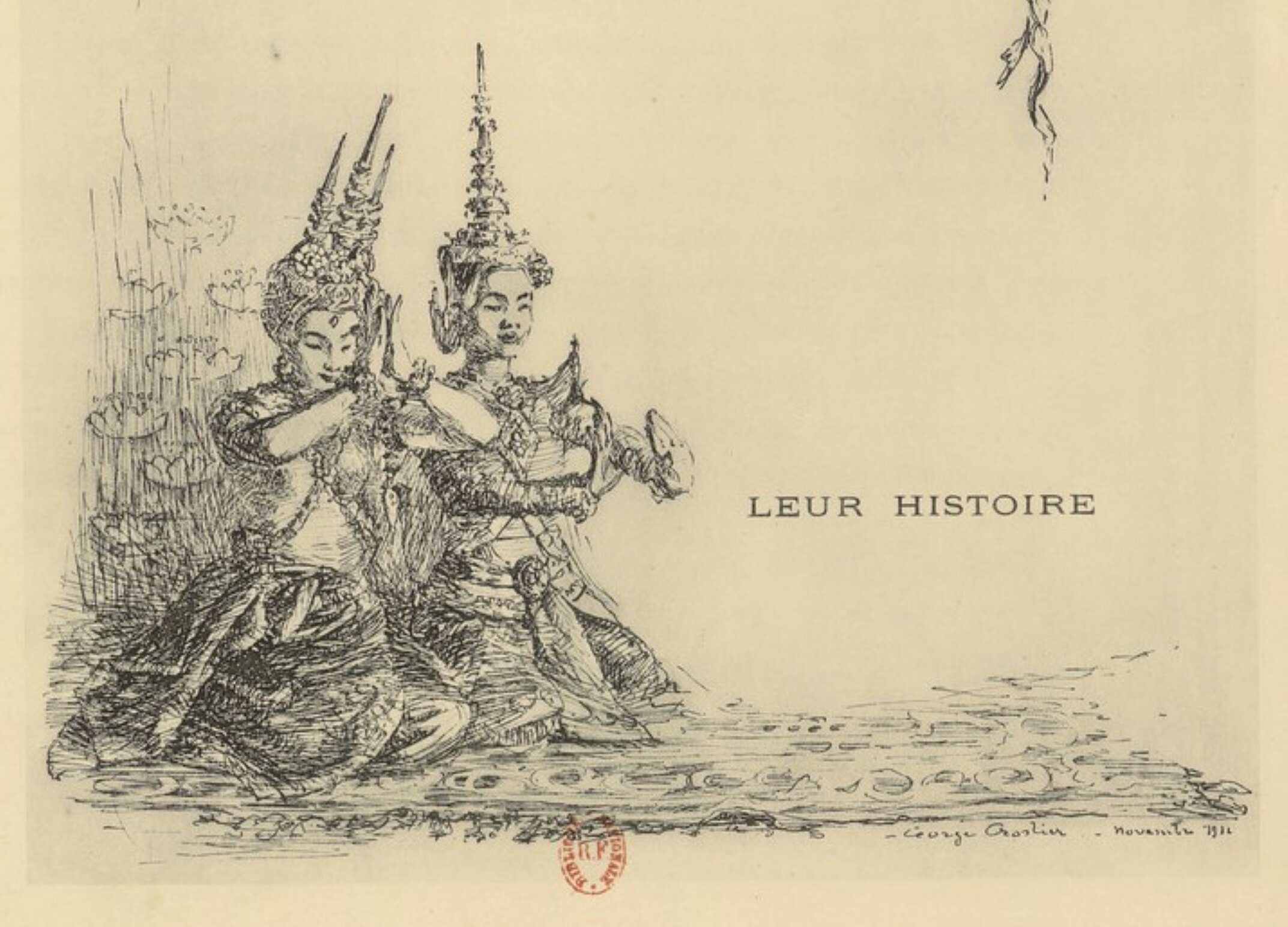
‘Une danseuse d’Angkor et une actrice moderne exécutant le grand salut’ [‘A dancer from Angkor and a modern actress performing the Grand Salute]. drawing p 122 (detail), frontispiece of chapter Leur histoire [Their History].
‘Une danseuse d’Angkor et une actrice moderne exécutant le grand salut’ [‘A dancer from Angkor and a modern actress performing the Grand Salute]. drawing p 122 (detail), frontispiece of chapter Leur histoire [Their History].
The book was dedicated to Albert Maignan (14 Oct. 1845 – 29 Sept. 1908), a French history painter and illustrator who was George Groslier’s teacher in France. Maignan is still noted for his frescoes in the foyer of Paris Opera-Comique and at the Gare de Lyon restaurant, Le Train Bleu.
Tags: dance, theater, King Sisowath, women, Khmer arts, bas-reliefs, apsara, Royal Ballet of Cambodia, tevoda, devadasi
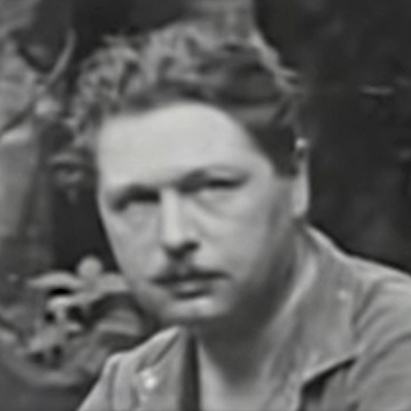
George Groslier [kh ហ្សក ហ្រ្គូសលីយេ, jp ヂョルヂュ・グロスリエ] (4 Feb. 1887, Phnom Penh — 16 June 1945, Phnom Penh), the first child with French citizenship born in modern Cambodia, was an artist, novelist, historian, archaeologist, ethnologist, architect, photographer, and the founder and curator of the National Museum of Cambodia in 1917, as well as the Ecole des arts cambodgiens (School of Cambodian Arts).
While organizing the School of Cambodian Arts (nowadays the Royal University of Fine Arts), Groslier has extensively portrayed and studied the country, its people and its traditions, in his writings, paintings and erudite communications. He founded Phnom Penh Albert Sarraut Museum in 1919, later to become the Cambodia National Museum.
On 27 May 1916, Groslier married Suzanne Poujade (8 Jun 1893, Paris — 12 Sept. 1979, Ivry-sur-Seine). She was a niece of Albert Sarraut, former Governor-General of Indochina and then French Minister of the Colonies and future Prime Minister. With Suzanne, he had three children, Nicole, Gilbert and Bernard-Philippe, the latter following his father’s steps and becoming an eminent researcher in Cambodian archaeology and history.
Independent-minded and balancing scholarly precision with artistic flair, Groslier had cordial yet sometimes tense exchanges with EFEO researchers in Cambodia. The cooperation between the Museum and the School did not survive his death, as the Ecole Française d’Extrême-Orient took over the Museum in 1945 [see Gabrielle Abbé, “Le développement des arts au Cambodge a l’époque coloniale: George Groslier et l’Ecole des arts cambodgiens (1917−1945”, Udaya 12, 2014: 7 – 39]
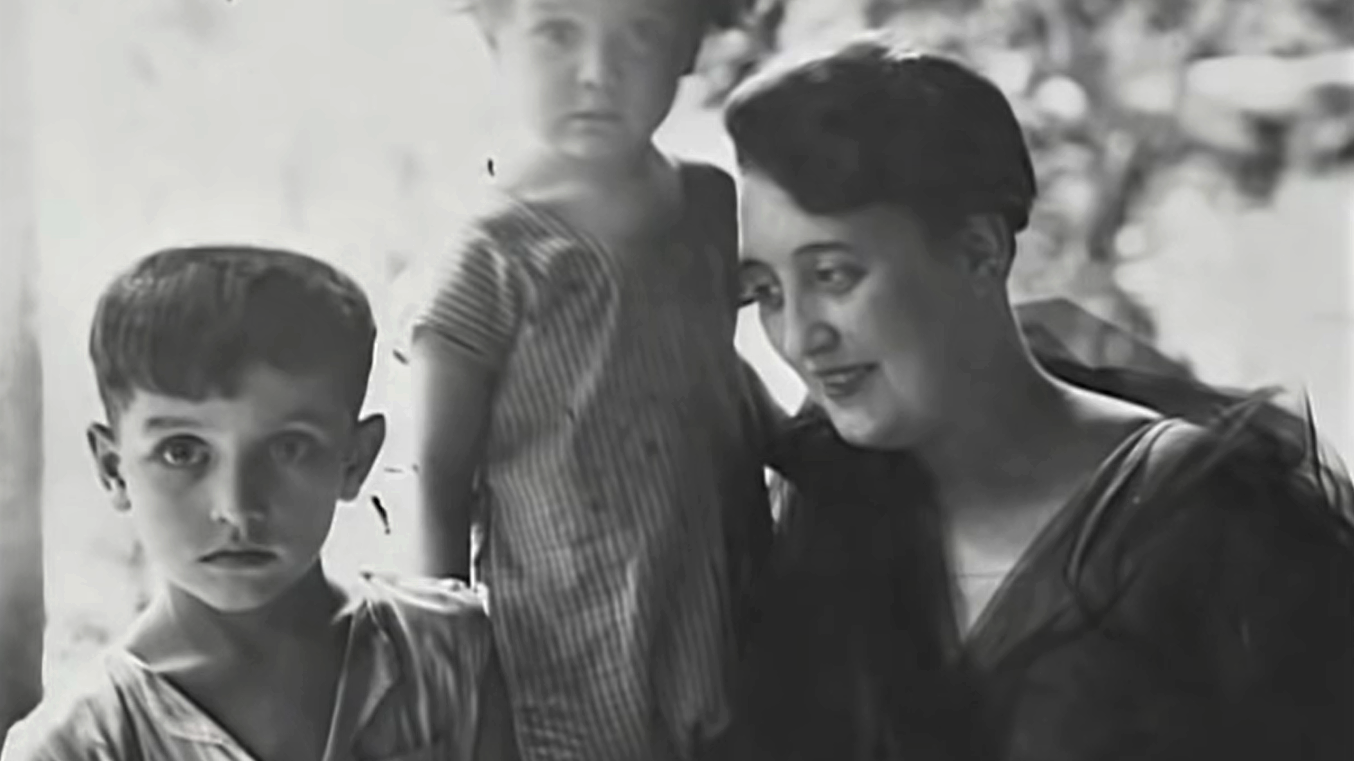
1) Suzanne Poujade and two of the Grosliers’ three children in the 1920s (EFEO). 2) George Groslier with daughter Nicole and Suzanne Poujade, far right, arrive at the Phnom Penh Museum for the 1922 visit of Maréchal Lyautey. Standing on the left side, André Silice and Jean Stoeckel, Groslier’s collaborators [photo courtesy of Kent Davis].
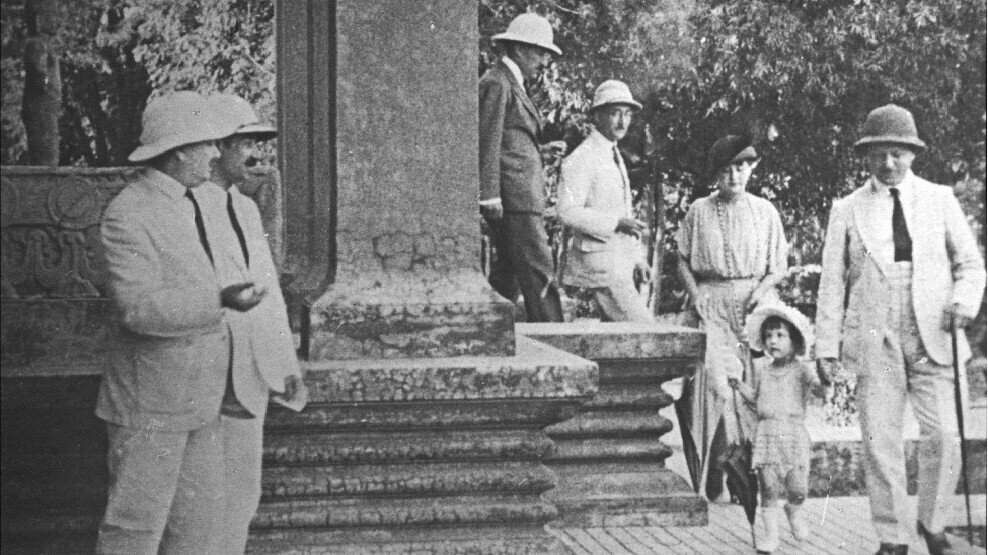
1) Suzanne Poujade and two of the Grosliers’ three children in the 1920s (EFEO). 2) George Groslier with daughter Nicole and Suzanne Poujade, far right, arrive at the Phnom Penh Museum for the 1922 visit of Maréchal Lyautey. Standing on the left side, André Silice and Jean Stoeckel, Groslier’s collaborators [photo courtesy of Kent Davis].
1) Suzanne Poujade and two of the Grosliers’ three children in the 1920s (EFEO). 2) George Groslier with daughter Nicole and Suzanne Poujade, far right, arrive at the Phnom Penh Museum for the 1922 visit of Maréchal Lyautey. Standing on the left side, André Silice and Jean Stoeckel, Groslier’s collaborators [photo courtesy of Kent Davis].
George Groslier was detained and tortured by the Japanese forces when Japan, a former ally of Petain’s French government, occupied vast swaths of South East Asia. Le Journal de Saïgon (7 Dec. 1945) reported six months after his death:
“Le 9 mars 1945, Georges Groslier était hospitalisé ; rétabli, il habite le camp où il rédige pour lui un journal de l’occupation japonaise. Le 1er juin, une rechute l’oblige à rentrer à nouveau à l’hôpital. Le 16 juin, il est arrêté par les Japonais, sorti de son lit et conduit à la Gendarmerie japonaise. Interrogé, torturé, il meurt à la suite du supplice de l’eau. Incinéré, ses cendres sont remises le 22 juin à sa famille. Déposé à la chapelle de l’Évêché, l’urne funéraire en sort le 25 juin pour être transportée au cimetière. Les dirigeants du camp français obtiennent des autorités japonaises que l’urne traverse le camp français et que 20 Français soient autorisés à sortir du camp pour l’accompagner au cimetière. Le matin du 25 juin, à 8 heures, le petit cortège traverse le camp, tous les Français sont rangés sur son parcours : dernier hommage à une noble victime.”
[“On March 9, 1945, Georges Groslier was hospitalized; after he recovered, he lived in the camp where he wrote a diary of the Japanese occupation. On June 1, a relapse forced him to return to the hospital. On June 16, he was arrested by the Japanese, taken from his bed, and taken to the Japanese military police. Interrogated and tortured, he died following the water torture. Cremated, his ashes were given to his family on June 22. Placed in the chapel of the Bishopric, the funeral urn left on June 25 to be transported to the cemetery. The leaders of the French camp obtained from the Japanese authorities that the urn cross the French camp and that 20 French people be authorized to leave the camp to accompany it to the cemetery. On the morning of June 25, at 8 a.m., the small procession crossed the camp, all the French people lined up along its route: a final tribute to a noble victim.”
Later, George Groslier’s ashes were transferred to France by his family, and have been interred in the family crypt in the 2020s.
George Groslier’ scientific and artistic contribution to Khmer archaeology and cultural history is celebrated, as well as his committment to protect the Cambodian cultural heritage — for instance when he successfully prevented André Malraux to take abroad the spoils of his plundering of Banteay Srei temple. Researcher Kent Davis has described him as ‘Le Khmerophile’ par excellence in the most complete biographical work about him, and has edited the English translation of five of Groslier’s major contributions (all published by DatASIA Press). Recent works by young researchers, however, have claimed that his official responsibilities somehow submitted him to the French colonial system, and his often pessimistic outlook of the “decline of the Cambodian arts” played along with the colonial system.
Nevertheless, his important photographic work on the rehearsals of the Royal Ballet dancers in 1927 has been restored and presented to the public in 2019. His statue still remains pre-eminent at the National Museum, and the debate around the validity of giving back the name of Rue Groslier (Groslier Street) to the lane accessing the Museum was still ongoing in the 2020s [see here].
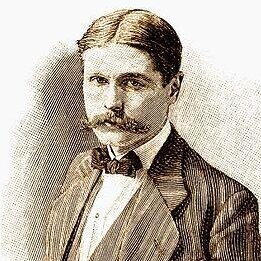
1) George Groslier portrayed in French journal Femina, 1913 [bnf.fr]. 2) That same year, 1913, at Prasat Preah Vihear. [from Kent Davis, Le Khmerophile, 2006]. 3) Holding a Khmer Prajnaparamita statue at his desk in 1926, by Martin Hürlimann (© National Museum of Cambodia).
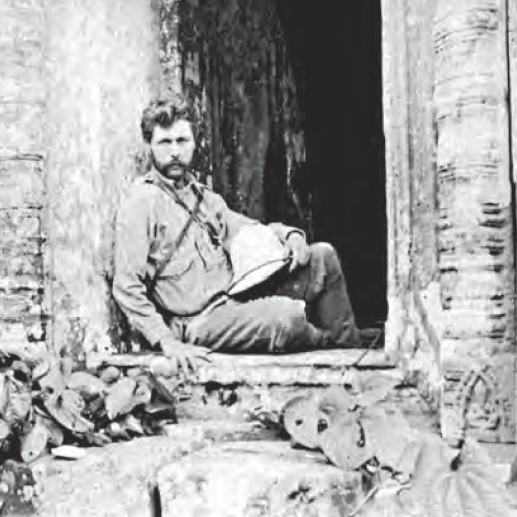
1) George Groslier portrayed in French journal Femina, 1913 [bnf.fr]. 2) That same year, 1913, at Prasat Preah Vihear. [from Kent Davis, Le Khmerophile, 2006]. 3) Holding a Khmer Prajnaparamita statue at his desk in 1926, by Martin Hürlimann (© National Museum of Cambodia).
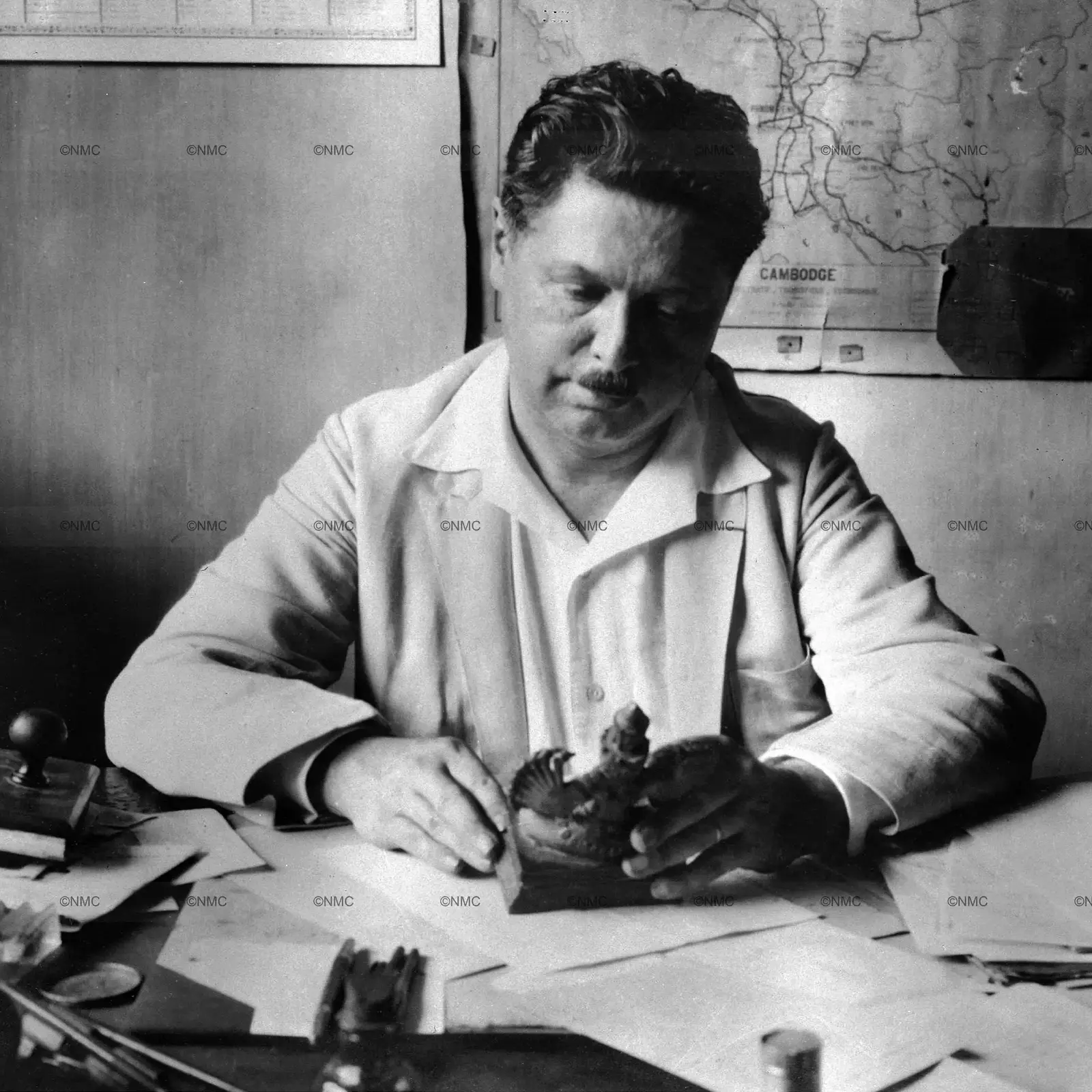
1) George Groslier portrayed in French journal Femina, 1913 [bnf.fr]. 2) That same year, 1913, at Prasat Preah Vihear. [from Kent Davis, Le Khmerophile, 2006]. 3) Holding a Khmer Prajnaparamita statue at his desk in 1926, by Martin Hürlimann (© National Museum of Cambodia).
1) George Groslier portrayed in French journal Femina, 1913 [bnf.fr]. 2) That same year, 1913, at Prasat Preah Vihear. [from Kent Davis, Le Khmerophile, 2006]. 3) Holding a Khmer Prajnaparamita statue at his desk in 1926, by Martin Hürlimann (© National Museum of Cambodia).
[based on “Works by George Groslier”, in Cambodian Dancers Ancient and Modern, Kent Davis (ed.), Holmes Beach (USA), DatASIA, 2011: 298 – 303.]
sk देवदासी devadāsi, 'maid-servant to gods' | kh ទេវទាសី tevatesei, 'god's maid', 'slave woman'.
Devadāsī referred in Ancient India to a lady involved in the worshipping of gods and goddesses. Specifically, a dancing girl attached to a temple; a female temple-servant. Equivalent to vilāsinī, gaṇikā, mahārī.
In modern India, the term was used to refer to 'courtezans', women dedicating themselves to sacred prostitution. Particularly in Southern India, devadasi were respected members of the community until the British colonial administration made the status unlawful.
In colonial India, devadasi were often confused with the nautchny or nautch girls, performers of a court dance of Hindustani origin which appeared in the last decades of the Mughal Empire. 'Nautch' was a British corruption of the Bengali word নাচ Nāca, "dance".
sk जातक jātaka “science of astrology" pl "birth story" | kh ជាតក cheatk 'jataka'
Initially the study of horoscope, the term Jātaka evolved into the Buddhist notion of "birth story", in particular stories related to the former births of the Buddha, and later to the birth of who is destined to be a Buddha in the future.
Written around the 3d century CE, the Jataka was a vast compendium of folk tales and mythic literature, primarily associated with the Theravada Buddhist tradition written in Pali. Telling the stories related to the birth of the Buddha became one of the nine types of teaching (sūtra) as defined in the Dharma-saṃgraha.
In Cambodian Buddhist tradition, it includes stories (រឿងរ៉ាវ rungreav) of edifying past experiences, such as 'the ten stories', as told by the Buddha Sakyamuni ('All-Knowing').
kh: ឧកញ៉ា angk: uk-na | in ancient vn texts: Ốc nha (屋牙)
sk स्तूप, stupa, "heap" | pa thupa | kh ចេតិយ chedi, cha-dey | th เจดีย์ cedyi, "stupa", "mausoleum".
A Buddhist mound-like or hemispherical structure containing relics, originally from the Buddha or from Buddhist monks or nuns, in modern times the remains of distinguished departed people, where one can come to meditate.
Thought to be derived from the ancient ritual of building tumuli, the stupa was designed to allow circumambulation [pradakhshina] around the structure, as seen until these days at Shewanagon Pagoda (Myanmar), the Abayagiri Dageba (Sri Lanka) or Borobodur Temple (Indonesia).
In Cambodia, royal stupas in pagodas (Oudong, Wat Ounalom, Wat Phnom...) and at the Royal Palace (Kantha Boppha chedi, King Suramarit...) have a distinctive style, different from Thai cedyis. In Khmer, the word originally meant "sign" [of a sacred place], and went to refer only to a structure containing relics.
