Books
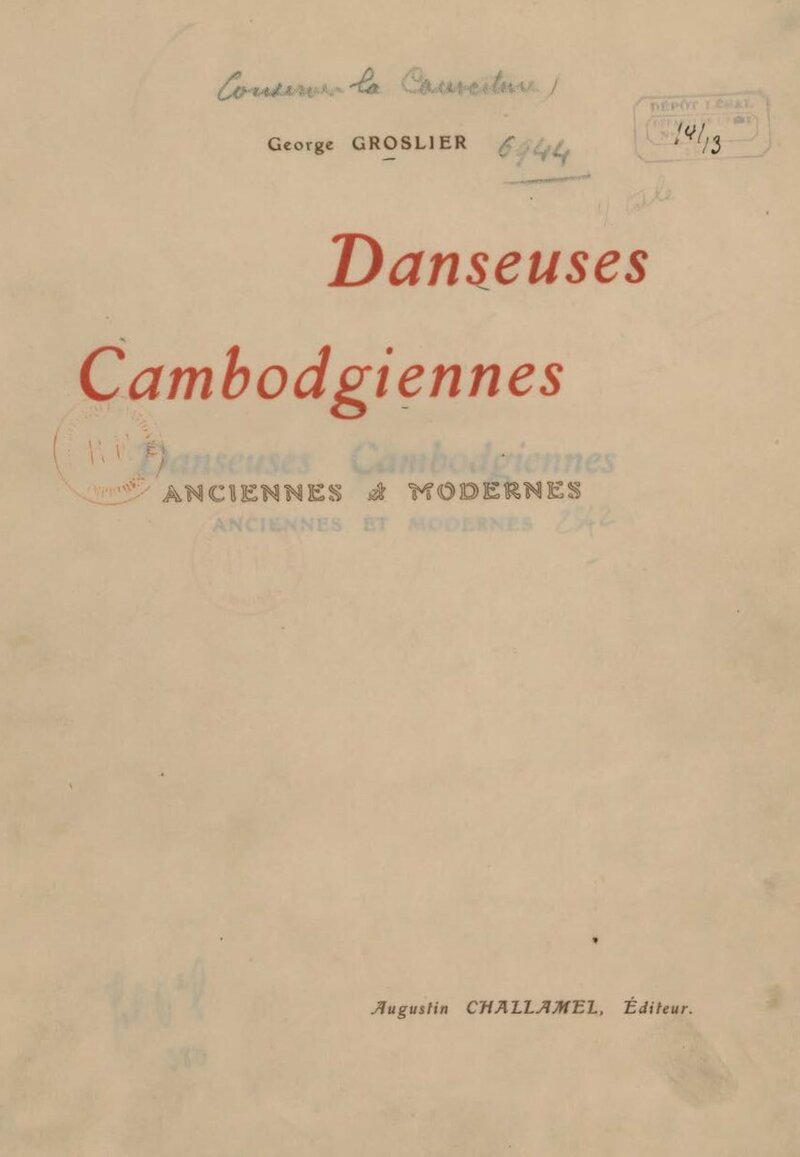
Danseuses cambodgiennes anciennes et modernes
by George Groslier
by Jules Gervais-Courtellemont & Octave Vandelet
A richly illustrated journey through Indochina, and in particular Cambodia in the early years of the French Protectorate.

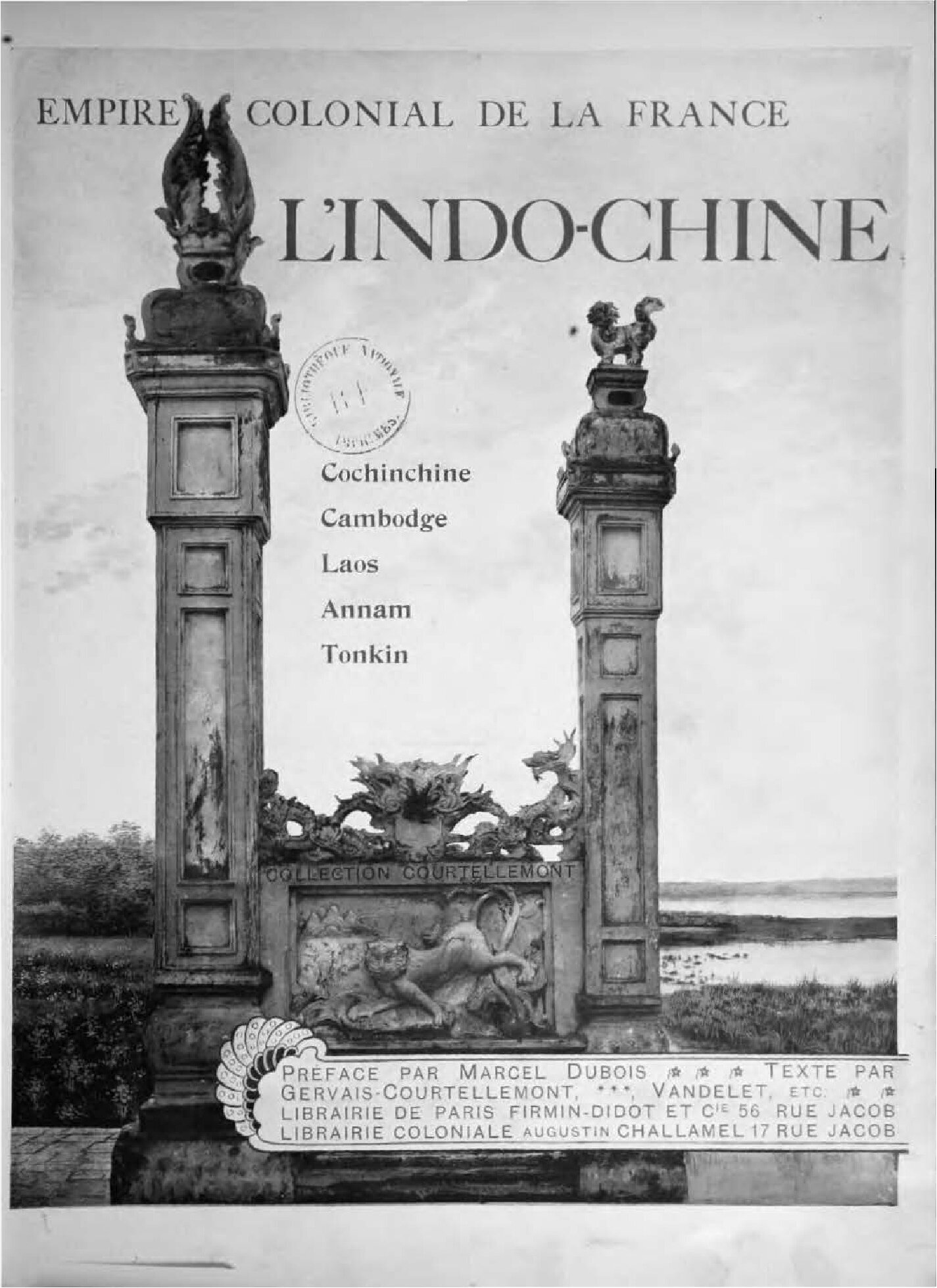
pdf 4.3 MB
If many of these photographs have been circulating until today, they are rarely attributed to their author, Jules Gervais-Courtellemont. A professional photographer, he had come to ‘Indochina’, after extensively traveling North Africa and the Middle East, at the invitation of Paul Doumer, then French minister of the colonies.
The colonial perspective is pervasive in the book, while archaelogy not mentioned. Yet there are interesting notations on Vietnamese, Siamese, Cambodian and Laotian daily life. We have selected:
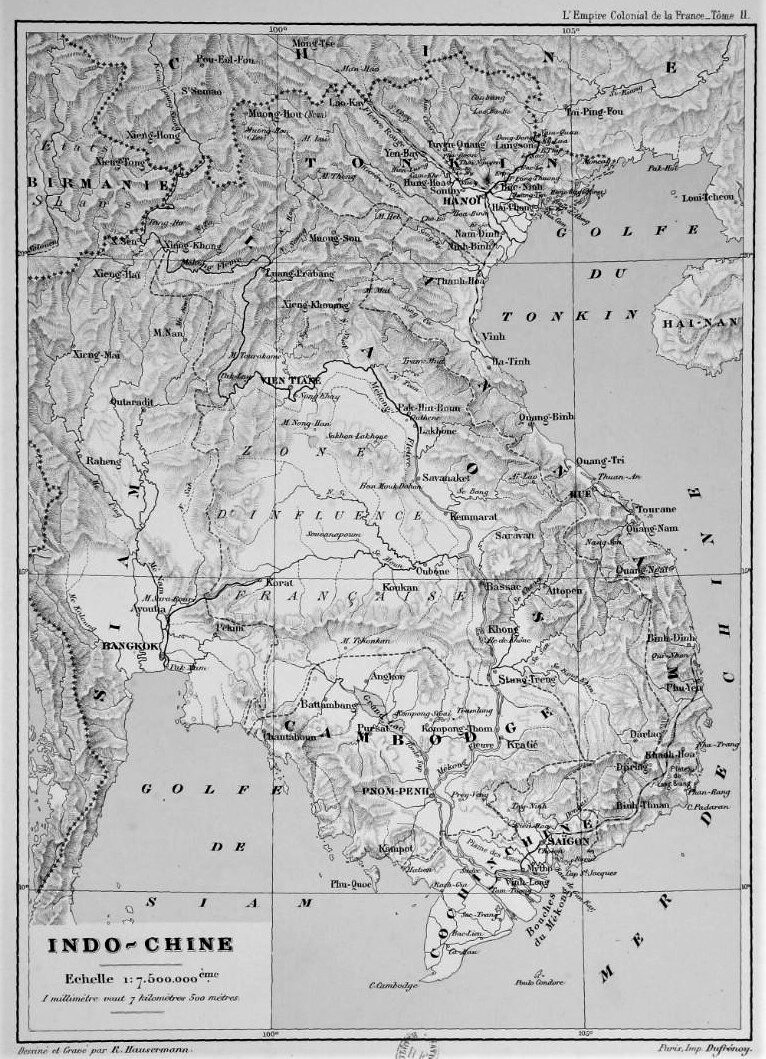
Map of Indochina by R. Hausermann, [from J. Gervais-Courtellemont, Empire colonial de la France: Indochine, 1901.]
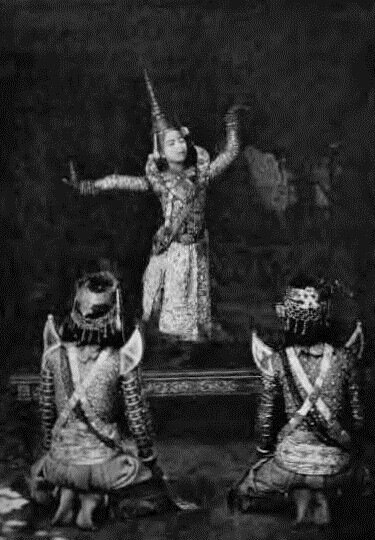
Dancers at King Norodom’s Palace [photo by J. Gervais-Courtellemont]
1) Map of Indochina by R. Hausermann, [from Empire colonial de la France: Indochine, 1901.] 2) Dancers at King Norodom’s Palace [photo by J. Gervais-Courtellemont].
We also have a rather detailed description of a dance performance at the inner Dance Hall of the Royal Palace, the wooden sala that would be replaced with the concrete structure of the Pochany Pavilion in 1912:
Le palais du roi n’offre à l’extérieur rien qui frappé l’œil du touriste. Une succession de cours aux murs tristes, dans lesquelles s’élèvent des petits pavillons en bois d’un style banal; rien de grandiose ni même de bien ordonné. Les appartements privés sont quelconques, plutôt pauvres que confortables, avec tout un mobilier rococo et des arrangements disparates. Le roi Norodom y vit très retiré, recevant peu, de plus en plus desinteressé du gouvernement de son royaume, souverain attristé et déçu, cherchant une diversion à son chagrin dans les représentations de ses bayadères et dans les menus details de la vie du palais.
Les bayadères sont la véritable curiosité de sa cour. Pour la plupart d’origine siamoise, elles dansent pour le roi et ses invités, pendant des semaines entières, les pantomimes et les ballets les plus brillants. C’est un art prestigieux, et ses virtuoses savent, par leurs gestes et leurs attitudes, donner une telle vie à leurs scènes que, sans comprendre un traitre mot au poème lu par une des princesses pour servir de theme aux tableaux et aux actes, rien né vous échappe du sujet: on en suit, captivé, toutes les péripéties. Richement vétues de soie et d’or, les danseuses ont grand caractère: pour les costumer, on a cousu sur leur corps nu des étoffes de soie afin d’en mieux mouler la forme et, sur ces maillots ultra-collants et improvisés, on appliqué de riches broderies, de lourds ornements d’or et de pierreries.
Assistons à une de leurs représentations: Un essaim de vingt-cing danseuses entre en scène; elles s’avancent au son d’une musique très fortement rythmée. En tête, sont les premiers sujets, les étoiles : Roi et Reine, pages, guerriers, Roi des singes, Yacks, toute une série de personnages légendaires. Le roi s’assied sur un trône, ayant deux princesses à ses côtés, et devant lui défilent les princes guerriers. La reine arrive, dansant un pas lent et solennel; elle relève de couches car on apporte, avec un cérémonial très compliqué, un nourrisson emmailloté; mais, horreur!… c’est une affreuse poupée de bois qui est présentée au roi, cependant que la reine, entourée de ses femmes, repose à terre, toute à sa souffrance et anxieuse de ce que pensera le roi de son enfant. Mais celui-ci, brusquement s’est dressé, il descend de son trône et danse un pas furieux en présentant à la reine la poupée de bois. La reine s’évanonit. La fureur du roi né connait plus de bornes. Évidemment, c’est le fruit de l’adultére avec quelque monstre de la forêt, quelque génie, quelque yack. Il ordonne de chasser la reine que des pages entraînent…
Entre alors une étoile qui esquisse son pas le plus savant pour essayer de calmer le douleur du roi. Celui-ci s’intéresse peu à peu au jeu de la bayadère et, pour Iui marquer sa satisfaction, quand elle termine sa danse, l’invite à s’asseoir près de lui. Mais le trone n’est pas large, et pour lui faire place, il se dérange un peu sur la gauche. Entre une deuxième danseuse qui, à son tour, rythme son pas des plus séducteurs. Elle charme aussi le roi, sans doute, car il l’invite à venir s’asseoir à sa droite. Grand émoi de la première danseuse, qui bondit dans l’arène et essaye de surpasser sa rivale et de la supplanter dans le cœur du roi. Elle y réussit, car il la rappelle à ses côtés et, pour lui faire place, recule encore un peu plus vers le bord de son trône. Le manège continue, tant et si bien que le monarque est enfin littéralement dépossédé de son siège par les deux rivales et c’est lui, maintenant, qui leur sert de spectacle et danse avec des déhanchements comiques.
Mais des guerriers et des princes font irruption dans la salle et c’est une chevauchée devant le roi, qui rougit de sa déchéance et chasse les deux courtisanes. A ce moment un compère, figurant un paysan quelconque, se lève dans l’assistance et vient dénoncer au roi la substitution d’enfant dont la reine a été victime à l’instigation des deux bayadères. Grand tumulte!…
Les années ont passé, l’enfant a grandi et c’est en guerrier victorieux que ce fils réapparait. II entre, acrompagné de pages et d’officiers, il enchante son père par sa bonne grace et sa vigueur. Le roi l’appelle a ses côtés, sur le trône. La reine, infortunée, portant dans ses bras la poupée de bois que depuis des années elle couvre de ses larmes, est introduite: hiératique, statue vivante de la douleur, elle s’avance à petits pas. Le roi se jette à ses pieds, implorant son pardon, lui montre son vrai fils et jette avec horreur loin de lui la poupée. La reine comprend, pardonne, danse un pas d’allégresse, se prosterne devant le roi qui la relève et l’entraine, laissant le trône à son fils.
Ce sujet de pantomime, pris au hasard, démontre comment, avec des moyens d’une grande simplicité, ces artistes arrivent à produire des effets seêniques tres émonvants. Sans aucun des artifices qui nous paraissent indispensables, les auteurs cambodgiens ont créé un theatre dont l’esthétique est certainement aussi pure, aussi noble et aussi idéale que la nôtre. La salle dans laquelle ont lieu quotidiennement ces danses a des apparences de hangar plutôt que de palais. Une charpente en bois supporte une vague toiture, sans plafond. Des nattes à terre et quelques potiches de Chine sont, avec quelques boules en verre de couleur comme les bourgeois de France en mettent dans leurs jardins, les seuls ornements du lieu.
Les invités européens s’asseoient près du roi qui s’empresse de leur offrir d’énormes cigares et du champagne frappé, pendant que l’orchestre cambodgien fait rage au pied de la tribune. Cymbales, flûtes, gongs, chapeaux chinois, cythares et luths, tout grince et gémit en une cacophonie de miaulements étranges. Comme fond de tableau, la foule des courtisans, des princesses, des femmes du roi, tous demi-nus, accroupis sur le sol pour né rien perdre du spectacle. Personne, hormis les Européens, né doit se tenir debout devant le souverain: ainsi l’exige l’étiquette et, pour vaquer aux soins du service, les domestiques sautillent et circulent à quatre pattes. Pour tout éclairage, des lampes de bronze en forme de vasques où, dans l’huile de coco, plongent des méches en coton filé. Un serviteur. une bouteille à la main, court de lampe en lampe pour renouveler l’huile; esclave de l’étiquette, il rase le sol, courbé en deux, s’appuyant sur une main, sautillant avec des allures d’oiseau blessé.
En résumé, cette cour de Norodom, dernier vestige d’une grande et curiense civilisation, offre encore un vif intérêt. Elle contraste étrangement avec les mœurs européennes que nous importons en ce pays; aussi, abrégerons-nous la description, forcément banale, du palais de la résidence française. A l’extérieur, une construction d’une apparence confortable. mais sans caractère. Quant a l’intérieur, nous n’y pénétrerons pas, pour éviter toute digression oisense sur les procédés de notre administration, irritante question qui a fait couler beaucoup d’encre, qui a méme un instant passionné l’opinion publi-que en France, mais qui n’a pas sa place ici. [p 58- 61]
[The king’s palace offers nothing to catch the tourist’s eye from the outside. A succession of courtyards with drab walls, in which stand small wooden pavilions of a commonplace style; nothing grandiose or even well-ordered. The private apartments are unremarkable, more impoverished than comfortable, furnished with rococo pieces and arranged haphazardly. King Norodom lives there in great seclusion, receiving few visitors, increasingly disinterested in the governance of his kingdom, a saddened and disappointed sovereign, seeking solace from his grief in the performances of his bayadères and in the minute details of palace life.
The bayadères are the true curiosity of his court. Mostly of Siamese origin, they can dance for the king and his guests for weeks on end, performing the most brilliant pantomimes and ballets. It is a prestigious art form, and its virtuosos, through their gestures and attitudes, bring their scenes to life so vividly that, even without understanding a single word of the poem read by one of the princesses to serve as the theme for the tableaux and acts, nothing escapes you: you follow, captivated, every twist and turn. Richly dressed in silk and gold, the dancers cut a fine figure: to costume them, silk fabrics are sewn onto their naked bodies to better mold their shape, and onto these ultra-tight, improvised leotards, rich embroidery, heavy ornaments of gold, and precious stones are applied.
Let us witness one of their performances: A swarm of twenty-five dancers enters the stage; they advance to the sound of very rhythmic music. At the head are the principals, the stars: King and Queen, pages, warriors, Monkey King, Yaks, a whole host of legendary figures. The king sat on his throne, with two princesses at his side, and the warrior princes filed past. The queen arrived, dancing a slow, solemn step; she was recovering from childbirth, for a swaddled infant was brought in with a very elaborate ceremony. But, horror of horrors! It was a hideous wooden doll that was presented to the king, while the queen, surrounded by her ladies-in-waiting, lay on the ground, lost in her grief and anxious about what the king would think of her child. But suddenly, the king rose, descended from his throne, and danced a furious step, presenting the wooden doll to the queen. The queen fainted. The king’s fury knew no bounds. Clearly, it was the fruit of adultery with some forest monster, some genie, some yak. He orders the queen to be led away by pages…
Then enters a star who performs her most graceful step to try and soothe the king’s grief. He gradually becomes interested in the bayadère’s performance and, to show his satisfaction, when she finishes her dance, invites her to sit beside him. But the throne is not wide, and to make room for her, he shifts slightly to the left. A second dancer enters and, in turn, performs her most seductive steps. She too charms the king, no doubt, for he invites her to sit to his right. The first dancer is greatly aroused; she leaps into the arena and tries to outshine her rival and supplant her in the king’s affections. She succeeds, for he calls her back to his side and, to make room for her, steps back a little further toward the edge of his throne. The charade continues, until the monarch is finally literally dispossessed of his seat by the two rivals and it is he who now serves as their spectacle and dances with comical hip swaying.
But warriors and princes burst into the hall, and a cavalcade ensued before the king, who blushed at his disgrace and banished the two courtesans. At that moment, a fellow, pretending to be an ordinary peasant, rose from the audience and denounced to the king the substitution of the queen’s child, her being a victim of a machination the two bayadères had been instigated. Great uproar ensued!
Years passed, the child grew, and it was as a victorious warrior that this son reappeared. He entered, accompanied by pages and officers, and charmed his father with his grace and vigor. The king summoned him to his side, to the throne. The unfortunate queen, carrying in her arms the wooden doll that she had been covering with her tears for years, was brought in: hieratic, a living statue of grief, she advanced with small steps. The king throws himself at her feet, begging her forgiveness, shows her his real son, and throws the doll away in horror. The queen understands, forgives, dances a step of joy, prostrates herself before the king, who raises her up and leads her away, leaving the throne to their son.
This pantomime subject, chosen at random, demonstrates how, with very simple means, these artists manage to produce highly moving stage effects. Without any of the artifice that seems indispensable to us, Cambodian playwrights have created a theater whose aesthetic is certainly as pure, as noble, and as ideal as our own. The hall in which these dances take place daily resembles a hangar rather than a palace. A wooden frame supports a flimsy roof, without a ceiling. Mats on the floor and a few Chinese vases, along with some colored glass balls like those placed in the gardens of the French bourgeoisie, are the only decorative elements.
The European guests sat near the king, who promptly offered them enormous cigars and chilled champagne, while the Cambodian orchestra played riot at the foot of the daïs. Cymbals, flutes, gongs, Chinese hats, zithers, and lutes all grated and groaned in a cacophony of strange mewing sounds. In the background, the crowd of courtiers, princesses, and the king’s wives, all half-naked, crouched on the floor so as not to miss a thing. No one, except the Europeans, was to stand before the sovereign: such was the etiquette, and to attend to their duties, the servants skipped and moved about on all fours. The only lighting consisted of bronze lamps shaped like bowls, into which spun cotton wicks were dipped in coconut oil. A servant, a bottle in his hand, rushing from lamp to lamp to refill the oil, hunched over, a slave to etiquette, supporting himself on one hand, hopping about like a wounded bird.
In short, the court of Norodom, the last vestige of a great and curious civilization, still holds considerable interest. It contrasts strangely with the European customs we have imported into this country; therefore, we will abbreviate the necessarily banal description of the palace of the French resident. From the outside, a building with a comfortable appearance yet lacking character. As for the interior, we will not venture inside to avoid any idle digression on the procedures of our administration, an irritating subject that has generated much ink and even briefly stirred public opinion in France, but which has no place here.]
One of the first French entrepreneurs to thrive in Cochinchina and Cambodia, the author of these notations, shows unsuspected talent in a description of Cambodian court dance that George Groslier would develop a decade later in his Danseuses cambodgiennes anciennes et modernes.
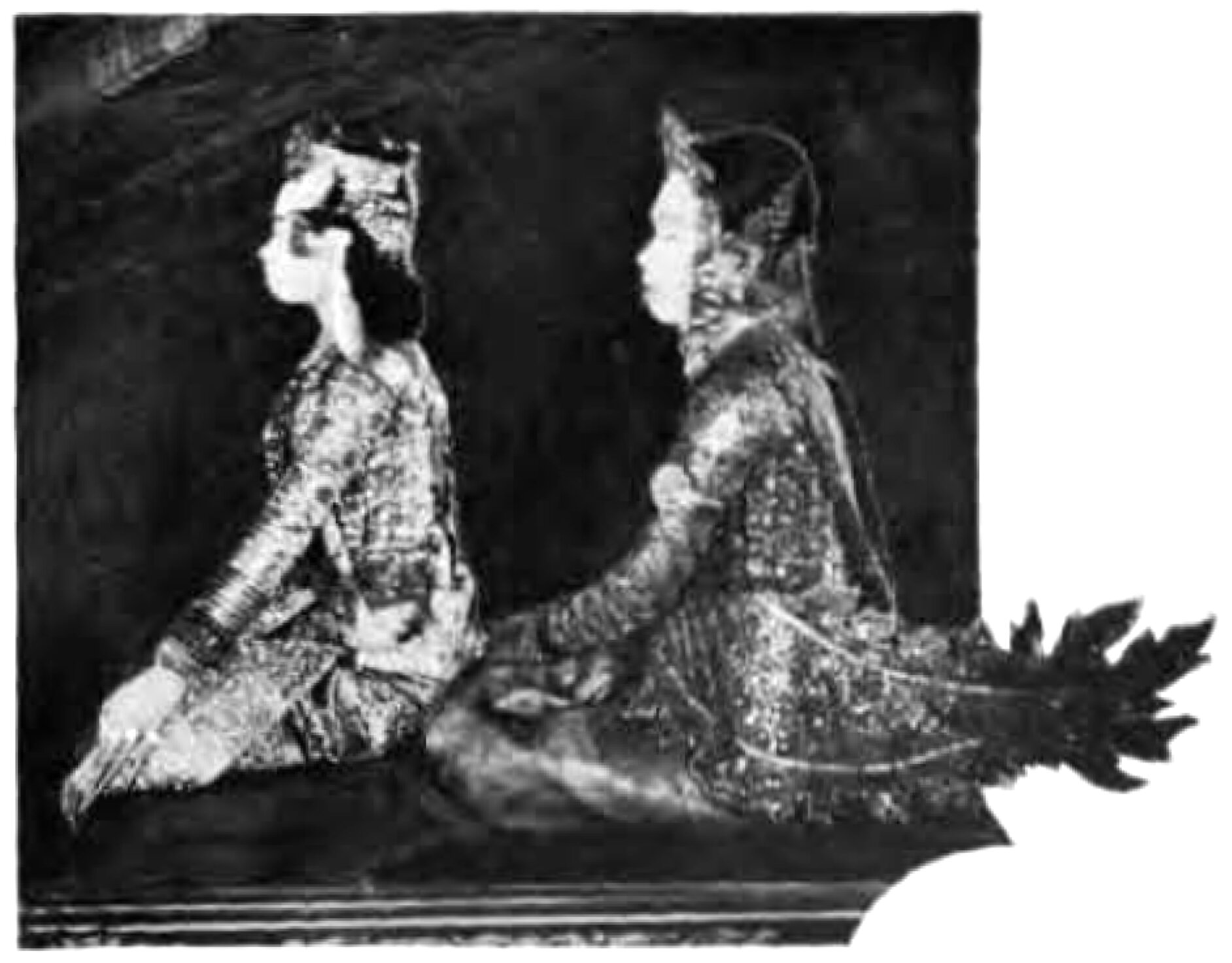
Apart from one photograph (reproduced above), all photos of Cambodian courts dancers by Gervais-Courtellemont were printed as small vignettes in the book.
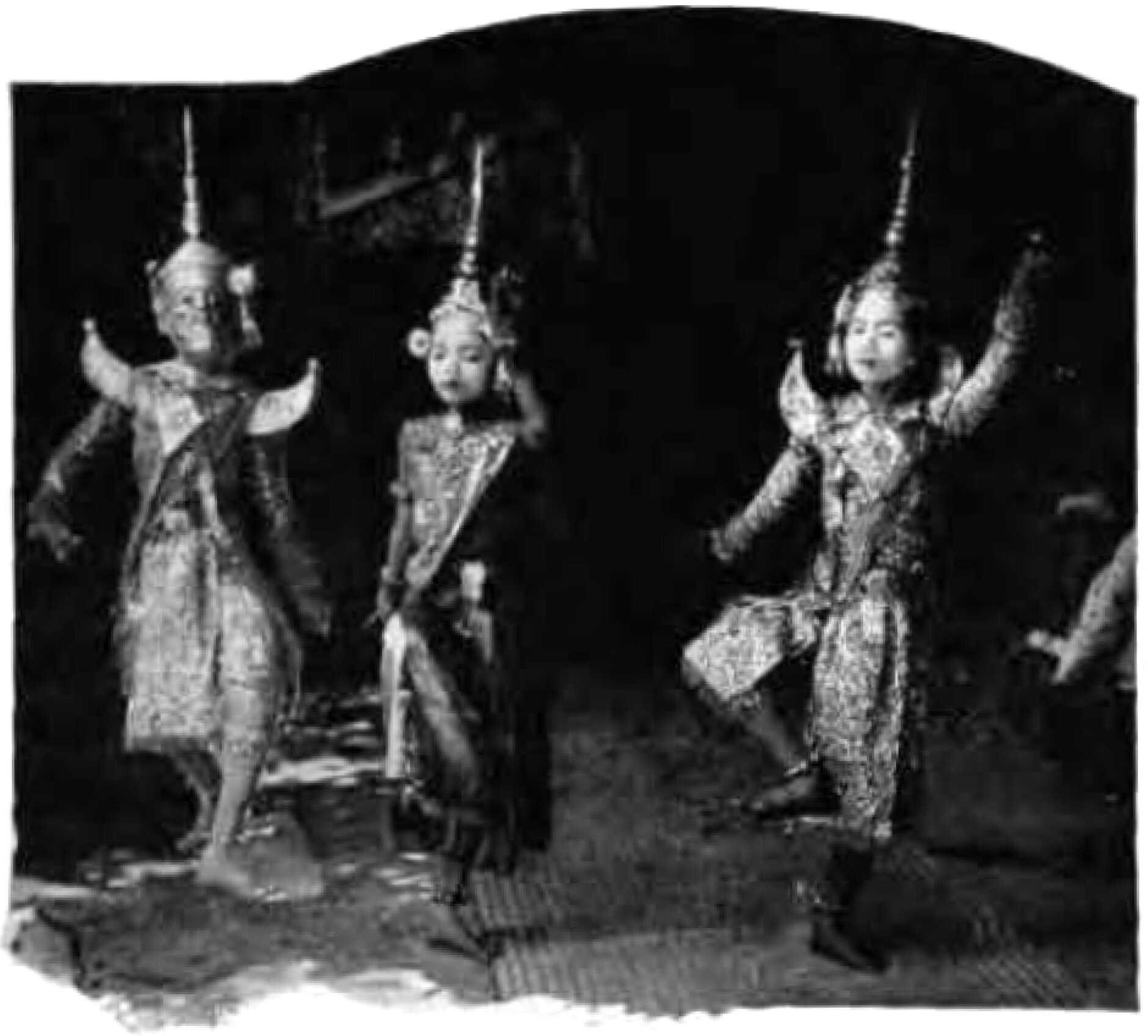
Apart from one photograph (reproduced above), all photos of Cambodian courts dancers by Gervais-Courtellemont were printed as small vignettes in the book.
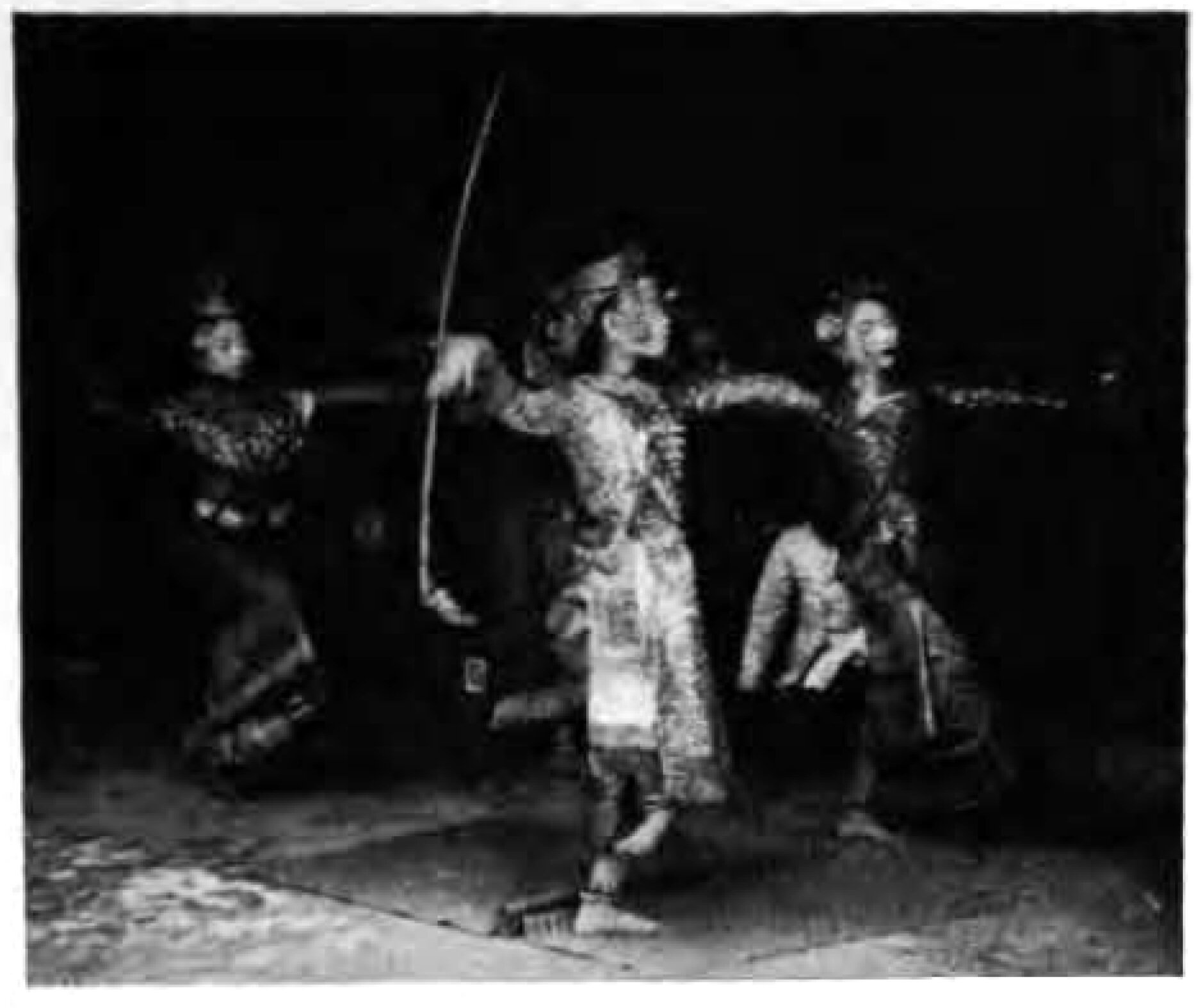
Apart from one photograph (reproduced above), all photos of Cambodian courts dancers by Gervais-Courtellemont were printed as small vignettes in the book.
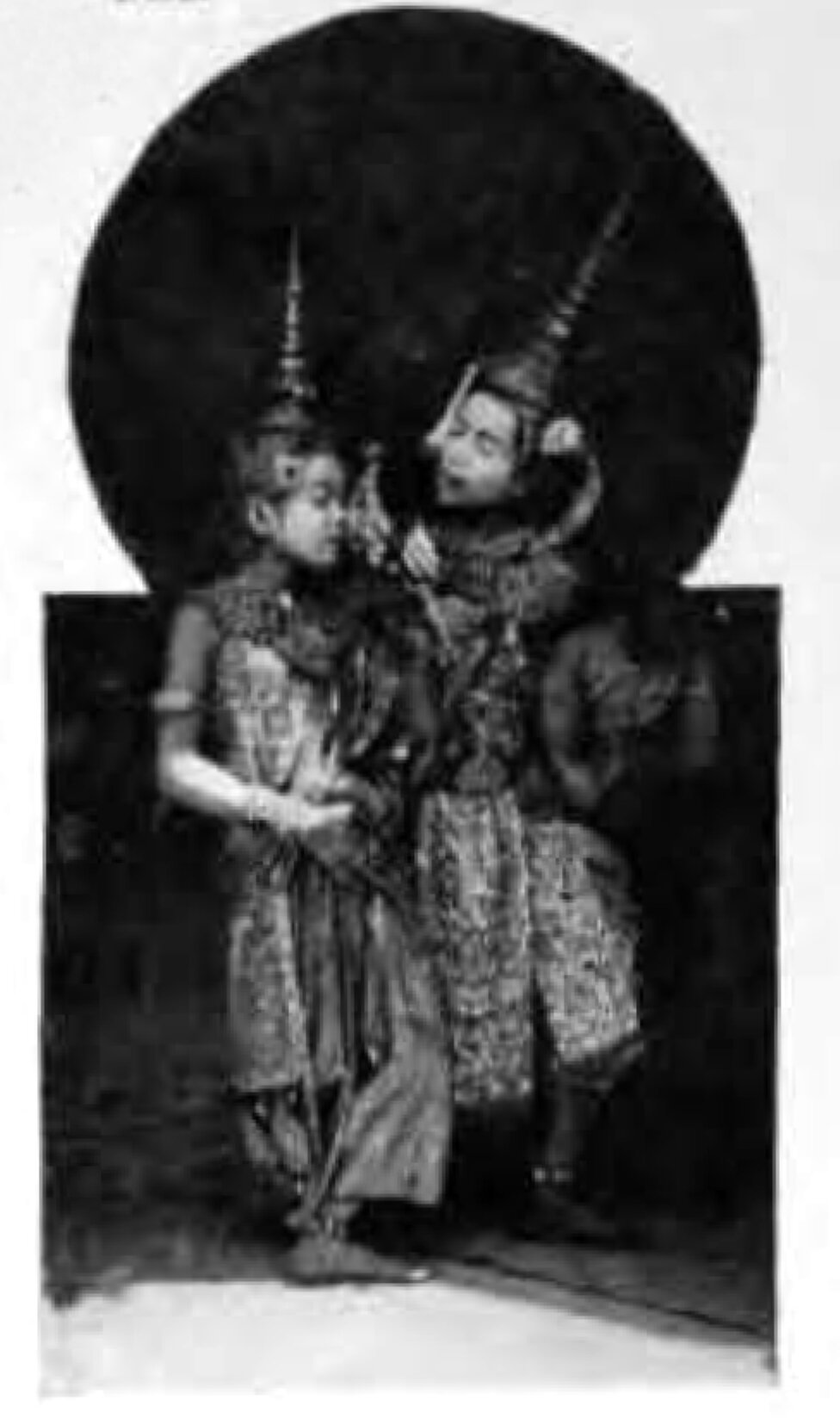
Apart from one photograph (reproduced above), all photos of Cambodian courts dancers by Gervais-Courtellemont were printed as small vignettes in the book.
Apart from one photograph (reproduced above), all photos of Cambodian courts dancers by Gervais-Courtellemont were printed as small vignettes in the book.
Tags: modern history, colonialism, photography, Modern Cambodia, Lao, dance, theater, dancers, Royal Palace, King Norodom I
Jules Gervais-Courtellemont (1863, Avon, France – 31 Oct. 1931, Paris) was a professional French explorer, photoengraver and photographer whose photographs of French Indochina and Cambodia were widely published, often without his knowledge.
In 1874, the young Jules moved to Algeria with his mother and his stepfather, Jules-Georges Courtellemont — his natural father, Louis Victor Gervais, had died in 1874. At 14 years of age, he was left alone in the family farm in the Relizane Valley as his parents had to hurry back to France for health reasons. As local Algerian peasants helped him manage the farm, he became strongly attached to the culture and religious traditions. In 1888, he opened opened a photographic studio in Algiers in 1888 and became the editor of the illustrated review L’Algérie artistique et pittoresque [1]. After visiting Spain and Syria, where he met and befriend famed French explorer and Islamologist Charles Lallemand in 1892, he converted to Islam and was one of the first Westerners to accomplish the Hajj and photograph Mecca in 1894. That same year, he illustrated and published in Algiers Lallemand’s works, Jérusalem-Damas and Le Caire.
With wife Hélène Lallemand (31 July 1861, Baden, Germany — 15 June 1922, Paris) — Lallemand’s daughter and a professional photographer herself –, he visited Indochina, then Yunnan — from which he seems to have been expelled by the local authorities, according to Charles Francois, an EFEO correspondent, as his interest in the Muslim minorities of Yunnan was seen as suspect — Tibet, and China in 1900 – 1903. Part of their work was exhibited in Hanoi in 1902, and Jules was granted the Gold Medal of the Société géographique de France. He was a lifelong friend of Pierre Loti’s, with whom he shared a passion for the ‘exotic’.
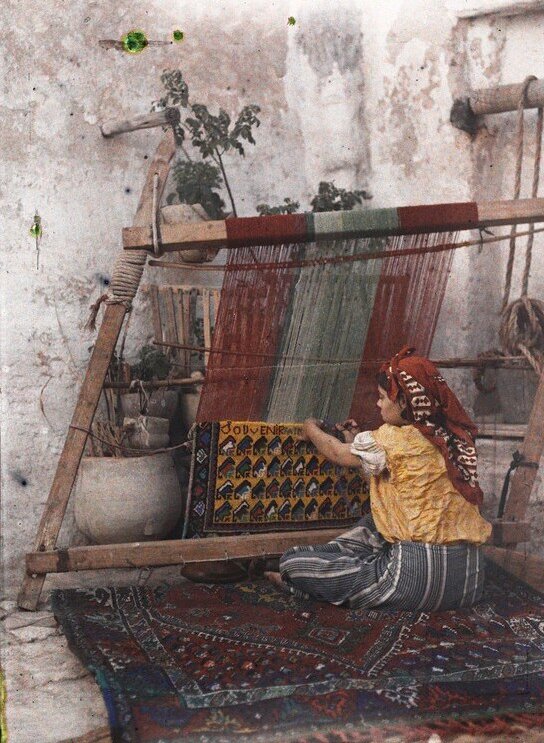
When First World War broke, Courtellemont decided to cover the military actions in France, in particular the involvement of ‘Colonial troops’ in the battles. He applied a technique of color photography known as ‘natural color photography’ or ‘autochrome’, which he had explored since 1907 to the extent he opened in Paris a Palais de l’Autochrome in 1911. His work is kept at the Albert-Kahn Museum in Boulogne-Billancourt — in 1913, he was entrusted with the artistic direction of Kahn’s monumental project, ‘Archives de la Planète’ –, and in the National Geographic archive in Washington, D.C. He also contributed to the French magazine L’Illustration from 1903 to 1923.
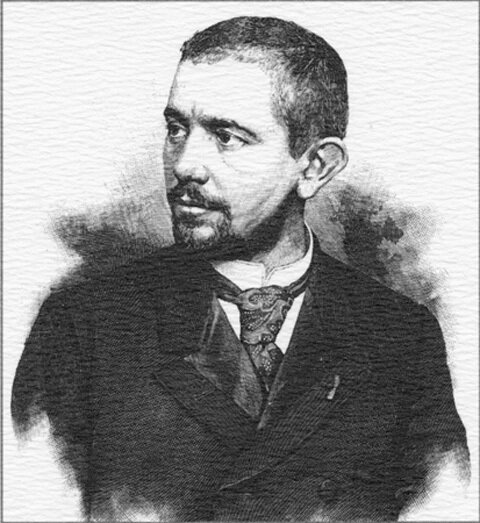
1) A self-portrait of Gervais-Courtellemont published in L’Illustration, 15 Dec. 1894. [source: Emmanuelle Devos, “À travers Le Caire, l’œuvre de Gervais-Courtellemont en Égypte de 1894 à 1911”, in Mercedes Volait (ed.), Le Caire dessiné et photographié au XIXe siècle, Paris, INHA/Picard, 2013, p. 215 – 226. 2) ‘Alger, jeune tisserande devant son métier’, by J. Gervais-Courtellemont, 1909 – 1911 — © Musée Albert-Kahn/A6.
1) A self-portrait of Gervais-Courtellemont published in L’Illustration, 15 Dec. 1894. [source: Emmanuelle Devos, “À travers Le Caire, l’œuvre de Gervais-Courtellemont en Égypte de 1894 à 1911”, in Mercedes Volait (ed.), Le Caire dessiné et photographié au XIXe siècle, Paris, INHA/Picard, 2013, p. 215 – 226. 2) ‘Alger, jeune tisserande devant son métier’, by J. Gervais-Courtellemont, 1909 – 1911 — © Musée Albert-Kahn/A6.
1) A self-portrait of Gervais-Courtellemont published in L’Illustration, 15 Dec. 1894. [source: Emmanuelle Devos, “À travers Le Caire, l’œuvre de Gervais-Courtellemont en Égypte de 1894 à 1911”, in Mercedes Volait (ed.), Le Caire dessiné et photographié au XIXe siècle, Paris, INHA/Picard, 2013, p. 215 – 226. 2) ‘Alger, jeune tisserande devant son métier’, by J. Gervais-Courtellemont, 1909 – 1911 — © Musée Albert-Kahn/A6.
The separation technique used to create printed color images from surimposed screen plates had initially been developed by inventors Louis Ducos de Huron (French patent in 1869), John Joly (British patent in 1894) and James William McDonough (US patent in 1896). Mosaic screen plate process was perfected by the Lumière brothers, who patented the ‘Autochrome Lumière’ in 1903 (France) and 1906 (USA). Autochrome was applied by professional travel photographers such as W. Robert Moore (for the US National Geographic) until the popularization of color photographic films after 1935.
[1] see Béatrice De Paste & Emmanuelle Devos, Les couleurs du voyage: L’œuvre photographique de Jules Gervais-Courtellemont, Paris, Paris Musées/Phileas Fogg, 2002, 127 p.
One of the first French planters, breeders and merchants in Cambodia, Octave Vandelet (28 June 1848, Chaumont-en-Vexin, Frances — 30 Sept. 1912, Phnom Penh) started to reside and work in Cochinchina and Cambodia as early as 1873.
A close confidant of Kings Norodom and Sisowath, Vandelet served as delegate for Cambodia to the Conseil Supérieur des Colonies and first president of the Mixed Council for Agriculture and Commerce in Phnom Penh.
With associate Félix-Gaspard Faraut, Vandelet imported 26 Ploermel cows and Craon pigs to start a breeding and dairy farm that numbered more than 1,000 heads. He grew cotton, corn, coffee, sugarcane and rice on some 650 ha of land. After an attempt to develop vineyards in Southern Vietnam (Cape St. Jacques), he was also the last farmer to grow opium in Cambodia — his firm Vandelet, Dussutour had obtained the opium concession for Cambodia in 1881 thanks to then Prime minister Chhun.
According to researcher Gregor Muller, Vandelet, “a restless entrepreneur and a vocal lobbyist for merchants interests”, had offered King Norodom an annual revenue of 11,000 silver bars in order to get the opium concession. [Gregor Muller, Colonial Cambodia’s ‘Bad Frenchmen’: The Rise of French Rule and the Life of Thomas Caraman (1840−1887), Oxon/New York, Routledge, 2006]. When the French colonial administration took control over the opium market in 1884, Vandelet and Faraut aimed at the spirit and betting game concessions. In 1888, they were again countered by the French governorate, the latter permanently banning the 36-beasts game from the streets of Cambodia.
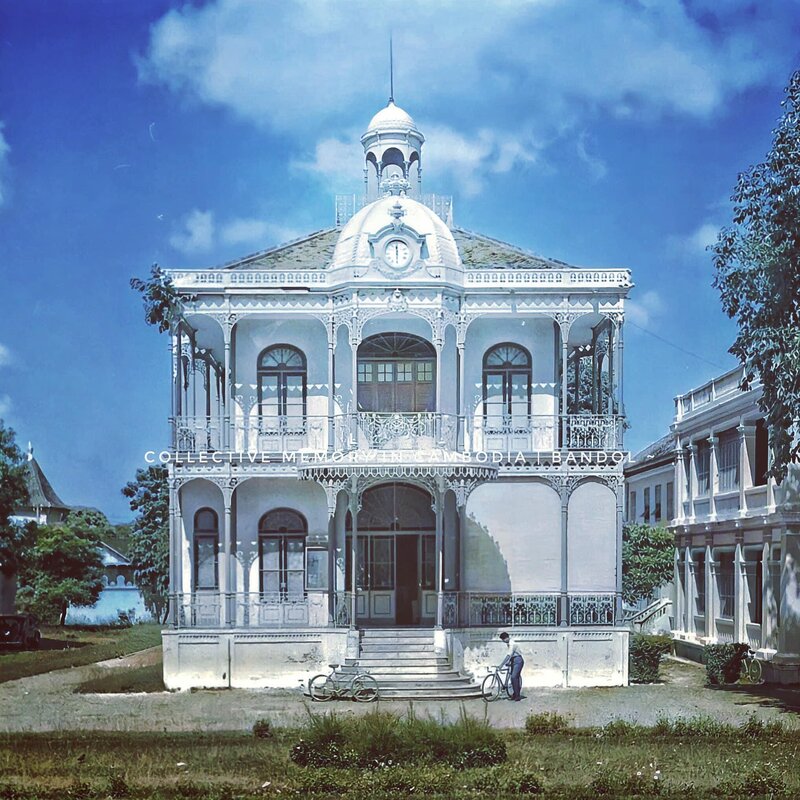
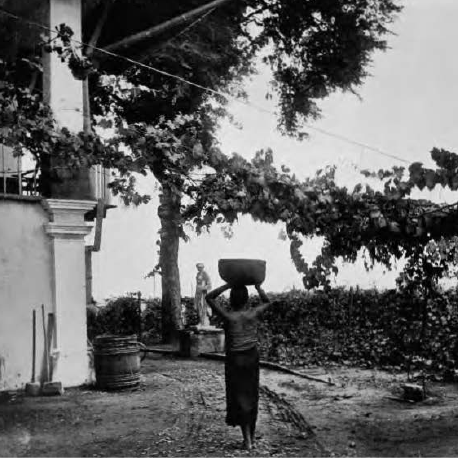
Photo: Vandelet’s house in Phnom Penh on the riverbank (photo J. Gervais-Courtellemont)