This special issue of France-Asie review can be seen as the handover of cumulated knowledge in Khmer studies by French researchers working in Cambodia for more than two decades — and even more, in the case of ‘founding father George Coedès — to upcoming generations of Cambodian scholars, two years after the country had peacefully gained its independence from France. Most of these distinguished specialists (Solange Thierry, Eveline Porée-Maspero, Henri Marchal, François Martini) considered themselves as ‘former’ actors of Khmer studies, and for most of them — except for Marchal, who serenely lived his last years in Siem Reap — about to leave the Kingdom for other horizons. They had gathered to celebrate the ‘Présence du Cambodge’ [‘Presence of Cambodia’, the French word having rich layers of meaning, from ‘existence’ to ‘relevance’ to ‘persistence’], yet they weren’t completely “there’ anymore.
Considered in hindsight, this collection of essays shows how limited the purely Cambodian contribution to Khmer studies was reflected in these pages. While all the analytical, synthetical studies were signed by French researchers, Cambodian authors contributed only short, purely technical considerations on very specific subjects, confined to the ‘ethnographic’ field. It is also striking to note how succintely they were presented — ‘achar of a pagoda’ (which pagoda? in which region?), ‘chauvea srok’ (‘district governor’, but of which district?). As for ‘Princess Rasmi Sutharot’, who was granted the title HRH Princess Norodom Rasmi Sobbhana [Reaksmey Sophoan] shortly after this publication, it would have been useful to mention she was already a respected teacher at Sutharot School, the first secondary school for girls in Cambodia. [She was also the author in 1960 of the first exhaustive book on the culinary art of Cambodia.]
These remarks certainly shed a hard light on the outcome of some 90 years of French protectorate over Cambodia. Colonial education had not really helped in the emergence of Cambodian intellectuals able to process their direct experience of a rich cultural substrate into a bigger picture of the history of their country. It also shows the limitations of knowledge sharing — it was only one decade later than EFEO researchers in Angkor such as Bernard-Philippe Groslier,Jean Boulbet or Guy Nafilyan understood the importance of training young Cambodian architectural renderers or budding archeologists and encouraging them in integrating processes of analyzis and elaboration to their cultural background.
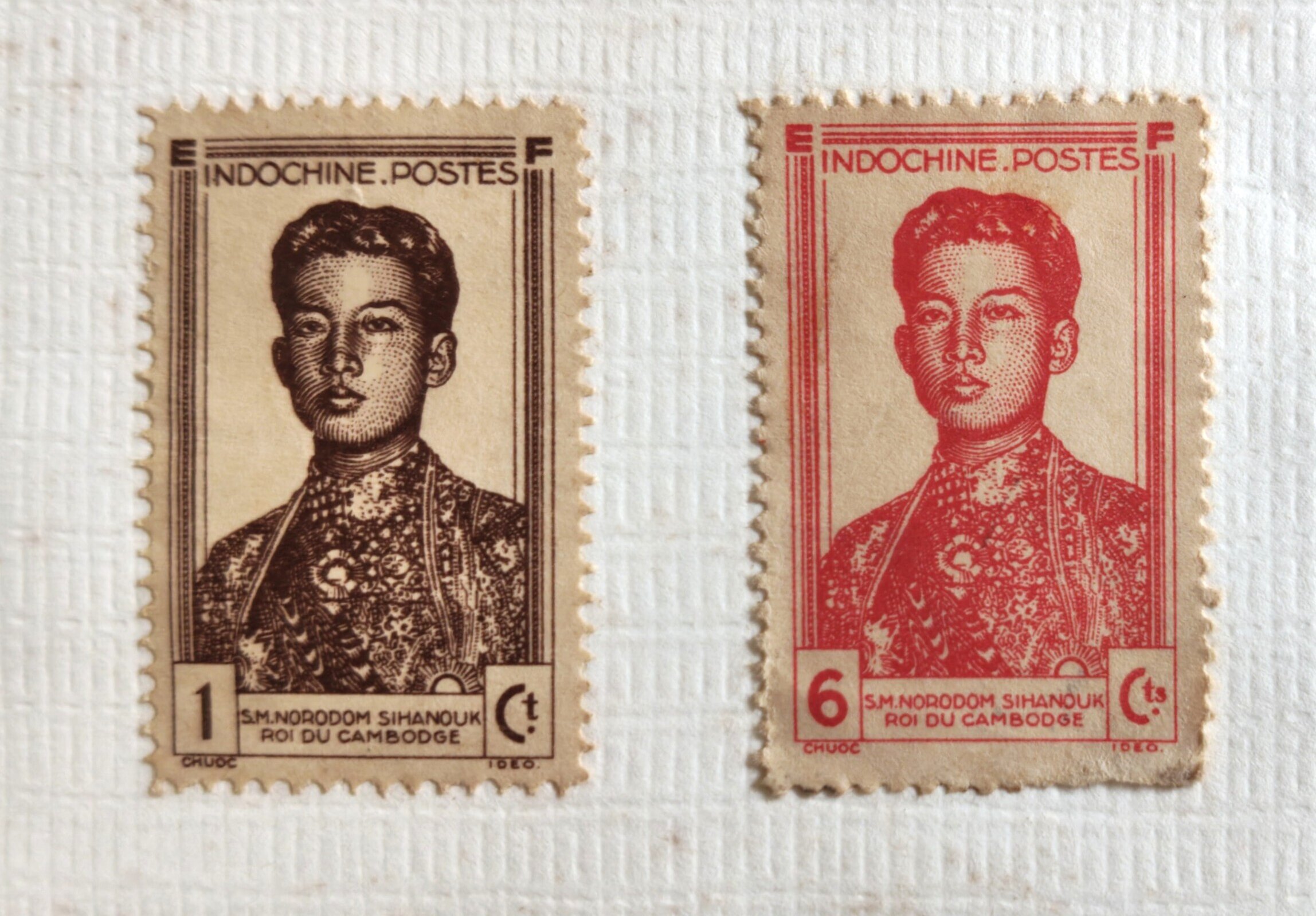
Awkward Transition — 2 real stamps were pasted on the inner cover page of the review, labelled ‘Indochine Postes’ and picturing King Norodom Sihanouk around the time of his coronation on 3 May 1941. [France Asie, Nov.-Dec. 1955].
Note: According to Khmer philatelist Sereyvong Jason Chhinlim, these 2 stamps had been issued in 1943, part of the series “Rulers of Indochina” in which the French Indochina postal service also issued x2 stamps with the image of King Sisavong Vong of Laos and a similar x2 stamps set with Emperor Bao Dai and Empress Nam Phuong of Vietnam. The 1‑centime value of King Norodom Sihanouk in brown color was issued on 10 March 1943; the 6‑centime value in red color was issued on 10 May 1943. All designed by Bùi Trang Chước from Hanoi — size of stamps: 26 by 41 mm (all vertical).
Awkward Transition — 2 real stamps were pasted on the inner cover page of the review, labelled ‘Indochine Postes’ and picturing King Norodom Sihanouk around the time of his coronation on 3 May 1941. [France Asie, Nov.-Dec. 1955].
Note: According to Khmer philatelist Sereyvong Jason Chhinlim, these 2 stamps had been issued in 1943, part of the series “Rulers of Indochina” in which the French Indochina postal service also issued x2 stamps with the image of King Sisavong Vong of Laos and a similar x2 stamps set with Emperor Bao Dai and Empress Nam Phuong of Vietnam. The 1‑centime value of King Norodom Sihanouk in brown color was issued on 10 March 1943; the 6‑centime value in red color was issued on 10 May 1943. All designed by Bùi Trang Chước from Hanoi — size of stamps: 26 by 41 mm (all vertical).
In addition, Henri Marchal’s brief essay on ‘Cambodian Modern Art’ illustrated a certain mindset, persistent even among the most open-minded and unprejudiced researchers — the idea that, left to its own devices, Cambodia would become more and more estranged to the ‘ancestral traditions’ French Khmerophiles had studied - and idealized through their own cultural prism:
A l’heure actuelle, il se produit au Cambodge un renouveau dans les arts qui est en sens inverse du mouvement que [George] Groslier avait cherché à provoquer en ramenant l’art khmer vers ses traditions ancestrales. […] Que ce soit en littérature, en musique, en sculpture ou en peinture, l’artiste cambodgien qui se croit évolué et veut paraître aucourant, se met à la remorque des écoles récentes les plus avancées, les plus audacieuses, ce qui n’est pas toujours une preuve de supériorité esthétique réelle de l’Europe. Or un art qui se met à la remorque d’un autre, sans contrôle sérieux, est un art qui peut avoir une vogue passagère et obtenir la faveur d’un certain public. Mais du point de vue national, cet art sera décadent. Un peuple peut et doit s’ins[pirer des plus récentes manifestations d’art moderne, mais sans abdiquer son tempérament et ses traditions. Il doit enrichir son répertoire sans tomber dans une imitation servile où il perd toutes ses qualités sans acquérir celles des écoles d’art mal comprises qu’il copie. [p. 349 – 50]
[Currently, a revival in the arts is taking place in Cambodia that runs counter to the movement that [George] Groslier sought to bring about by returning Khmer art to its ancestral traditions. […] Whether in literature, music, sculpture, or painting, the Cambodian artist who considers himself evolved and wants to appear knowledgeable follows the lead of the most advanced and audacious recent schools, the latter not being necessarily proof of Europe’s genuine aesthetic superiority. Now, an art that follows another, without serious oversight, may enjoy a passing vogue and gain favor with a certain public. But from a national perspective, this art will be decadent. A people can and should draw inspiration from the most recent manifestations of modern art, but without abandoning its temperament and traditions. He must enrich his repertoire without falling into a servile imitation where he loses all his qualities without acquiring those of the poorly understood art schools that he copies.] The blossoming of creativity in the following years under the Sangkum Reastr Neyum would be a spectacular refutation of such a pessimistic — not to say reactionary — view.
That said, the France-Asie 1955 special issue included several important contributions to Khmer studies. We will explore and make them more accessible as time goes by.
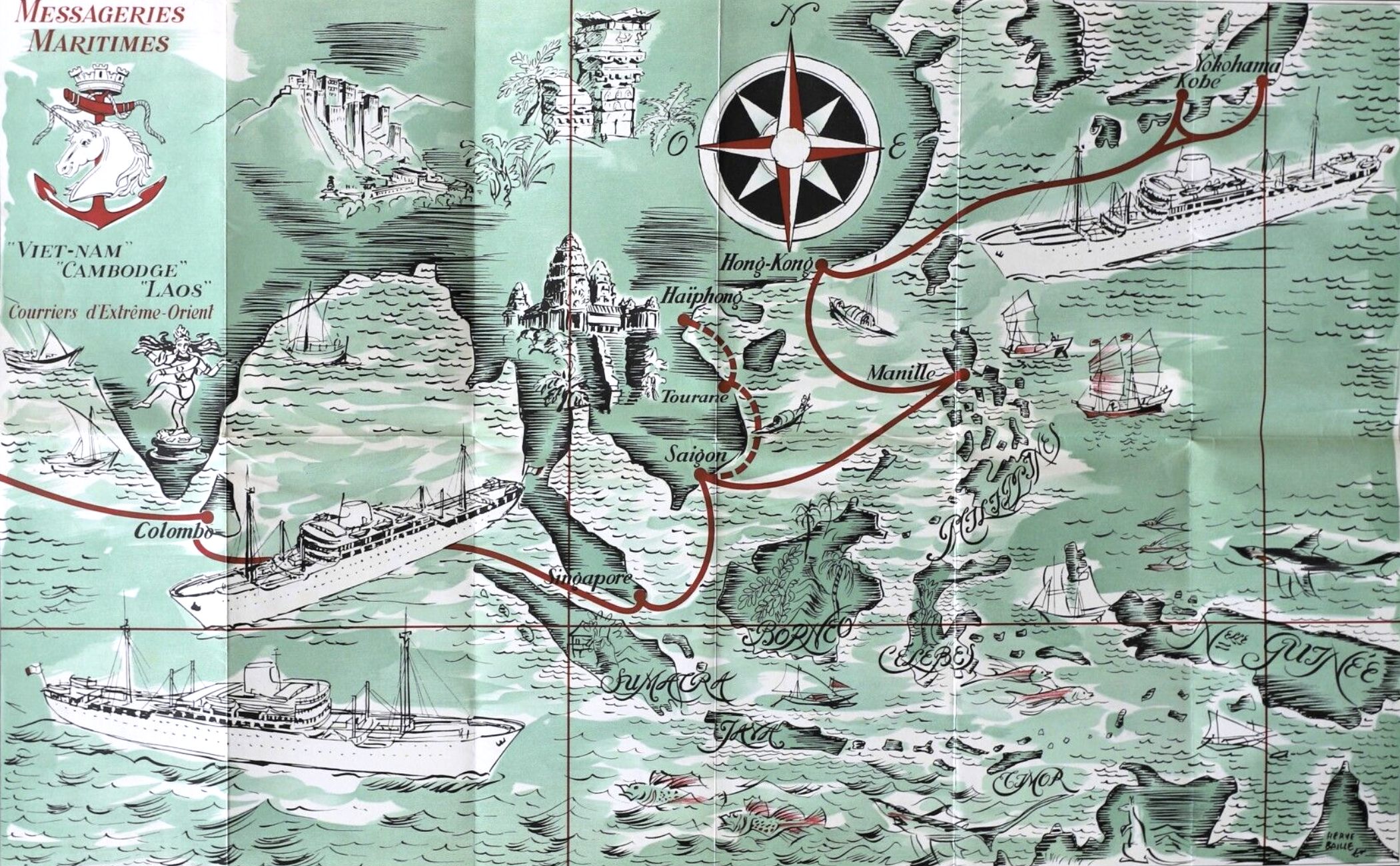
Published that same year (1955), a promotional tourist poster of French transoceanic company Messageries Maritimes, ‘Vietnam-Cambodge-Laos’ [artwork by Hervé Baille].
Published that same year (1955), a promotional tourist poster of French transoceanic company Messageries Maritimes, ‘Vietnam-Cambodge-Laos’ [artwork by Hervé Baille].
Sommaire [Table of Contents]
PRESENTATION 315
I/ GEOGRAPHIE
Présences géographique et humaine, Jean Delvert, Chef de la Mission Française de Coopération culturelle au Cambodge 321
Imagerie populaire, Solange Bernard-Thierry, m. de l’Ecole Française d’Extrême-Orient, ex-Conservateur du Musée de Phnom-Penh 351 Angkor, ou l’Univers manifesté, Pierre Grison 355
IV/ ETHNOGRAPHIE
Travaux d’ethnographie au Cambodge, Eveline Porée-Maspero, m. de l’Ecole Française d’ExtrêmeOrient, ex-Présidente de la Commission des Moeurs et Coutumes du Cambodge (CMCC) 363
Cérémonies militaires du Nouvel An, résumées d’après le Tome I, fasc. I de la CMCC 368
La danse du Trott, Guy Porée 371
Les Néak Tâ, Eveline Porée-Maspero 375
Métiers de la forêt, extraits de textes de la CMCC 379 a) Extraction de la gomme-gutte, Révérend Uk-Préoy 382 b) Les chercheurs de ruches, U‑Ku, àchàr de Pagode 384 c) Capture des martins-pêcheurs Méas-Ham, Chauféay srok 388 d) La chasse aux éléphants, A‑Tith, aiguillleur [mahout], 390
Jeux cambodgiens, Mme Chham-Chhom, de la CMCC 392
Gateaux et friandises, Mme Srin Saris-Yann, de la CMCC 395