Publications
និរាសនគរវត្ត Niras Nokor Wat-1969 Edition
by Suttantaprija Ind & Team Teng Ly
by Suttantaprija Ind
One of the first literary works - and the most famous one - linking Cambodian tradition to modernity: conventional ពាក្យកាព្យ (pikhap) form, modern message.

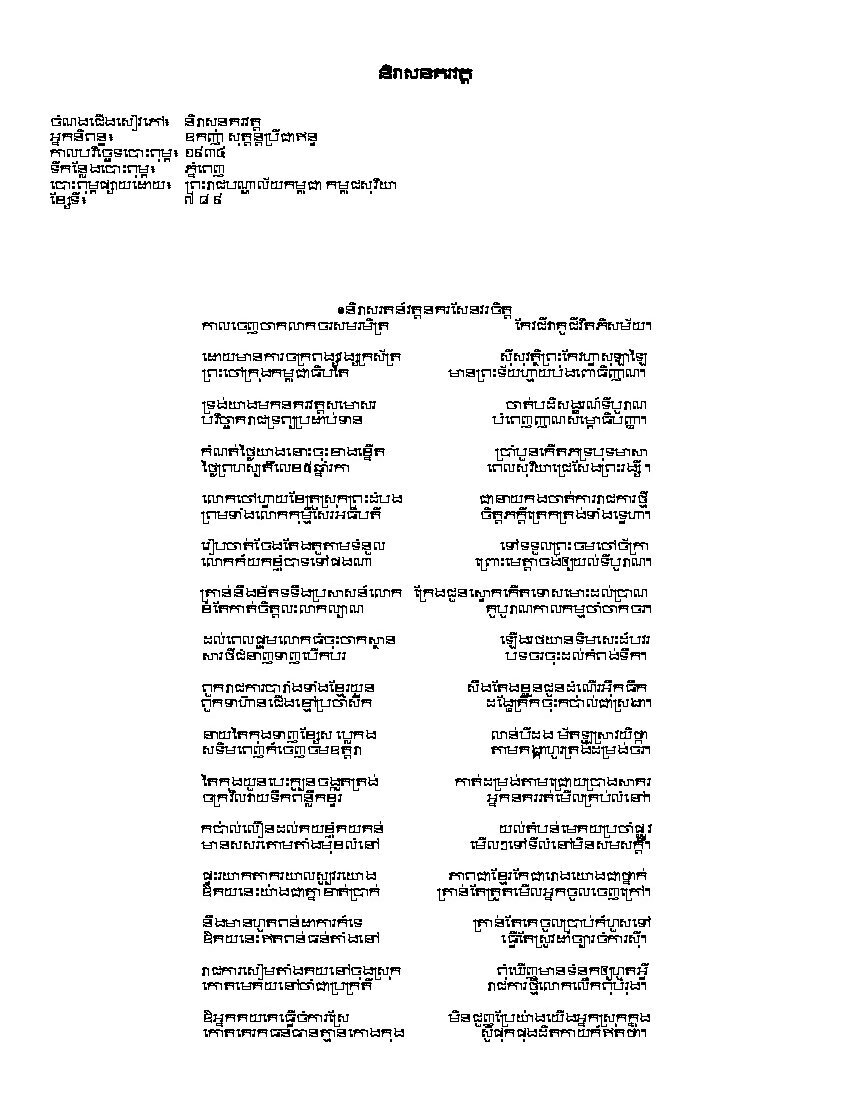
pdf 390.3 KB
The poem និរាសនគរវត្ត Niras Nokor Wat by former Buddhist monk, linguist and Battambang intellectual Ind Suttantaprija has been often studied and commented, yet this is the first time it appears in an easily accessible form. Published only in 1934, it reflects the visit to Angkor the poet made in September 1909 to join the royal celebrations led by King Sisowath. Using the Thai poetic genre, nirat นิราศ — ’ travel’ or ‘separation’ poem, Acharya Ind, who had spent years studying Thai manuscripts in Bangkok, expressed his feelings at attending the King’s tribute to the spirits of his august ancestors for the first time since the provinces of Siem Reap and Battambang — his hometown — had been handed back by the Kingdom of Siam under the French-Siamese 1907 Treaty.
At the time of this visit, Suttant Prija Ind [as his name is sometimes spelled in Latin letters] was 50, married since 1896 after leaving monkhood, and would join the Commission for the publication of the first Dictionary of Modern Khmer five years later, in 1914. He was, to quote Khmer literature historian Khing Hoc Dy, “the perfect example of the traditional Cambodian man of letters of that time who had an impeccable knowledge of Buddhism, and mastered Thai and Pali languages as well as his mother tongue.” [Khing Hoc Dy, Ecrivains et expressions litteraires du Cambodge au XXeme siecle, vol 2 of Contribution à l’histoire de la litterature khmere, Paris, L’Harmattan, 1993, p 10 – 11].
The nirat style Acharya Ind used to narrate his journey to Angkor for a ceremony to mark the temple’s return to Khmer sovereignty was a poetic genre developed in Siam since the end of the 15th century. Historian Penny Edwards was in the opinion that “this literary framing might have been an ironic riposte to the ancien régime of Siam, whose administration in Battambang had shaped the first 45 years of Ind’s life. As an ardent devotee of Old Khmer orthography and regional dialect, Ind might also have been seeking to set new boundary markers around the niras genre and to gesture to the possibility of the form’s Angkorian ancestry.” [Penny Edwards, “Inarguably Angkor”, in The Angkorian World, 2023, p 636]. Yet, the Cambodian poet was following a much older tradition, the Pali metrics codified in the Vuttodaya, the major treatise on Pali versification written in the 12th century by the Ceylonese grammarian Moggallana (Sangharakkhita Thera).
Spatially, the journey goes from Battambang to Angkor, with Bangkok in the far background. Symbolically, the visit is a way to travel in time, to go back to what Angkor was and meant for Khmer people, trying to reconnect with the past without political interferences — the difficult dealings with the Kingdom of Siam and the 1907 Treaty — nor scientific pretense — the Khmer word បុរាណវិទ្យា [boranvitya, lit. science of the old] for archaeology never appears in the poem, and in fact this Khmer neologism wasn’t not even listed in Guesdon Dictionary (1930). At the core, the poet “goes into the forest to watch ruins” as a way to grasp with the Buddhist essential doctrine of impermanence (anitya).
Ind’s poem didn’t attempt to break grounds in the approach of Cambodian history. Theara Thun, for instance, noted in 2024 that
Ind conveyed an understanding that closely resembled Thiounn’s regarding the portrayal of the founding of the Angkor dynasty and its glories by the legendary King Ket Mealea. He even believed that this fictitious ruler had had his portrait carved on the bas-reliefs of the southern gallery of Angkor Wat (Ind 1934). Ind’s assertion was contradicted by the French scholar Aymonier (1900 – 1904, 230), who in his 1904 study had identified the portrait as that of King Suryavarman II (r. 1113 – 1145), now identified by some scholars as the builder of Angkor Wat. In the same poem, however, Ind rejected the long-held view accounted in the chronicles that claimed Indrā, the King of Heaven, had constructed the Angkor temples. Instead, he argued that the temples had been built by meritorious ancient Khmer kings and that the sandstone used in the construction had been taken from the nearby mountains (Ind 1934, 50 – 51). In this respect, while to some extent holding on to what had been traditionally assumed about the ancient temples, Ind’s poem also conveys ideas that partially denied this long understanding. His poem reveals a mixture of understanding that combines elements both of the chronicle and of more recent knowledge in the interpretation of the history of Angkor as it moves toward a more rationalist and less supernatural view of the temple’s construction. [Thun Theara, Epistemology of the past : texts, history, and intellectuals of Cambodia, 1855 – 1970, University of Hawai Press, Kindle edition, 2024, p 67]
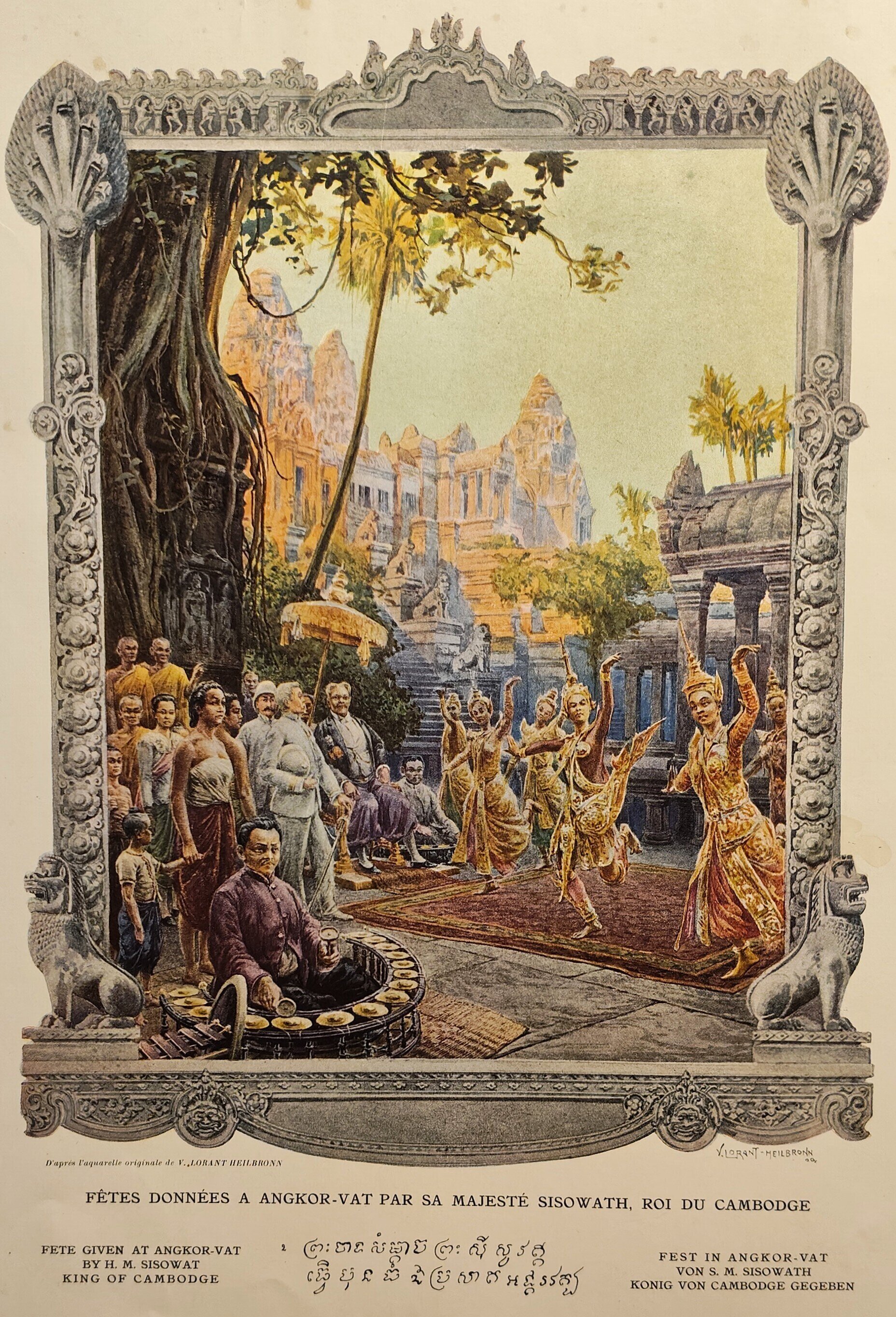
“Fetes donnees a Angkor par S.M. le roi Sisowath” [“Celebrations offered by HM King Sisowath”], frontispice in Pierre Dieulefils, L’Indochine Monumentale et Pittoresque (1911). Lithograph from a watercolor by Vincent Lorant-Heilbronn (1874−1933), a decorative painter and poster designer of Dutch-Belgian origin.
In spite of the wishes expressed by then governor-general of Indochina Anthony Klobukowski — who attended the ceremonies along with General de Beylié -. the 1909 celebrations didn’t make the headlines in the French media.
“Fetes donnees a Angkor par S.M. le roi Sisowath” [“Celebrations offered by HM King Sisowath”], frontispice in Pierre Dieulefils, L’Indochine Monumentale et Pittoresque (1911). Lithograph from a watercolor by Vincent Lorant-Heilbronn (1874−1933), a decorative painter and poster designer of Dutch-Belgian origin.
In spite of the wishes expressed by then governor-general of Indochina Anthony Klobukowski — who attended the ceremonies along with General de Beylié -. the 1909 celebrations didn’t make the headlines in the French media.
The experience of witnessing the ruined temples — and the Cambodian workers toiling under the command of archaeologists Jean Commaille and Henri Parmentier — essentially brought back the poet to his questioning about a “modernist” vision of Buddhism combining “purification, authenticity, and rationalism”, to use the definition by Anne R. Hansen (How to Behave, Buddhism and Modernity in Colonial Cambodia, 1860 – 1930, Chiang Mai, Silkworm Books, 2007, 254 p.). Meditating on “impermanence” — the ruins of a once formidable Empire — is surely a “path to purity” (as explicited in the Pali Canon’s Dhammapada, in particular verse 277), but the question now is the one raised in his manual of ethics, Gatilok: “How should we behave if we want to make ourselves pure?”
Anne Hansen also noted that Ukñā Suttantaprījā Ind was already deeply aware of social issues. For instance, he
wrote a poetic account of a revolt in Battambang in 1898, when Khmer cardamom pickers rose up against an oppressive [Siamese] tax collector. The leader of the revolt, a peasant named Ta Kae, is described in the poem as a man whose “mind was strong, stubborn, without fear.… a kind man such as he one can rarely find.” Ta Kae was guided-or, as the poem implies, misled-by a Vietnamese monk named Sav who conferred protective amulets on the rebels. The Thai general who was dispatched to put down the revolt beat the monk to death with a large pestle, accusing him as “the main enemy, imagining yourself a great man,” the culprit who had incited the peasants to revolt. Another revolt directed against Siamese authorities occurred between 1899 and 1902, when ethnic Lao villagers in northeast Siam began to circulate prophetic texts about an imminent catastrophe and the arrival of the Lord Thammikarāt, the righteous ruler. The predictions crystallized into a movement around several different leaders claiming to be phū mī bun, who attracted thousands of followers. In 1902, they attacked and ransacked provincial posts of the Siamese government. Keyes, drawing on Thai historical sources, reports that the peasant army, armed with old muskets, farm tools, and protective amulets, warned the Thai troops, “ ‘Don’t anybody shoot or do anything at all. Sit in meditation and our side will shoot but a single shot.’ ” Unfortunately for the rebels, the Thai soldiers began to fire, and the rebellion was quickly disbanded. [Hansen, op. cit.,p 63 – 63]
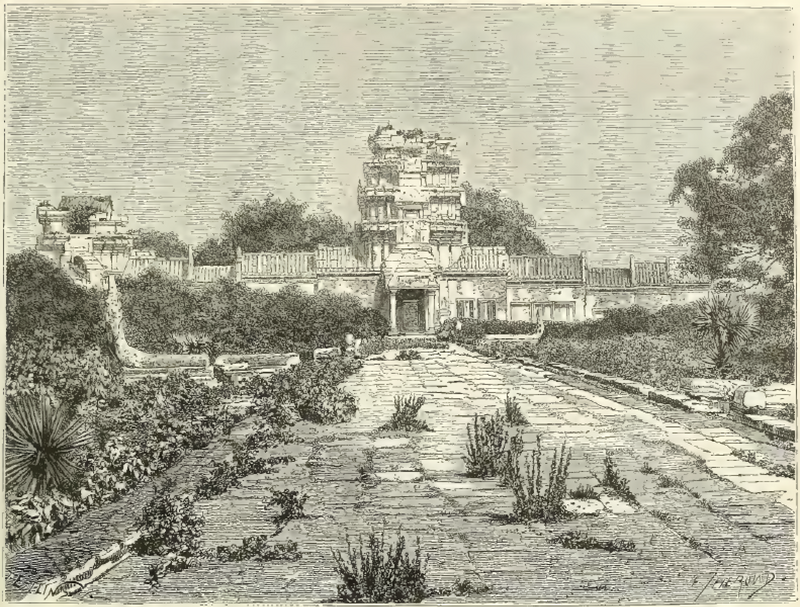
When he steps onto the western bridge leading to Angkor Wat, he meditates on the transient nature of all things while watching the nagas of the balustrade “broken and cracked”, resigning himself to the unescapble death: “Let the stone nagas of Angkor weigh on your chest!” And it also an occasion to sadly observe Khmer coolies sweating to implement a French vision of the renovation-restoration of Angkor:
Sir Monsieur Commaille, from France, / Takes cement and paints it on like paper as reinforcement. /Wherever moss grows thick enough to block your view, / Sir has it swept out clean. / Coolies are hired as labor / Chopping wood and hauling stone slabs to and fro / Or sweeping the paths spotlessly clean; / People come and go but there’s no dust to be seen. /I walk up to the path which Sir [is having] swept / And, seeing our Khmer race as coolies, / Am overcome with pity for the Khmer race, dirt poor, /Working as coolies for somebody else’s money. [translation by Penny Edwards].
‘Achar’ and future ‘Oknha’ — rank conferred to him by King Sisowath in 1914 — Ind, a Pali scholar who had left monkhood 13 years before his travel to Angkor, had traveled from Battambang by boat, a few days before King Sisowath himself was due to arrive in Angkor. It is not said but we can guess that the sovereign wanted to visit on his way his birth place, Mongkol-borey មង្គលបូរី, 60 km north of Battambang (now in Banteay Meanchey Province) where he was born on 7th September 1840 as Prince Sam-Our [Sar Ok] when his father, Ang Duong, had been appointed Governor before going to establish the Royal Palace at Udong, before his mother, Anak Muang Pou or Peou (1819- 23 June 1868), Ang Duong’s fourth wife, was given the title of H.M. Queen Mother Samdach Brhat Vararajini Mata. Sisowath had lived in forced residence in Siam after studying there, permitted to return in Cambodia in June 1958, had been forced to leave again (for Bangkok and Saigon) when his half-brother Norodom ascended to the throne in 1864, appointed Upauyvaraja (viceroy) on 28 May 1870 and succeeded Norodom after his death on 24 April 1904.
When he reaches the sprawling Royal encampment set right in front of the western causeway at Angkor Wat — after recovering under a banyan tree nearby from the walk of exactly “140 or 145 sen” (សិន) [5.6 or 5.8 kms] that had brought him from the little town of Siem Reap -, called the “Palace of Victory” (វាំងជ័យ, Vang Chey), on the 11th day of the waxing moon — that would be 25 September — the King has just arrived, and Ind feels anxious for the 10 monks that have come from the venerable Battambang pagoda Wat Ta Mem វត្តតាមិម — if the Pali recitations and ceremonies they came to join in start late, they risked to break their Vassa (វស្សា) vows, as the three-month Buddhist rainy season retreat allowed them to travel away from their pagoda for 7 days only. [p 30 – 4]
Ind’s account relates to rituals and symbolic actions that had little to do with some profane celebration of a French diplomatic victory over the Kingdom of Siam. In the poem, he mentions the King preparing the offerings to his ancestors for the ceremony of the Blessing of the King’s Age រាជពិធីចំរើនព្រះជន្មា — his seventieth birthday, according to the Khmer computation - , and presiding to the Sacred Water Drinking Ceremony ពិធីផឹកទឹកព្រះសច្ចា — the oath of loyalty that was to be performed by all officials in attendance, Cambodian and French on the 13th day.
Two days later, the day of full moon (29 September), the King received at his encampment the Buddhist monks for the praeng changhan ប្រគេនចង្ហាន់ — meal offering — to 100 monks gathered there. Later in the day, The 100-Monk Council of Recitation (សង្គាយនា sangayana) performed the the Dedication of the Tripitaka (Pali canon) for Study Pali, and then the recitation of the vinaya (Buddhist monastic discipline) precepts until dusk, attended by recitants from Wat Ta Mem, Wat Pipitharam វត្ត ពិភិទ្ធារាម (built in 1873 in Prek Moha Tep Village, Battambang) and from the Siem Reap sangha (Buddhist community). [p. 36, 39]
The day after, 1st day of the waning moon, there was a large procession to bring the sacred texts of the Tripitaka (ហែព្រះគម្ពីរត្រៃបិដក) to the ho trai ហោត្រៃ (pavilion of the Tripitaka, called “library” in Thai (หอไตร) for everyone to come and study at Angkor Wat. The French officials, who had arrived quite late — Governor-General Klobukowski and his suite — including Général de Beylié, a career officer and “old school” amateur archaeologist whose views on the history of Angkor Wat had been dismissed by leading EFEO researcher Louis Finot — left Saigon on 24 September, making the trip in 3 days only thanks to the French Navy steamer they had boarded -, thought that this meant the foundation of a School of Pali right in Angkor, under the supervision of the Siem Reap Buddhist leaders, in particular the Head Monk of Wat Bo, known for his conservative views. On the evening of the 30 September, he solemnly inaugurated the ‘school’, unaware of what was really going on in the Buddhist establishment.
The 10 monks of Wat Ta Mem were in reality representatives of the ‘modernist’ movement, a movement in which Suttantaprija Ind was more and more involved. King Sisowath had also made sure to name two like-minded Pali scholars, Acharya Oum អាចារ្យអ៊ុម and Preah Pouthisvong ព្រះពុទ្ធវង្ស , to supervise Pali studies in the Angkor area. At that time, Ind was already thinking of moving to Phnom Penh in order to join forces with progressive Pali specialists with the approval of Minister of War and Minister of Public Instruction Pech Ponn. Reform of the Khmer orthography and ‘modern Dhamma’ were their two beacons, and in his poem Ind refers to the capital city as the pole of change.
Antony Wladislas Klobukowski [Klobu, as he had been nicknamed by his friend Georges Clemenceau] (25 Sept. 1855, Auxerre, France — 24 Apr. 1934, Paris), a French career diplomat of Polish origin who had married one of the daughters of Minister of Public Education Paul Bert (19 Oct. 1833, Auxerre — 11 Nov. 1886, Hanoi), had been appointed Governor-General of Indochina only a few months earlier, and was to stay quite briefly at that post (1908−1911). He was one of the few diplomats to have a deep knowledge both of Cambodia and Siam, since he had served as Governor Charles Thomson’s first secretary in Cochinchina and Cambodia from 1882 to 1886, special envoy to Siam in 1886 and Minister Plenipotentiary in Bangkok from 1901 to 1903 [he was then posted to various countries including Japan, India, Peru, Egypt, Ethiopia]. He had envisioned these celebrations at Angkor on a grandiose scale, and was disappointed to see that the September event was mostly ignored by the metropolitan and regional press.
Klobukowski was substituted by Albert Sarrault in 1911 at the general governorate of Indochina precisely because he tended to “favor the traditional elites” instead of pushing for the ‘modernization’ [Frenchifying] of the educative system, particularly in Vietnam [see Gilles de Gantès, “L’absolutisme colonial face au développement de la sensibilité moderniste vietnamienne. Le sens et les limites d’une tolérance exceptionnelle”, in Vietnam: Le moment moderniste, Gilles De Gantès et Phuong Ngoc Nguyen (dir.), Aix-en-Provence, Presses Universitaires de Provence, 2009, p. 215 – 221]
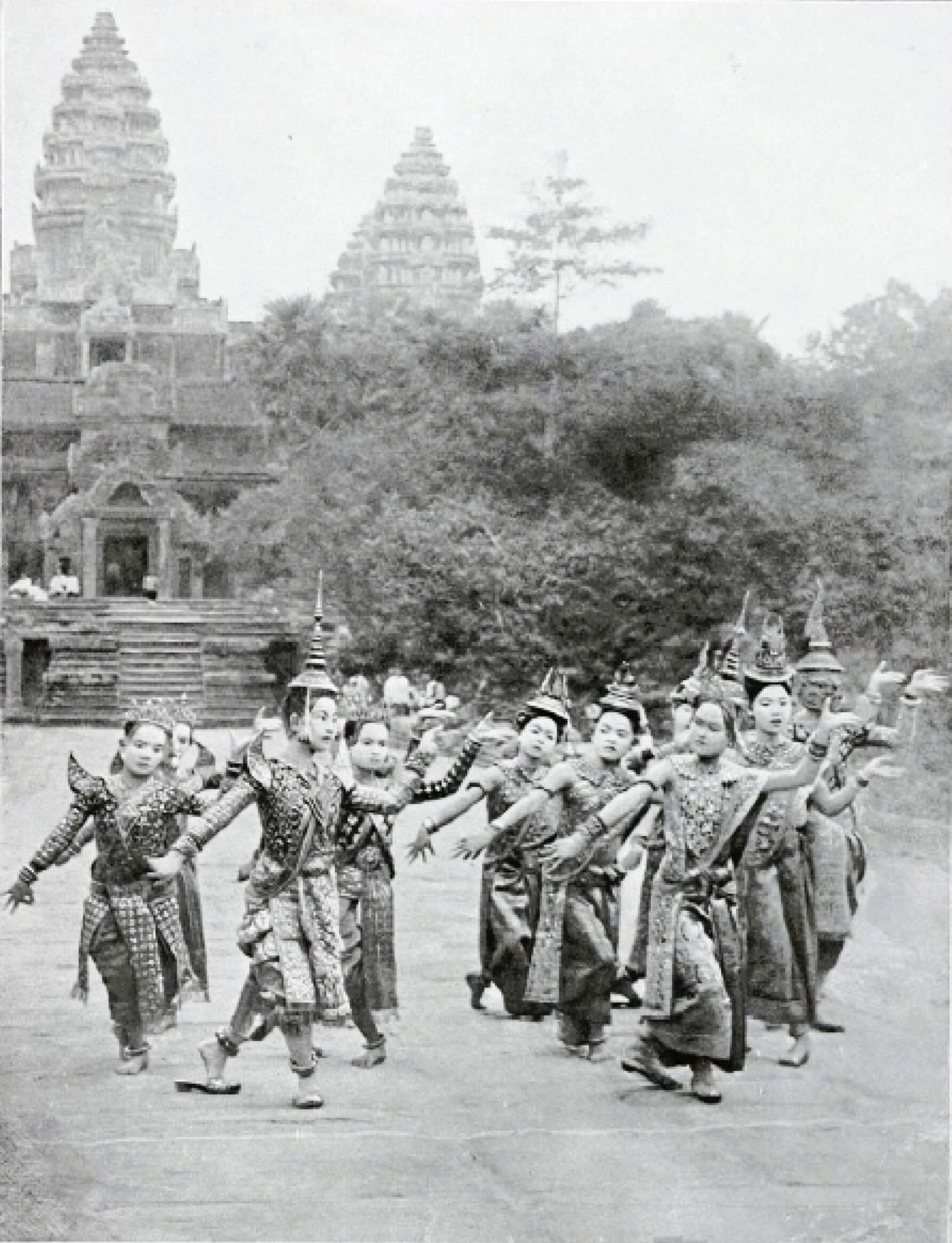
“Une vision du lointain passé: les petites ballerines du roi Sisowath dansant dans les ruines d’Angkor.” [Vision of a distant past: the little dancers of King Sisowath dancing amongst the ruins of Angkor]. The dancers had also traveled from Battambang by boat along the Sangke River and the Tonle Sap Lake. [photographer unknown].
“Une vision du lointain passé: les petites ballerines du roi Sisowath dansant dans les ruines d’Angkor.” [Vision of a distant past: the little dancers of King Sisowath dancing amongst the ruins of Angkor]. The dancers had also traveled from Battambang by boat along the Sangke River and the Tonle Sap Lake. [photographer unknown].
Even the performances of the Royal Ballet among the magnificent ruins did not get much attention, only three years after the triumph of the Cambodian dancers in France. This can be partly explained by the fact that the Cambodian sovereign himself had wished to keep the dances within the register of the sacred tribute to the ancestors. Ind didn’t mention the royal dancers in his poem, even once, only reporting the Yike យីកេ dances during the night of the full moon as part of the popular merriment in Angkor, along with many games of chance (អាប៉េ, a‑pae ) enjoyed by the “local villagers [who had] come to watch in massive, orderly crowds.” Far for from the somehow Siamese-influenced court dances, the Lakhon Yike, rythmed by large drums and incorporating singing and dancing, reflects the deepest roots of Cambodian culture as this art form is said to have come from Champa to Funan. Malay influences are noticeable in its rythm, and it had stayed alive as a traditional village dance and theater particularly in the Mekong Delta communities.
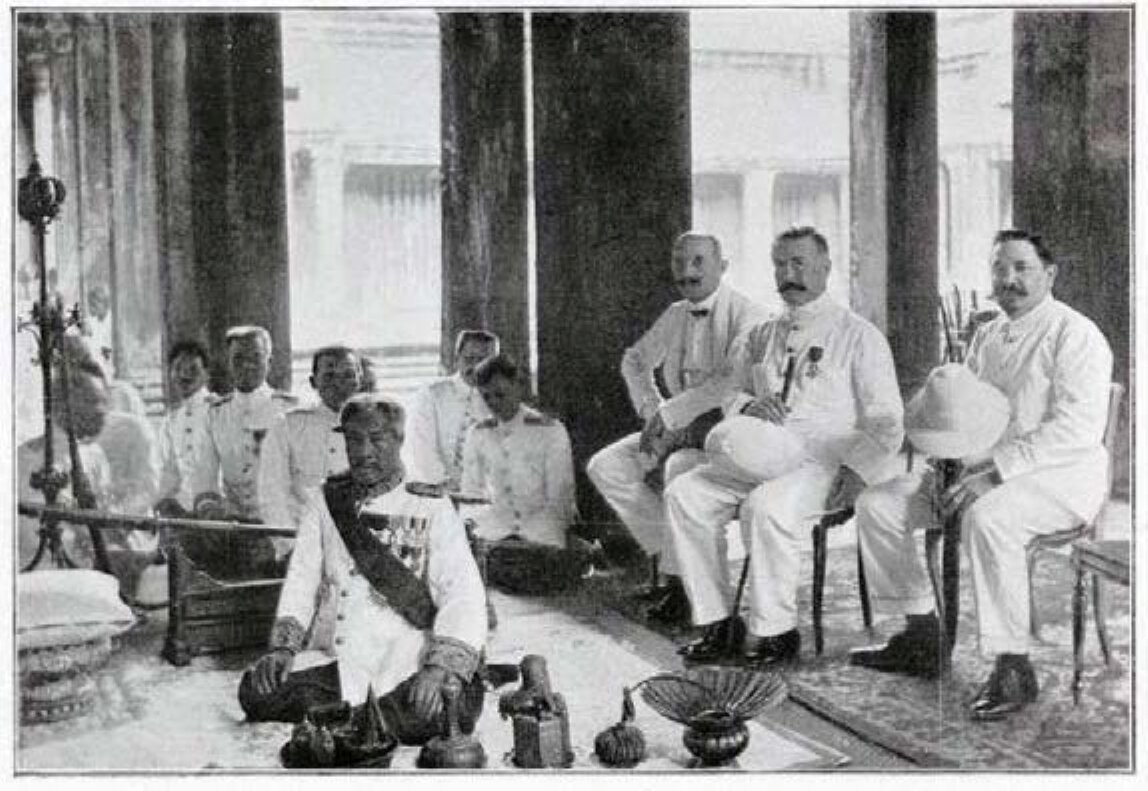
1) The four Buddha statues “just recently discovered” in the walled-up inner cella beneath the central tower [Bakan] at Angkor Wat. 2) King Sisowath meditating in the first inner courtyard. Behind him, musicians (left) and, sitting on chairs from left to right, Mr. Petillot (first secretary of the Residence), Mr. Louis Luce (Resident-Supérieur in Cambodia), and Mr. Michel, French Attorney General in Cambodia. [source: photographer unknwon, published in L’Illustration n. 3483, 27 Nov. 1909, p. 386].
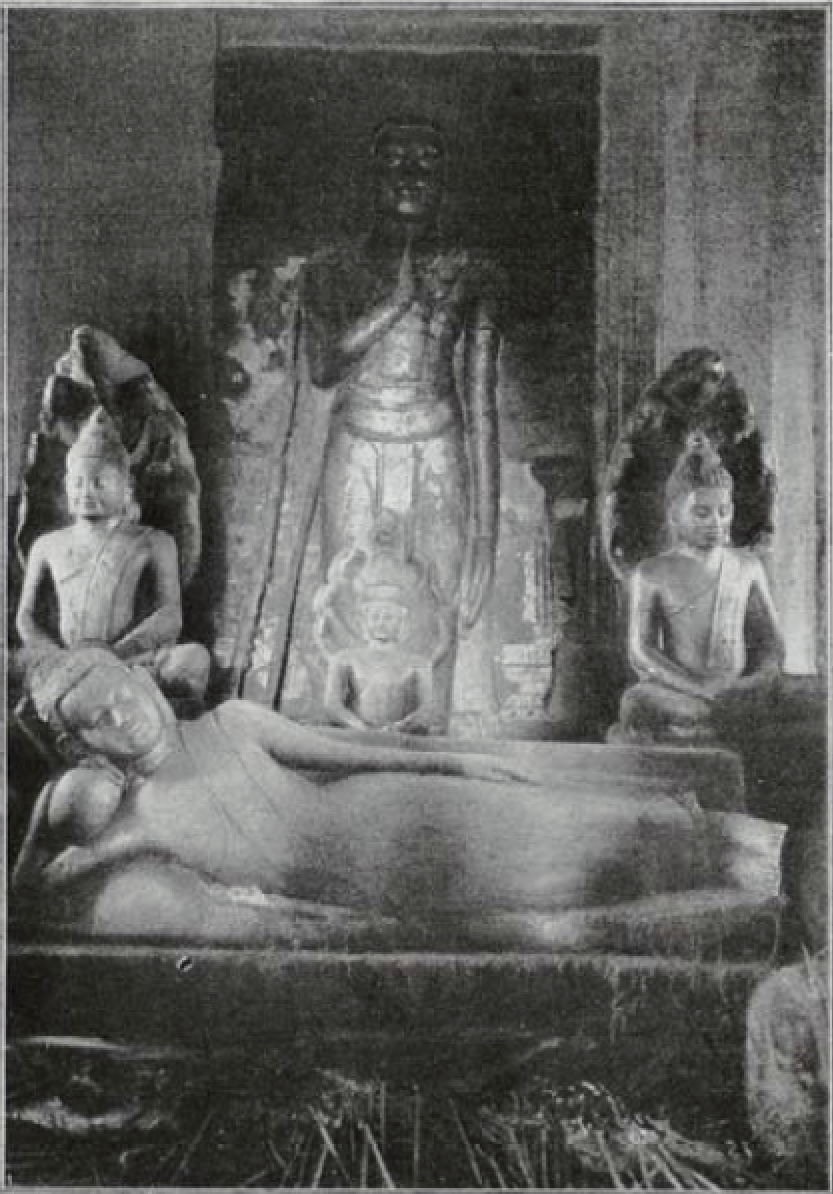
1) The four Buddha statues “just recently discovered” in the walled-up inner cella beneath the central tower [Bakan] at Angkor Wat. 2) King Sisowath meditating in the first inner courtyard. Behind him, musicians (left) and, sitting on chairs from left to right, Mr. Petillot (first secretary of the Residence), Mr. Louis Luce (Resident-Supérieur in Cambodia), and Mr. Michel, French Attorney General in Cambodia. [source: photographer unknwon, published in L’Illustration n. 3483, 27 Nov. 1909, p. 386].
1) The four Buddha statues “just recently discovered” in the walled-up inner cella beneath the central tower [Bakan] at Angkor Wat. 2) King Sisowath meditating in the first inner courtyard. Behind him, musicians (left) and, sitting on chairs from left to right, Mr. Petillot (first secretary of the Residence), Mr. Louis Luce (Resident-Supérieur in Cambodia), and Mr. Michel, French Attorney General in Cambodia. [source: photographer unknwon, published in L’Illustration n. 3483, 27 Nov. 1909, p. 386].
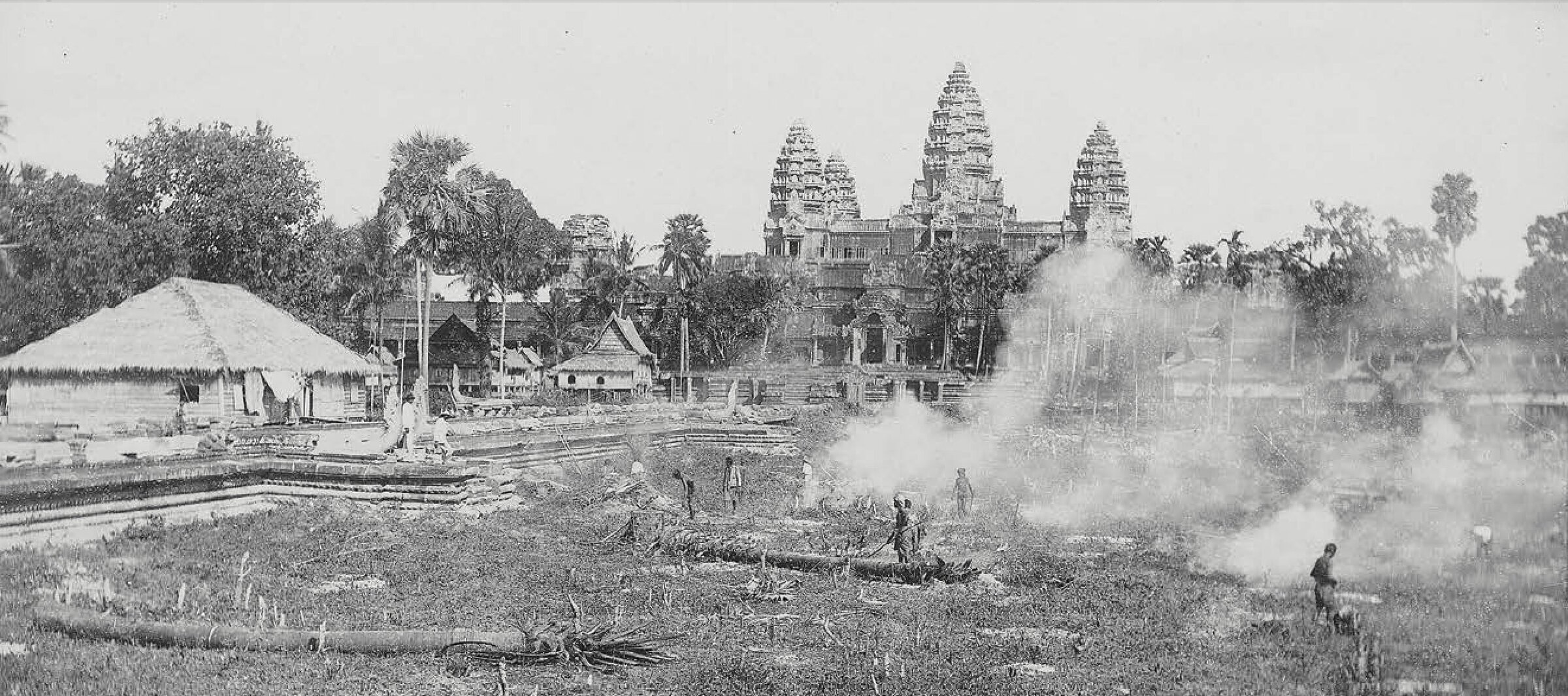
Conservator Jean Commaille’s bungalow on the western causeway to Angkor Wat, c. 1911. [source: EFEO-CAM04214]. The encampment for French officials at the celebrations had been settled nearby, and top-ranking French attendants stayed at the newly completed Bungalow d’Angkor.
Conservator Jean Commaille’s bungalow on the western causeway to Angkor Wat, c. 1911. [source: EFEO-CAM04214]. The encampment for French officials at the celebrations had been settled nearby, and top-ranking French attendants stayed at the newly completed Bungalow d’Angkor.
All along his poetic narration, the author seems to be looking for spatial markers, the seima symbolizing the limits of a particularly sacred space but also geographical indications, as if the recently reclaimed territory from the Siamese authority needed to be more precisely measured. For instance, he notes that The distance of the journey from Chong Kneas [the port on the Tonle Sap Lake] itself,/Reaching the city walls of Siem Reap, the officials have determined,/Is exactly three hundred and ninety-five sen.” (395 sen = 15.8 kilometers). [p.14] To refer to these ramparts, he uses the word កំពែង kampeang, then commonly used in Battambang for dam, dyke, or city walls. That would be place the ancient city walls a little south of Wat Damnak.
“What did the retrocession of Angkor mean to this brilliant poet of elegant wit? His verse leaves us guessing,” concluded Penny Edwards at the end of her recent essay on Niras Nokor Wat. This was is a journey through “layered history and mythology, through time and space” (with Phnom Penh and Angkor as “two clear compass points.” [Penny Edwards, “Inarguably Angkor”, op.cit., p. 636]. With references to Hindu deities (Indra), tutelar local spirits such as Srey Khmau [Neang Khmau] — the animist interpretation of ancient goddesses Kali, Durga, Parvati, and the search for a Dhamma (Buddhist way) adapted to modern times.
Before its first print publication in 1934, Ind’s poem made of 525 stanzas in tetrameter had widely circulated in Cambodia, both in oral (public recitations) and written forms, the latter as handwritten copies that were already called “books” [សៀវភៅ sievphow as ប្រជុំក្រដាស ‘collection of papers’]. While we don’t know exactly why Niras Nokor Wat was published in print only ten years after the author’s death, the notion that it is because the text was discovered posthumously doesn’t seem to be valid.
Niras Nokor Wat was composed in the បទពាក្យ៨ (eight-syllable verse) poetic form, meaning that each line follows an eight-syllable structure.
The versification is organized through two types of rhyme: internal rhyme within a stanza, and linking rhyme between stanzas.
Within a stanza, there are four groups of words (lines). The rhyming pattern is as follows:
For inter-stanza rhyme, the final vowel of the last group of one stanza rhymes with the final vowel of the second group of the following stanza.
ដើម្បីជាការបកស្រាយចម្ងល់របស់អ្នកសិក្សាស្រាវជ្រាវ អ្នកអានទូទៅក៏ដូចជាអ្នកនិយមពាក្យកាព្យឃ្លោង ដែលមានមន្ទិលសង្ស័យទៅលើបែបបទ ទីតាំងឃ្លាកំណាព្យរបស់អត្ថបទពាក្យកាព្យ និរាសនគរវត្ត ដែលយើងខ្ញុំបានចម្លងយកមកនិងបានផ្លាស់ប្តូរនូវទម្រង់នៃការរៀបរាងឃ្លាល្បះខុសពីអត្ថបទដើមរបស់កវីខ្មែរគឺ លោកឧកញ៉ា សុត្តន្តប្រីជាឥន្ទ ជាអ្នកប្រាជ្ញអក្សរសាស្ត្រដែលមានកិត្តិសព្ទល្បីល្បាញ។ អត្ថបទនេះដែរ យើងបានចម្លងចេញពីអត្ថបទកំណាព្យ និរាសនគរវត្ត ដែលបានបោះពុម្ពឡើងនៅក្នុងឆ្នាំ ១៩៣៤ ដែលជាការបោះពុម្ពផ្សាយក្នុងទស្សនាវដ្ដី កម្ពុជាសុរិយា។ នៅក្នុងអត្ថបទដើមដែលយើងចម្លងមកនោះ ត្រូវបានរៀបរាងជាបទពាក្យប្រាំបី និងមានវគ្គខ្លះមាន៣ឃ្លា ៤ឃ្លា ទៅ៥ឃ្លាក្នុងមួយវគ្គ។ ចំណែកទីតាំងនៃឃ្លាមានការចុះបន្ទាត់រៀងរាល់មួយឃ្លាម្តង និងបញ្ចប់វគ្គកំណាព្យដោយសញ្ញាខណ្ឌ (។) ។
យើងក៏បានពិភាក្សាគ្នាជុំវិញបញ្ហានេះដែលថា គម្រោងនិងទីតាំងឃ្លាល្បះនៃកំណាព្យនិរាសនគរវត្តនេះមានការខុសគ្នាពីគម្រោងនិងរបៀបនៃការសរសេរឃ្លាល្បះរបស់កំណាព្យតាមបែបបទនៃសម័យបច្ចុប្បន្ន។ យើងបានព្យាយាមសិក្សាស្វែងយល់អំពីមូលហេតុនៃភាពខុសគ្នាខាងលើ ព្រមទាំងបានសាកសួរទៅកាន់សាស្រ្តាចារ្យផ្នែកអក្សរសាស្រ្តគឺសាស្ត្រាចារ្យ ឡុង សារិន និងទទួលបានចម្លើយដែលមានភាពសមហេតុសមផល ពោលគឺរាល់អត្ថបទកំណាព្យដែលត្រូវបានតាក់តែងឡើងនោះ ទីតាំងនិងរបៀបនៃការសរសេរឃ្លានៃកំណាព្យគឺអាស្រ័យលើទំនោរនិងចំណង់ចំណូលចិត្តរបស់លោកអ្នកនិពន្ធ ហើយវាក៏មិនមែនជាបញ្ហាដែលធ្វើឲ្យប៉ះពាល់ដល់សិល្ប៍វិធីនៃការតាក់តែងកំណាព្យឡើយ ប្រសិនបើកាលណាកំណាព្យនោះមានឃ្លាចុងចួនផ្ទួនរណ្តំគួបផ្សំនឹងអត្ថរូបនិងអត្ថរសដែលជាច្បាប់គោលនៃការតាក់តែងកំណាព្យ។ យើងក៏ដឹងដែលថា ចំពោះវិធីតាក់តែងកំណាព្យពាក្យប្រាំបីនៅសម័យយើងបច្ចុប្បន្ននេះមានការសរសេរជា២ឃ្លាក្នុងមួយបន្ទាត់ ៤ឃ្លាក្នុងមួយវគ្គនិងមានបញ្ចប់ដោយសញ្ញាខ័ណ្ឌនៅចុងបញ្ចប់នៃវគ្គ ត្រង់ឃ្លាទី៤។ បើទោះបីជាយ៉ាងនេះក៏ដោយ របៀបនៃការសរសេរទម្រង់នៃកំណាព្យទាំង២គឺមានភាពត្រឹមត្រូវដូចគ្នា។ យើងខ្ញុំក៏បានសម្រេចសម្រួលគ្នាថាគួរចម្លងអត្ថបទកំណាព្យនេះទាំងស្រុង មិនកែប្រែទៅលើចំនួនឃ្លានៃវគ្គមួយចំនួនដែលមានលើសឬខ្វះពី៤ឃ្លាក្នុងមួយវគ្គឡើយ ប៉ុន្តែគ្រាន់តែផ្លាស់ប្តូររបៀបនៃការសរសេរឃ្លាកំណាព្យមកជាទម្រង់កំណាព្យដែលយើងគ្រប់គ្នាសិក្សានិងប្រើប្រាស់ក្នុងសម័យបច្ចុប្បន្ននេះវិញដើម្បីផ្តល់ជាភាពងាយស្រួលដល់អ្នកអាន។
ជាចុងបញ្ចប់ ក្រុមការងារយើងខ្ញុំក៏សូមអភ័យទោសចំពោះចន្លោះខ្វះខាតដោយប្រការណាមួយ ដោយអចេតនានៅក្នុងកិច្ចការដែលយើងរាបរៀងឡើងមកនេះ។
To address the questions of scholars and general readers, and poetic skeptics regarding the form, structure, and verses of the present presentation of Niras Nokor Wat - we have opted for a text layout which differs from the original version by the renowned Khmer poet. The poem was sourced from the 1934 edition published in the review Kambuja Surya. In the original text, the poem follows an eight-syllable verse structure, with some stanzas containing 3, 4, or even 5 lines per stanza. Each line is indented (written in a single column) and ends with the Khmer comma (។).
We also assessed the structure of the poem Niras Nokor Wat, noting that it differs from the poetic forms and writing styles commonly used today. In our efforts to understand these differences, we consulted literature professor Long Sarin, who provided the following explanation:
“The format or structure of a poem often reflects the poet’s personal inclinations and preferences. This does not affect the artistic quality of the poem, as long as it includes a cohesive sequence of words and phrases, strong imagery, and an underlying educational or moral message, the fundamental principles of Cambodian poetic composition. Today, an eight-syllable poem is typically written with two segments per line, four lines per stanza, and a comma at the end of the fourth line. However, both styles of poetic structure are equally valid. While opting to preserve the original text of the poem in its entirety, without altering the number of phrases per stanza, even if there are more or fewer than four, the only adjustment made was reformatting the text from a single-column layout to a two-column format, consistent with the style we study and use today, in order to make it easier for readers to follow.” — Ranith, Angkor Database Researcher, Sept. 2025.
This digitization of a print text is part of Angkor Database contribution in making accessible
Tags: Khmer literature, poetry, 1900s, 1910s, Cambodian writers, French Protectorate, dance, education, Pali canon
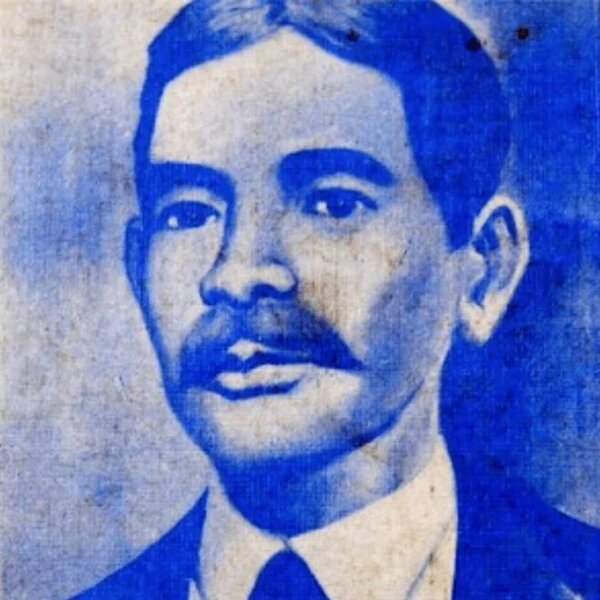
Oknha Suttantaprījā [Sothnpreychea] Ind សុត្តន្តប្រីជាឥន្ទ (22 July 1859, Rokar Korng Village, Kandal Province – 8 Nov. 1924, Battambang) was a Cambodian monk and writer whose work is considered as “pivotal” in the Cambodian literature transitional period between tradition and modernity.
His stanza poem Niras Nokor Wat - on which he worked between 1909 and 1915, his manuscript having been discovered posthumously and published by the Buddhist Institute in 1934 -, related to his attending of King Sisowath’s ceremony at Angkor on Thursday 23 September 1909, marking the 1907 retrocession of Siem Reap and Battambang provinces from Siam and possibly commissioned by the King, is a Khmer literary modern-classic work [1], an account of a “river journey [on the Sangke River] that becomes a meditation on life, desire, and impermanence,” according to Trent Walker. As Penny Edwards remarked, “Ind’s verse is burnished by his monastic training, Pali repertoire, and cosmopolitan schooling.” [“Inarguably Angkor”, in The Angkorian World, 2023, p 641.]
When Suttantaprija Ind was 15, he lived at Wat Prek Por, studying Pali scripts. At 18, he went to Phnom Penh to study under a Buddhist preacher called Prak at Wat Unalom. One year later, he studied with Lok Achar Sok for a year at Wat Keo pagoda, Battambang. He became a monk again when he was 20 at Wat Keo for one year, and went to study in Bangkok, Siam, in 1880. After seven years there he came back to Cambodia in 1887, during the time of Lok Prash Yakatha Chhum Khnon [th เจ้าพระยาอภัยภูเบศร (ชุ่ม อภัยวงศ์), kh ចៅពញាអភ័យភូបេស្ស (កថាថនឈុំ) Chao Ponhea Apheayphubet Kathatan Chhum [2]] (29 July 1861 – 27 Aug 1922), the last ruler of Battambang under Siamese control who appointed him Khon Vichit Voha and Hluong Vichit Vohar, special counselor, after he left the monastic life.
His life reflects the tensions between Cambodia, Siam and France at the time. For instance, his closeness to ‘viceroy’ Chhum could explain his choice of leaving for Bangkok, but also reflects the close family ties across the two countries: Chhum’s sister, acclaimed court dancer Khun Chom Iem Boseba [3](1864 – 1944), was one of King Norodom’s wives and, by giving birth to Prince Sutharot (1872−1945), at the origin of the Royal House of Norodom. She was a daughter of Chao Banam Abhayadipati [Nhonh], from the Abhaivongse family, sometime Governor of Battambang, by his wife, Than Pu Ying Tuptim Bunnag. But Chhum’s granddaughter, Princess Chao Sovathana ព្រះនាងចៅសុវឌ្ឍនា (th พระนางเจ้าสุวัทนา พระวรราชเทวี HRH Princess Suwattana) (15 Apr 1906- 10 Oct 1985) was to marry in 1924 Siam’s King Vajiravuth (Rama VI) April 15, 1906 — October 10, 1985), thus being Queen of Siam for less than one year. During his spare time, Ind was also fond to translate the famous French folktales by La Fontaine in Khmer [4].
According to researcher Thun Theara, he “had translated a chronicle manuscript from Siamese into Khmer. The manuscript was a Cambodian palace chronicle, probably translated from Khmer into Siamese during Ang Duang’s reign, and collected by the Siamese intellectual K. S. R. Kulap (see Khing 2012, 15). Ind had probably come across the manuscript during his years as a Buddhist monk studying in Bangkok in the 1880s. In 1917 there was an effort in Thailand to compile and publish Khmer chronicle manuscripts that had been translated into Siamese since the reign of King Mongkut in the 1850s. The Thai edition included three different versions of the original Khmer manuscripts: the Nubbarath version of 1878 on the pre – fourteenth-century period, a manuscript composed during Ang Duong’s reign in around 1855 on the 1346 – 1794 period, and another text acquired by Coedès in the 1910s on the 1794 – 1865 period. The edition was published as Ratchaphongsawadan Krung Kamphucha (Royal chronicles of Cambodia).” [in Epistemology of the Past: Texts, History, and Intellectuals of Cambodia, 1855 – 1970, New Southeast Asia: Politics, Meaning, and Memory, University of Hawaii Press, 2024, Kindle Edition, p 47) [5].
After staying at Wat Kandal (Battambang) for ten years, Suttantaprija Ind — then 37 — decided to leave the monkhood and married Lok Yay Tuet from Chomka Somroung village, Battambang, living in Chivea Thom village. In ជីវប្រវត្តិអ្នកនិពន្ធខ្មែរ [Biography of Khmer Writers] by Chhay Sokhai ឆាយ សុខៃ and Meas Sopanha មាស សុបញ្ញា (Phnom Penh, 2016, p 134 – 5), we find that “in Battambang province everyone appreciated him for his contributions to society, called him Lok Achar Ind, and loved his work. People borrowed and hand-copied his works before they were published. The hand-copied books were passed around from person to person for reading and studying. Some people knew the entire collection of his poetry by heart. […] According to his daughter, Lone Ind, Suttantaprija Ind was frequently invited to talk about dharma and tell stories when there was an event or ceremony such as a wedding, open house, etc. He would come back home with a lot of money, which he would like to give away to his grandchildren. At night, he would lay flat on his stomach writing all night long.”
In 1914, at 55, Suttantaprija Ind was back to Phnom Penh with honors, being granted the title of Oknha by King Sisowath for his contribution to the knowledge of Cambodian religion and traditions. He was called back to contribute to new Pali School (Ecole de Pali), with temporary quarters in the Silver Pagoda, transferred in 1922 to the building where the Buddhist Institute was to be set [6]. He was particularly occupied with the preparation of a Pali-Khmer Dictionary, and with the Dharma’s saying verification department. He resigned his civil servant post at 65, returning to Battambang where he passed away a few months later, surrounded by his family.
___________
[1] According to Sharon May in her 2015 essay on Cambodian literature,“the Buddhist Institute, which printed Ukñā Suttantaprījā Ind’s famous Gatilok and other literature, became the nation’s first publisher in the early 1900s. Khmer-language newspapers and journals first appeared in the 1920s, although the first Khmer-owned and operated newspaper, Naggaravatta [Angkor Wat] did not appear until 1937. The first Khmer modern novel also appeared in the 1930s. A new Khmer term was invented for the novel, ប្រលោមលោក pralomlok, which means a story that is written to seduce the hearts of human beings. Many of these early works featured ill-fated lovers and contained moral and social critique. As was common for the era in Southeast Asia, and for writers such as Dickens and Tolstoy earlier in Europe, most novels were first serialized in newspapers or journals. Among the early novels still read today are The Waters of Tonle Sap by Kim Hak, The Tale of Sophat by Rim Kim, The Rose of Pailin by Nhok Them, and Wilted Flower by Nou Hach. Literature became linked with national identity, as quoted in the journal Kambuja Surya, “If its writing disappears, the nation vanishes.”
[2] Abhayavongsa อภัยวงศ์ was a Thai noble surname used by the Thai family that formerly governed parts of Cambodia at the time it was ruled by Siam. Despite its long presence in Cambodia, it was never considered part of the Khmer nobility. The Abhayavongsa family governed Phra Tabong Province (modern Battambang Province, Cambodia) for six generations from the late 18th century, when Siam annexed the Khmer territories, until 1907, when the area was ceded to French Indochina effectively reuniting it with Cambodia. The title bestowed by the Thai King to the governor of Phra Tabong which was used by each successive governor was Aphaiphubet [Apheayphubet]. [source: Wikipedia].
[3] บุษบาท่ Bus’ba in Thai means flower. In “The Gru of Parnassus: Au Chhieng among the Titans” (Udaya 15, 2021, p 127 – 82 [tr. by Robert Fowler], Grégory Mikaelian noted that
her filiation varies according to the family trees available: for Népote and Sisowath, Khun Cham Iem Bossaba is the daughter of a Battambang mandarin and a relative of the royal family of Thailand, without further specification (Népote and Sisowath, État présent, 68); for Corfield, Yem Bossaba is the sister of Thao Sri Sudorn-nath, herself the grandmother of Phra Nang Chao Suvadhana (1905−1985), who married Rama VI (also known as Vajiravudh) in 1924, (Corfield, The Royal Family, 47 – 48); for Nhiek Tioulong, Khun Chom Iem is the daughter of a titled dignitary, “Piphéak Bodin”, former governor of Siem Reap under Siamese authority, another of whose daughters, Mâm Keo, is the grandmother of Pranang Tiv, wife of Rama VI (Nhiek, Chroniques khmères, 44). At this stage, the divergences are easily resolved: the “Battambang mandarin” father of the two sisters (one of whom is the grandmother of one of the wives of King Rama IV) is none other than “Piphéak Bodin,” governor of Siem Reap falling within the orbit of the regents of Battambang (Loch, “Chronique des vice-rois de Battambang”). On the other hand, things become complicated when you try to clarify the identity of this dignitary and that of the mother of Iem. If you follow the genealogies of the Siamese royal family (“Khmer-Siam Royal Family Tree”), she is none other than the daughter of the eighth governor of Battambang (see likewise Khuon, Battambang et sa région, 119 and So, The Khmer Kings, Book II, 372).
[4] In his monograph on Suttantaprija Ind, Khing Hoc Dy noted that he helped Père [Father] S. Tandart in his research on Khmer language when the Catholic missionary was active in Battambang. The latter published a few years later S. Tandart, Dictionnaire Français-Cambodgien, t 1, Hong-Kong, Imprimerie de la Société des Missions-Etrangères, 1910, 1104 p. In his review of the dictionary (Toun’g Pao, vol 13, 1912, p 744 – 5), Henri Cordier noted that the same author was “set to publish an Essay on Khmer Grammar.” We do not know whether this project came to fruition.
[5] Known as “Royal Chronicle ME”, since the manuscript is kept at the library of the Missions-Étrangères (ME) in Paris. In his Histoire du Cambodge… (p 15), historian Mak Phoeun noted that this chronicle was “apparently a translation into Khmer — made around 1909 (?) under the reign of Sïsuvatthi (Sisowath) (1904−1927) by the Achary “Ind”, later known as Ukañā Suttant Prījā “Ind” (1859 — 1924) — of a Cambodian royal chronicle previously translated into Siamese. It starts with King Rām de Joen Brai (or Rām I) and ends in 1811 AD. The text often records the same facts than other royal chronicles, yet is much more detailed in relation to events reported from the end of the 18th century, with a slightly different list of kings for the end of 17 th century.”
[6] It has often be said that Ind had worked at the Buddhist Institute but this institution was founded on 12 May 1930 by King Sisowath Monivong of Cambodia, King Sisavong Vong of Laos, the Governor General of Indochina Pierre Pasquier and George Coedès, then director of the EFEO.
See also
sk आचार्य, "he who knows the sacred writings" | kh អាចារ្យ achar
Knowledgeable person, officiant, spiritual preceptor/guide, religious teacher. Royal acharyas are named in pre-Angkorian and Angkorian inscriptions.
In modern Cambodia, the Achar is the officiant who communicate with the monks performing rituals for the community.
sk अनित्य anitya, “non-eternal”. | pl anicca, "impermanent". | kh អនិច្ចា anichya, "not fixed".
In Buddhism, anitya refers to the state of ‘impermanence’, constant and fleeting change, the 'impermanent objects.
In Theravada Buddhism, aniccānupassanā is the contemplation of impermanence, the first of the 18 chief kinds of insight.
In modern Khmer, the word is used to express sorrow in phrases like ឱ អនិច្ចាអ្វីម្ល៉េះទេ! , ឱ អនិច្ចា !, lit. "What an anichya!", "How anichya!".
sk दुर्गा Durga "invicible", "fortress-like", "beyond defeat" | sk दुर्गा महिषासुर मर्दिनी Durga Mahishasura Mardini "who defeats Mahishasura". | kh ព្រះម៉ែទុគា Preah Me Thuka, ព្រះនាងទុរគ្គា Preah Tureka, ចៅម៉ែទុគ៌ា Chao Methuka, ព្រះម៉ែទុគ៌ា Preah Maa Tukra, "Preah Maa Durga" ["Goddess Mother Durga"] | th เจ้าแม่ดูร์กา Cea mae Durka "Goddess Durga" | jv Loro Jonggrang "slender maiden"
Durga is a major Hindu goddess, worshipped as a principal avatar of mother goddess Mahadevi, associated with protection, strength, motherhood, destruction, and wars. She has different names, including Durgā, Bhadrakālī, Vijayā, Vaiṣṇavī, Kumudā, Caṇḍikā, Kṛṣṇā, Mādhavī, Kanyakā, Māyā, Nārāyaṇī, Īśānī, Śāradā and Ambikā.
In Shaktism (goddess-centric sect), she is Devi (the Goddess), primordial creator of the universe, and in the Bhagavata purana she is Vishnu's younger sister. In Indian representations - in particular at Aihole Temple - Mahishasura Mardini Durga has eight arms, carrying the weapons and attributes given to her by male deities: the trident (given by Shiva), the Chakra (Vishnu), the conch (Varuna), the Pasha an iron rod (Yama), the dart (Agni), the bow (Vayu), the quiver and arrows (Surya), the thuderbolt (Indra), the mace (Kubera), the rosary and a water pot (Brahma), the sword and shield (Kala), the battle axe (Vishwakarma), the lion (Himavan), a disc and a lotus, a bell, etc...She is standing in the Tribhanga pose (three bends), legs apart, left leg pressing down the buffalo demon.
Across Indonesian islands, Durga was the most common representation among ancient sculptures of female deities. Durga statues have been discovered at stone temples and archaeological sites in Vietnam, likely related to Champa or Cham dynasty era.
In Cambodian art, Durga, in particular in the Mahishasurmardini form, was revered since the oldest recorded times. An 1.65 meter-high statue was retrieved at what has been supposed to be the site of the main temple of King Ishanavarman of Chenla (r. c. 615–628 C.E.) in Ishanapura (Sambor Prei Kuk).
In modern Cambodia, the Indian community has started to give social resonance to the celebration of Durga Puja, the festival observed usually in September or October, from the sixth (Shashti) to the tenth day of the bright lunar fortnight in the Hindu lunar calendar month of Ashvin, concluding with Durga Visarjan (immersion of the idol).
kh: ល្ខោន (l'khon), 'theater, dance' | fr. trans.: 'lokhon".
kh: ឧកញ៉ា angk: uk-na | in ancient vn texts: Ốc nha (屋牙)
sk & pl विनय vinaya, “humble behaviour”, "virtue", "modest woman". | kh វិន័យ vi-năy, "discipline".
Vinaya refers to numerous monastic rules and ethical precepts for the Sangha communities, and by extension to a category of Buddhist text discussing the application of these precepts.
In Theravada Buddhism, the Vinaya Piṭaka (lit. Basket of Discipline) is one of the three divisions of the Pali canon, Tripitaka, along with the Sutta Piṭaka and the Abhidhamma Piṭaka, dealing with the monastic codes of conduct for monks (bhikṣu) and nuns (bhikṣuṇī) of the Sangha (community of faithful). It covers rules of individual discipline (prātimokṣa), guidelines for communal harmony, and recommendations for handling transgressions.
Upāli (kh ឧបាលី), a barber by trade and one of the ten chief disciples of the Buddha, was the first in charge of reciting and reviewing the vinaya.