Roland Théodore Emile Meyer (10 July 1889, Moscow, Russia — 9 Sept. 1976, Paris 13) was a French colonial civil servant and novelist who described the life at Phnom Penh Royal Palace and the world of the Royal Ballet dancers in Saramani, danseuse khmère(1919), living in Cambodia (1909−1920) and in Laos (1920−1933).
Roland Meyer’s father, Théodore-Charles Constant Meyer (6 Apr. 1839 — 1914), had been a French diplomatic clerk and diplomat since 1863, first as certified translator with the French legations in Germany and Poland, chief-interpreter of the French Army during the 1870 – 71 French-Prussian war, chancelor of the Sankt-Petersburg consulate from 1874 to 1880 when he was appointed consul in Fou-Tchéou (mod. Fuzhou 福州市, where the invading French fleet was to defeat the Qing naval forces in Aug. 1884), Commissioner of the Government in Tamatave (mod. Taomasina, Madagascar, 1881), consul-general in Singapore (1882−6), Tiflis (Georgia, 1883 – 1885), and Moscow (1888−1891). Between Tiflis and Moscow, his official biography (France’s Ministry of External Relations) stated that he was “chargé de travaux particuliers” [‘entrusted with particular projects’]; later, he served as consul-general in Zurich (1892), Genoa (1893), and plenioptentiary ambassador to Haiti (Port-au-Prince from 1897 to March 1899, when he left the diplomatic service.
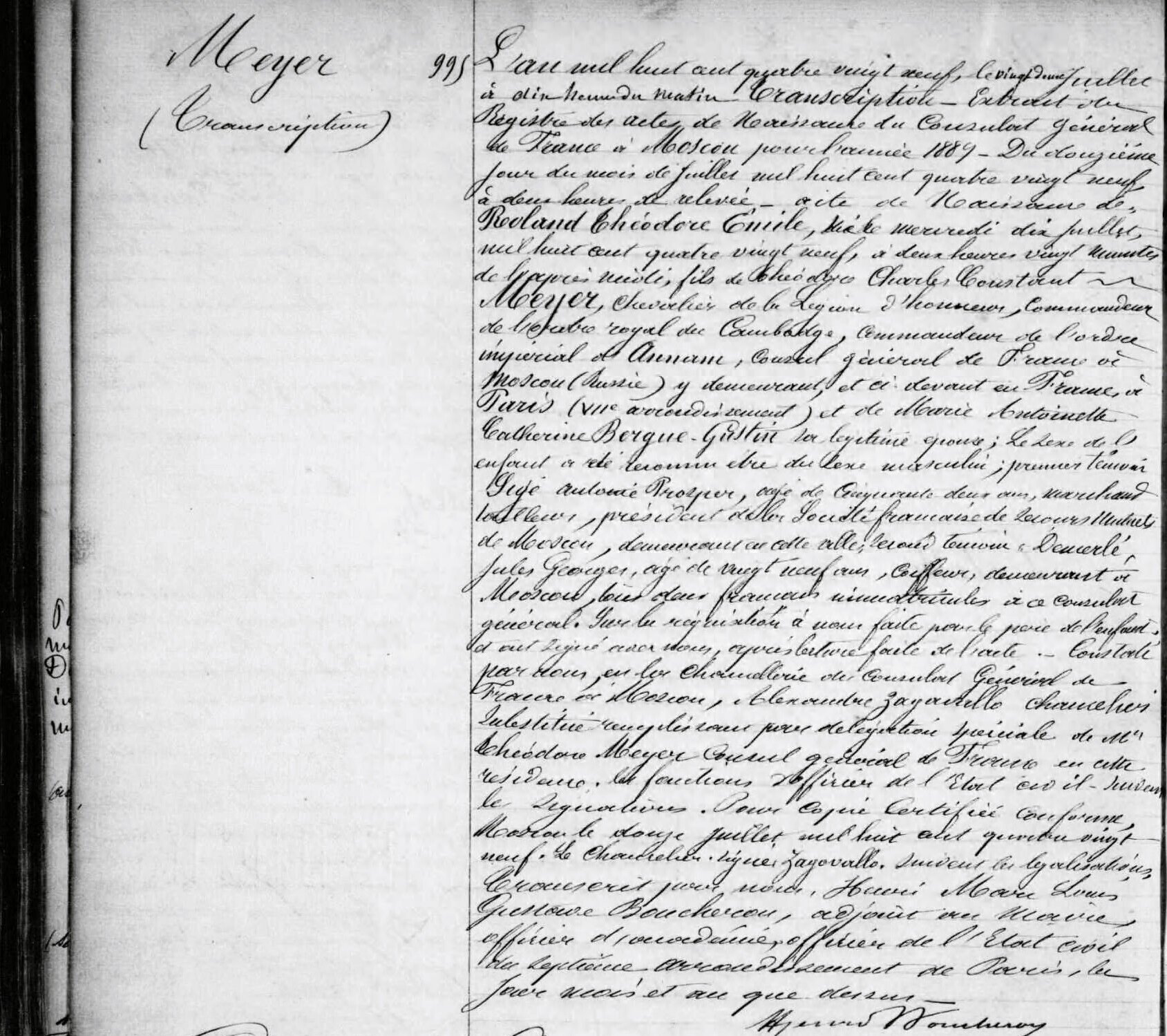
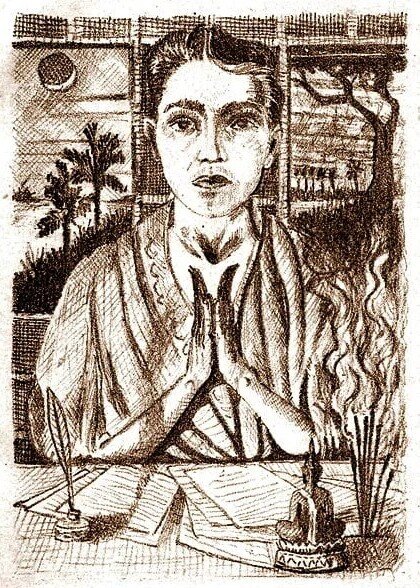
1) Roland Meyer’s birth certificate issued by the French consulate in Moscow, and transcribed at Paris 7th District townhall twelve days after his birth, on 22 July 1889. Along with the name of his mother (Marie-Antoinette Catherine Bergue-Gustin), we can see his father Théodore Meyer’s distinctions as per 1889: ‘Chevalier de la Légion d’honneur, Commandeur de l’Ordre royal du Cambodge, Commandeur de l’Ordre impérial d’Annam’. Singapore or Genoa would be the the only postings listed in the official resumé mentioned above where he could have been distinguished with these decorations, possibly for some involvement in the 1893 ‘Affaire de Siam’. [source: retrieved from filae.com] 2) Roland Meyer, Self-Portrait dated 1909 (at 20 years of age) and reproduced in Saramani (1919).
1) Roland Meyer’s birth certificate issued by the French consulate in Moscow, and transcribed at Paris 7th District townhall twelve days after his birth, on 22 July 1889. Along with the name of his mother (Marie-Antoinette Catherine Bergue-Gustin), we can see his father Théodore Meyer’s distinctions as per 1889: ‘Chevalier de la Légion d’honneur, Commandeur de l’Ordre royal du Cambodge, Commandeur de l’Ordre impérial d’Annam’. Singapore or Genoa would be the the only postings listed in the official resumé mentioned above where he could have been distinguished with these decorations, possibly for some involvement in the 1893 ‘Affaire de Siam’. [source: retrieved from filae.com] 2) Roland Meyer, Self-Portrait dated 1909 (at 20 years of age) and reproduced in Saramani (1919).
1) Roland Meyer’s birth certificate issued by the French consulate in Moscow, and transcribed at Paris 7th District townhall twelve days after his birth, on 22 July 1889. Along with the name of his mother (Marie-Antoinette Catherine Bergue-Gustin), we can see his father Théodore Meyer’s distinctions as per 1889: ‘Chevalier de la Légion d’honneur, Commandeur de l’Ordre royal du Cambodge, Commandeur de l’Ordre impérial d’Annam’. Singapore or Genoa would be the the only postings listed in the official resumé mentioned above where he could have been distinguished with these decorations, possibly for some involvement in the 1893 ‘Affaire de Siam’. [source: retrieved from filae.com] 2) Roland Meyer, Self-Portrait dated 1909 (at 20 years of age) and reproduced in Saramani (1919).
In 1907, one year after watching the performance of the Cambodian royal dancers at Marseille Colonial Exhibition, he traveled to French Indochina for an internship arranged by his father, joining the team of then Governor-General Paul Beau. Sent to Phnom Penh, he started to work on educational and cultural affairs. He also met a young dancer of the Royal Ballet, Saramani — her real name was ម្រេច Mrek (Pepper) but and as it was customary for women she was also known as Thiem, Yem and possibly Saramani like the eponymous novel Meyer came to publish. Interestingly, when his book Saramani, danseuse khmèr(1919) surfaced back in Cambodia in 1970 – 1971, the translator into Khmer only mentioned he had been in charge of the Musée Khmer [‘Khmer Museum’], an embryo of what would become in 1920 the Musée Albert-Sarraut under the direction of George Groslier, now the National Museum of Cambodia [1].
From there, Roland Meyer’s life became two-faceted, the well-groomed, disciplined colonial civil servant and the budding poet-chronicler with privileged access to the Royal Palace, surfing on the waltz of Résidents-Generaux (‘Resident-Superiors’, administrators of the French Protectorate over Cambodia) — Louis Paul Luce (from 1905 to 1911), Ernest Outrey (1911−1914), two acting residents in 1914 (François-Xavier Tessarech and Joseph Le Gallen), and the overwhelming François Marius Baudoin, who was to reign suprem from 22 October 1914 to 20 January 1927. The relative candor of past years was gone — Baudoin was set to enroll young Cambodians in the French army as WWI had broken out, to fight the insurgency linked to nationalist activities in Annam and Cochinchina (Vietnam), and to exploit thousands of ‘itinerary or fugitive workers’ (not attached to plantations) and other outcasts in order to build emphatic projects such as the ‘station climatique’ [sanitarium-resort] on the Bokor mountain.
On 28 June 1917, Albert Sarraut, once again Governor-General of Indochina (2nd mandate), set up by decree the Sûreté générale indochinoise [Secret police], including the ‘Service de la Sûreté et des Affaires politiques et Indigènes du Cambodge’, an apparatus of security surveillance Meyer was already involved in [he had been appointed ‘Chef de la section politique et indigène’ on 1 March 1916] and of which he was appointed Chief by Baudoin in 1918. Some observations in the novel Saramani about surrepititious groups around Phnom Penh Royal Palace evoke what was really at stake: “La Sûreté faisait état de la propagation des rumeurs, de ce que des groupes se formaient dans les rues pour les commenter et les grossir et que des personnes commençaient à être prises à partie.” [“The Sûreté reported that rumors were spreading, that groups were forming in the streets to discuss and amplify them, and that people were beginning to be targeted.” [see Marianne Boucheret, “Le pouvoir colonial et la question de la main‑d’œuvre en Indochine dans les années vingt”, Cahiers d’histoire, Revue d’histoire critique 85, 2001, p 29 – 55.]
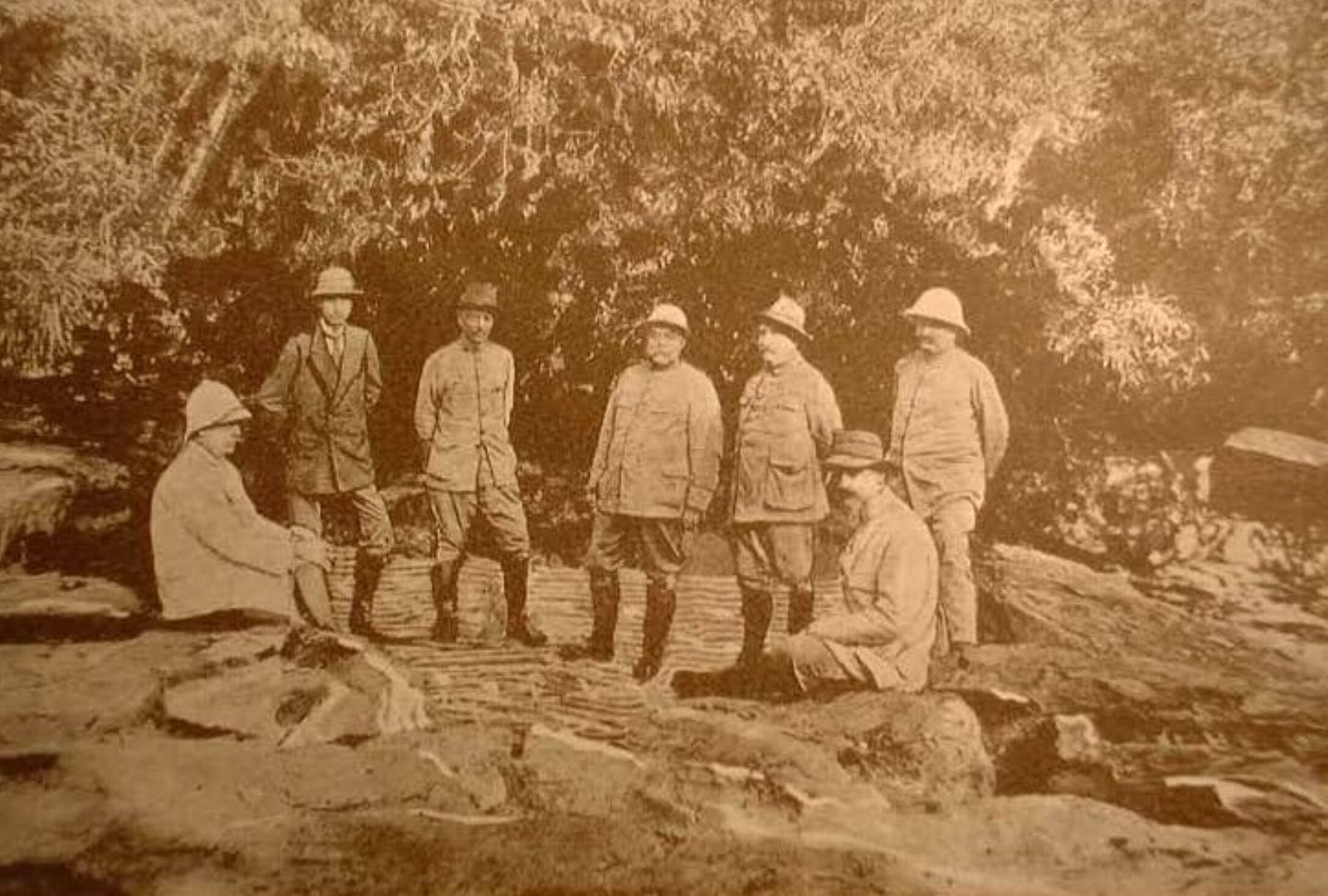
1) On Top of Bokor Mountain, 1917. Left to right, Flacourt (Agricultural Department), R. Meyer (Chef de la sûreté [Head of Security]), Courgand (Forestry Dept.), Baudoin (Résident-supérieur of Cambodia), A. Rousseau (French Resident in Kampot), Jubin (Head of Land Registry), Babillo (Chief-engineer) [source: Berret & Jubin, Revue indochinoise, 7 – 8, 9 – 10, Jul.-Oct. 1919, repr. in Luc Mogenet, ‘La station climatique de Bokor’, 2007, op. cit.] 2) Map of the Gulf of Siam drawn by Roland Meyer before 1925 [published in L’éveil économique de l’Indochine, 15. Jan.1925].
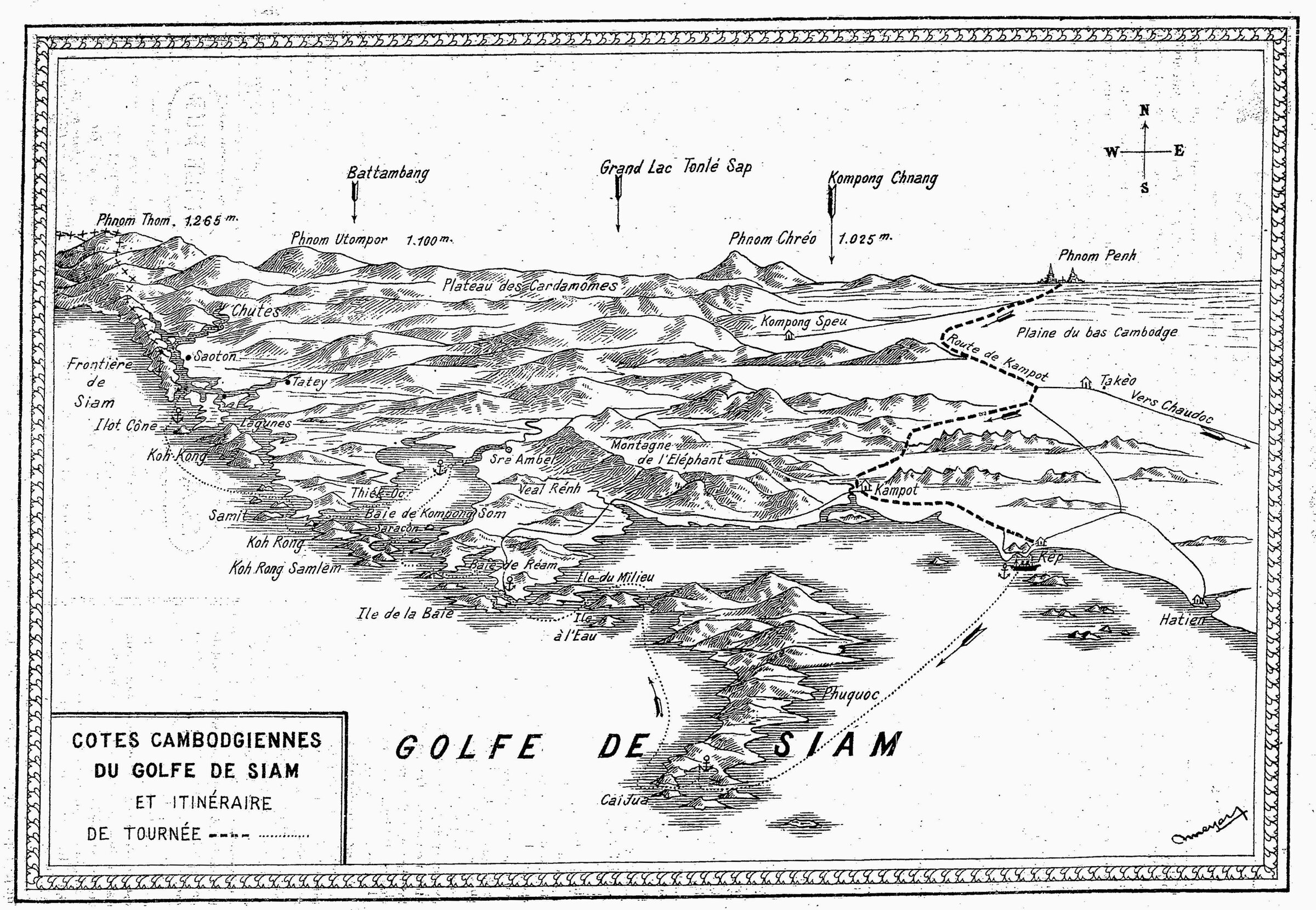
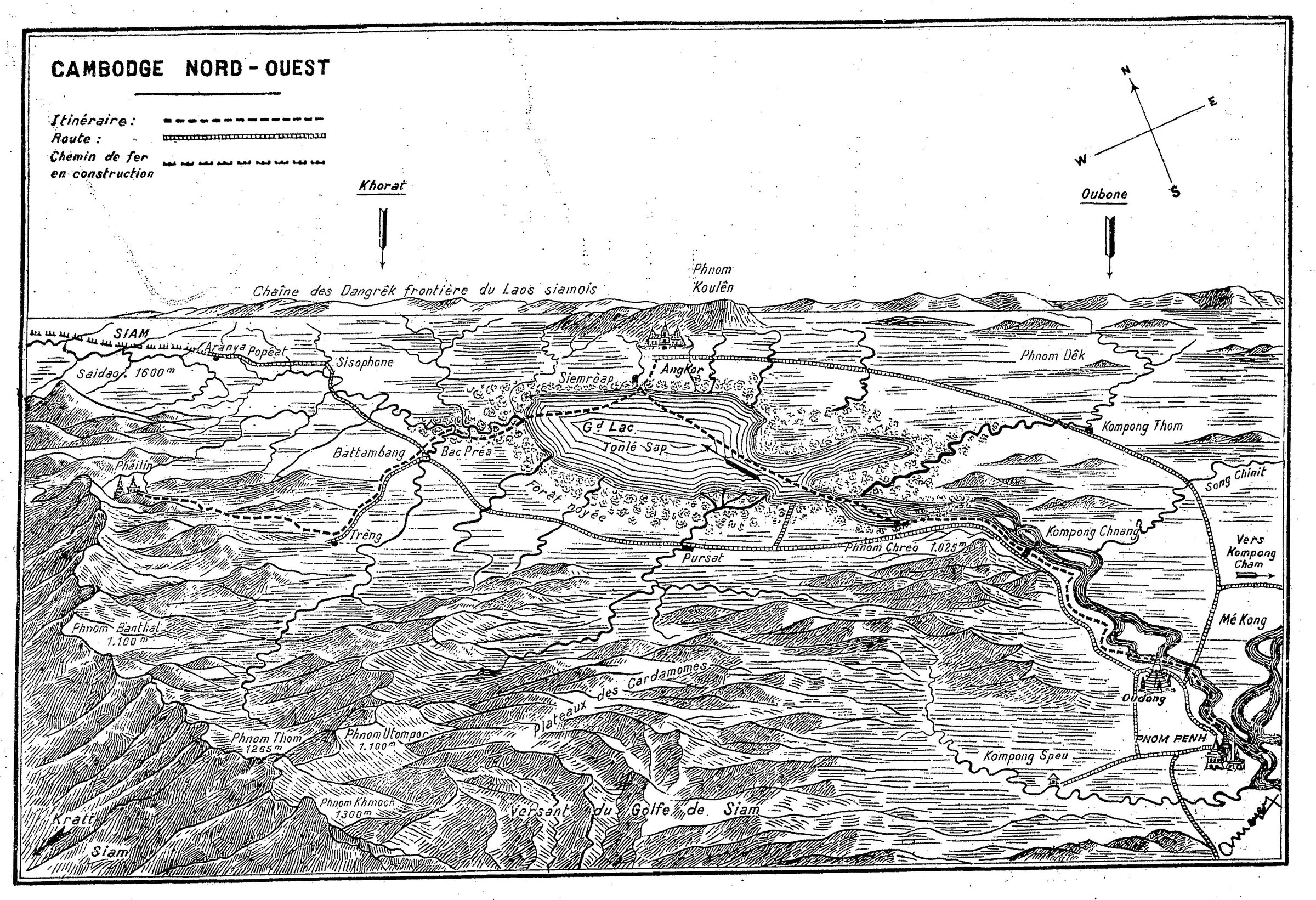
Map of the Gulf of Siam drawn by Roland Meyer before 1925 [published in “Croisière au Golfe de Siam”, L’éveil économique de l’Indochine, 15 Jan.1925]
1) On Top of Bokor Mountain, 1917. Left to right, Flacourt (Agricultural Department), R. Meyer (Chef de la sûreté [Head of Security]), Courgand (Forestry Dept.), Baudoin (Résident-supérieur of Cambodia), A. Rousseau (French Resident in Kampot), Jubin (Head of Land Registry), Babillo (Chief-engineer) [source: Berret & Jubin, Revue indochinoise, 7 – 8, 9 – 10, Jul.-Oct. 1919, repr. in Luc Mogenet, ‘La station climatique de Bokor’, 2007, op. cit.] 2) Map of the Gulf of Siam drawn by Roland Meyer before 1925 [published in L’éveil économique de l’Indochine, 15. Jan.1925].
Precisely at that time, Resident-General François Marius Baudoin embarked in a voluntaristic — the French political opposition would come to call it “megalomaniac” and even “criminal” — building program on the Bokor Hill, including a private villa for himself and a mountain road that would cost hundreds (at least 800) of dead among the forced laborers. The official goal was to establish a “station climatique” [sanatorium] and an experimental farm in climatic conditions that would befit the Europeans. Meyer was initially ecstatic about the project — he himself had to go several times to France “take the waters”, as it was called then, in order to mitigate the impact of tropical heat — and even a decade later, in 1925, he was waxing lyrical about the Cambodian southern coastline:
Enfin, nous contournons un promontoir boisé et arrivons à Kep, la plage aimable, le port d’escale où nous attend à quelques encablures, le joli yacht l’Espadon. Le boulevard du bord de mer court sous les palmes des cocotiers, au long de plages étroites, ou bien serpente en corniche au flanc des caps verdoyants’ où apparaissent les premières villas de la station balnéaire, découverte et créée en 1906 par le colon Dupuy. Au large, le Golfe dresse son horizon d’un bleu intense parsemé d’îles drapées dans une flore d’Insulinde et sous un ciel d’Attique, indemne des perturbations atmosphériques propres au versant indochinois des mers de Chine. Kep est un coin du Golfe ou règne en tous les temps “l’immuable splendeur d’un éternel printemps”. [Roland Meyer, ‘Croisière au Golfe de Siam’, L’éveil economique de l’Indochine, 4 Jan. 1925, p 6]
[Finally, we round a forest-crowned promontory and arrive at Kep, the pleasant beach, the port of call where, a few cables away, the lovely yacht Espadon awaits us. The seaside boulevard runs beneath the coconut palms, along narrow beaches, or winds its way along the cliffside of verdant headlands where one can spot the first villas of this seaside resort discovered and established in 1906 by the colonist Dupuy. Offshore, the Gulf deploys its horizon of intense blue, dotted with islands draped in Insulindian flora and under an Attica sky, untouched by the atmospheric disturbances typical of this Indochinese side of the South China Sea. Kep is a corner of the Gulf where at all times reigns ‘the immutable splendor of an eternal spring’ ”.]
His not-so veiled criticism of Baudoin would come much later, in his 1925 article on Popokvil [partly reprinted in Komlah, Visions d’Asie, 1930, p. 204 – 6] in which one can read behind the lines that he felt he had been ‘banished’ out of Cambodia because of Baudoin’s excessive haste:
Comme par un remords d’avoir trop tardé, on voulait réaliser vite et grand, à coups de vies humaines et de milliers de piastres. Une frénésie se déchaînait pour l’achèvement coûte que coûte de la route d’accès au plateau de Popokvil et pour l’édification de palaces somptueux, là où auraient suffi, au début, de jolis villages suisses encadrés dans les bois de pins. [.…] Huit cents prisonniers renouvelés, raflés dans toutes les prisons du Cambodge achevèrent en deux ans une route de trente kilomètres montant à 1.050 mètres d’altitude, sur les falaises qui dominent le Golfe de Siam. L’inauguration eut lieu en Mai 1919 — Deux ouvriers français de la grande entreprise : Gourgand et Fabre et combien d’indigènes, avaient payé ce succès de leur vie? Mais Popokvil qui avait patienté tant d’années, n’avait pas attendu un an de plus ! Beaucoup d’erreurs grandes ou petites avaient sans doute été commises. Il fallait commencer plus tôt ou finir plus tard ; mais le passé est révolu et Popokvil demeure une réalisation magnifique. Le présent rend hommage aux artisans européens et indigènes qui, chacun dans le domaine limité de sa compétence, furent les agents d’exécution de la grande idée qui les dirigeait tous. L’avenir rendra justice aux inventeurs, aux promoteurs qui furent l’âme de l’entreprise et qui, jalousés, méconnus ou bannis, emportèrent avec eux le secret de leur fortune: la noblesse de leur vocation. […] Sa réalisation a bercé bien des rêves, coûté bien des fatigues, exigé bien des morts.… Profitez-en !
[As if out of remorse for so much procrastination, there was a desire to achieve things quickly and on a grand scale, at the cost of human lives and thousands of piastres. A frenzy was unleashed for the completion at all costs of the access road to the Popokvil plateau and for the construction of sumptuous palaces, where, as a first stage, pretty Swiss villages framed in pine woods would have been enough. Eight hundred prisoners, rounded up from every prison in Cambodia, completed in two years a thirty-kilometer road climbing to an altitude of 1,050 meters on the cliffs overlooking the Gulf of Siam. The inauguration took place in May 1919. Two French workers in this grand undertaking, Gourgand and Fabre, and how many locals, had paid for this success with their lives? But Popokvil, which had waited so many years, hadn’t waited another! Many mistakes, large and small, had undoubtedly been made. It should have started earlier or finished later; but the past is gone, and Popokvil remains a magnificent achievement. The present pays tribute to the European and local craftsmen who, each within the limited scope of their competence, were the agents of execution of the grand idea that guided them all. The future will do justice to the inventors and promoters who were the soul of the enterprise and who, envied, misunderstood, or banished, took with them the secret of their success: the grandeur of their calling. […] Its realization nurtured many dreams, cost much toil, and demanded many lives.… Enjoy it!]
He would reiterate this enthusiastic support of European hill stations — while conceding that Baudoin had probably gone to far in the Bokor ruthless adventure — a ghastly episode that deeply informed the writing career of French novelist Marguerite Duras — in his brochure on Laos prepared for the Paris Colonial Exhibition (1931), praising the project of “our future hill station at Phou-khao-khoai” [2] in “our Indochinese Far-West”, adding that this kind of building programs, including the “new railroad from Tân-ap to Thakhek”, was paving the way to “l’entrée du Laos dans le concert des Frances-Mineures appelées à concourir à la prospérité de la Mère-Patrie.” [“Laos’s entry into the concert of minor French nations called upon to contribute to the prosperity of the Motherland.” [Le Laos, 1930, p. 111] Two years later, he described this ‘Bokor repetitis’ — yet “without one single victim, without one single wounded man left limping behind” — in Laos, in such a pompous way one has to wonder whether this was an exercise in third-degree humor:
Trois cent prestataires [ont été] convoqués à cette fin du mois de janvier 1931 pour accomplir leurs corvées annuelles, par équipes renouvelées de seize en seize jours ont pris leurs outils neufs sans broncher. Dix kilomètres de route à bâtir à flanc de montagne, jusqu’au plateau convoité, telle sera la route des cent jours ! […] Et derrière le résident, blanche fée d’Europe, sa femme en tenue d’amazone, la belle Madame, bien connue des Laotiens de la province, procède à la distribution de tabac, de gâteaux et d’alcool glacé, amené de la ville en touques soudées, pour encourager les prestataires et leur promettre des ripailles semblables, chaque dimanche, à l’avancement des chantiers. […] A cheval elle aussi, telle une Jeanne d’Arc coloniale menant au combat ses guerriers de bronze, la belle résidente, aimée du peuple, étend la main vers les frais bocages environnés de hautes cimes qui s’ouvrent à ses yeux ravis et s’écrie : “En ce soir mémorable du 1er mai 1931, remercions nos loyaux sujets qui nous ont donné la victoire, avec le secours du Bouddha. Il nous reste à consacrer cette réalisation magnifique. Sur ce plateau conquis, auquel je lègue mon nom, nous fonderons Ritaville, sanatorium de Vientiane!” [La Revue du Pacifique, 1932] [3]
[Three hundred ‘service providers’ [ADB: this is the literal translation of the French word, which obviously clash with their actual status of forced laborers] were summoned at the end of January 1931 to carry out their annual work corvee. In teams of sixteen, rotated every sixteen days, they took up their new tools without complaint. Ten kilometers of road to be built on the mountainside, up to the coveted plateau — this would be the hundred-day road! […] And behind the resident, a European fairy, his wife, dressed as an Amazon, the beautiful Madame, well-known to the Laotians of the province, distributed tobacco, cakes, and iced alcohol, brought from the city in sealed jugs, to encourage the laborers and promise them similar feasts every Sunday, as the construction progressed. […] Also on horseback, like a colonial Joan of Arc leading her bronze warriors into battle, the beautiful resident, beloved by the people, stretches out her hand towards the cool groves surrounded by high peaks that open before her delighted eyes and exclaims: “On this memorable evening of May 1, 1931, let us thank our loyal subjects who have given us victory, with the help of Buddha. It remains for us to consecrate this magnificent achievement. On this conquered plateau, to which I bequeath my name, we will found Ritaville, Vientiane’s sanatorium!” [La Revue du Pacifique, 1932] [3].
With the noteworthy exception of Saramani (1919), this ‘epic-colonial’ style infused all Roland Meyer’s writings during his time in French Indochina (1907 – 1st Dec. 1938 [4]). Komlah, Visions d’Asie (1929), the second and last of his books as ‘ecrivain colonial’ [‘colonial writer’, the label he insisted to have assigned to himself for the rest of his natural life, and under which he was always mentioned in the French press], was essentially self-justification of Saramani against “le ressentiment des jaloux et des méchants” [“the resentment of the envious and the malicious”] (Komlah, Visions d’Asie, p. 23), with the [unspecified] addition of six press articles he had previously published in several French media [see bibliography below]. This permanent feature, combined with some elements in his personal life, may shed light on the circumstances that led to his exit from Cambodia to Laos in 1920.
Romanticism being often contagious, researchers have tended to describe Roland Meyer as a free-thinker who rapidly ‘went native’ under the influence of his love story with a Royal Ballet dancer, and whose book immensely irked the French administrators and the Cambodian Royal Palace when it was released in Saigon. Official, classified correspondence retrieved by researcher Lucie Labbé in 2020 did emphasize “King Sisowath’s protestations” to Resident-General Baudoin. These have not been proven, and Prof. Ang Choulean has remarked in a short essay that Cambodian kings have never been obsessing with alleged crime of ‘lese-majesty’ [contrary to their Siamese and later Thai counterparts]. Moreover, right up until Meyer’s transfer to Laos, he was very much installed in the Phnom Penh establishment, both French and Cambodian. We have found the following entry in the Bulletin Administratif du Cambodge :
Par arrêté du Gouverneur Général par interim de l’Indochine du 5 octobre 1919 : La composition des Commissions locales chargées de faire subir au Cambodge les épreuves des examens de langues orientales est fixée ainsi qu’il suit pour la 2e session de 1919: Langue Cambodgienne: MM. Létang, administrateur de 1ere classe des Services civils, président; Desenlis, administrateur de 4e classe des Services civils, Meyer, administrateur de 5e classe des Services civils; membres, Son-Diep, ministre de la Marine, Chhun, ministre de la Justice.
[By order of the Acting Governor General of Indochina on October 5, 1919: The composition of the local Commissions charged with administering the examinations of Oriental languages in Cambodia is fixed as follows for the 2nd session of 1919: Cambodian Language: Messrs. Létang, 1st class administrator of the Civil Services, president; Desenlis, 4th class administrator of the Civil Services, Meyer, 5th class administrator of the Civil Services; members, Son-Diep, Minister of the Navy, Chhun, Minister of Justice.]
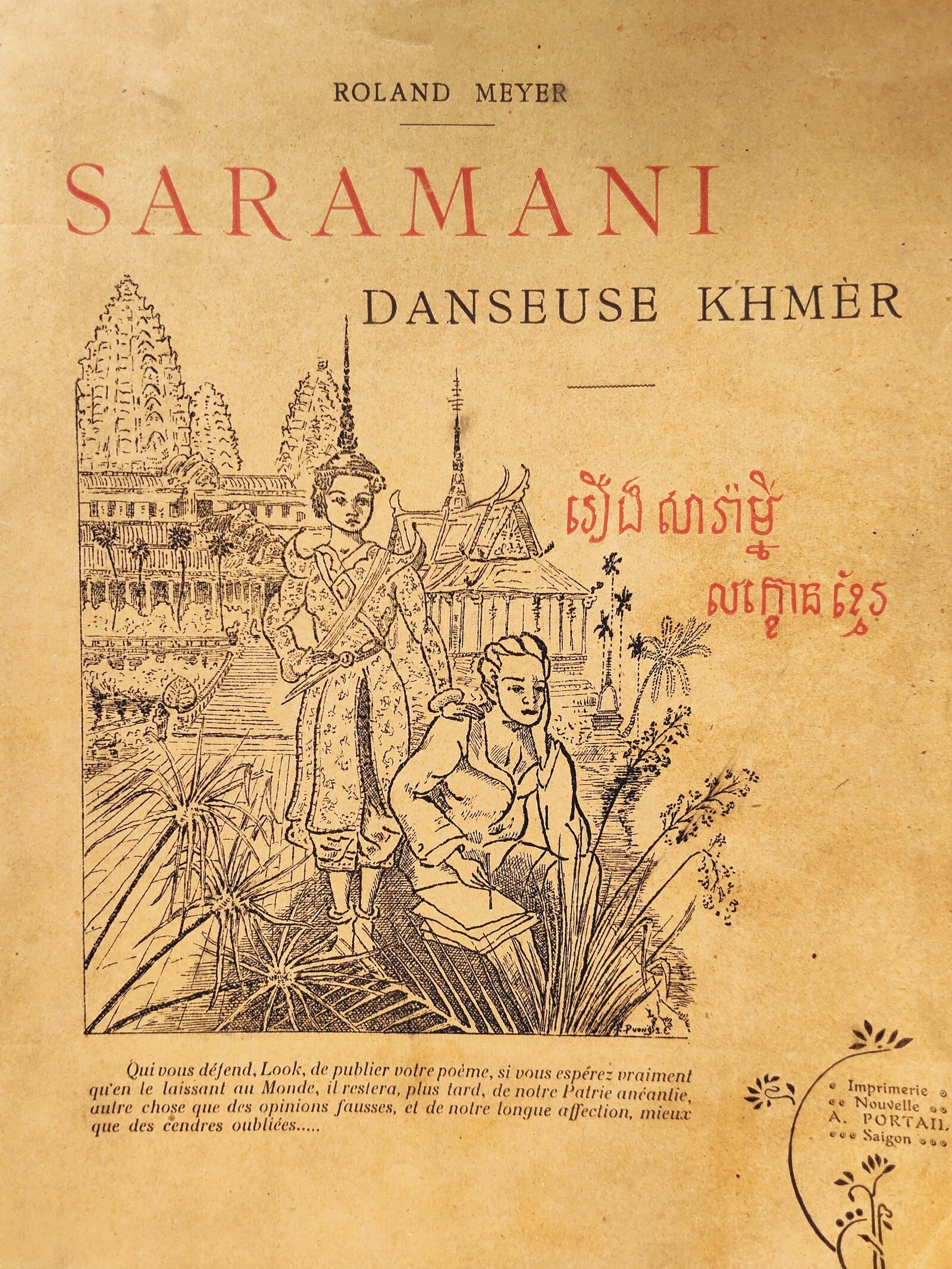
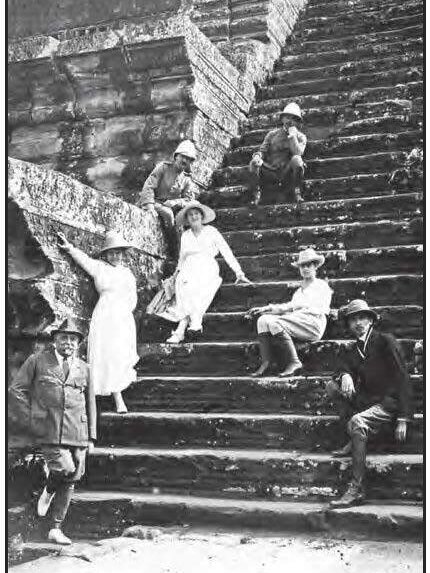
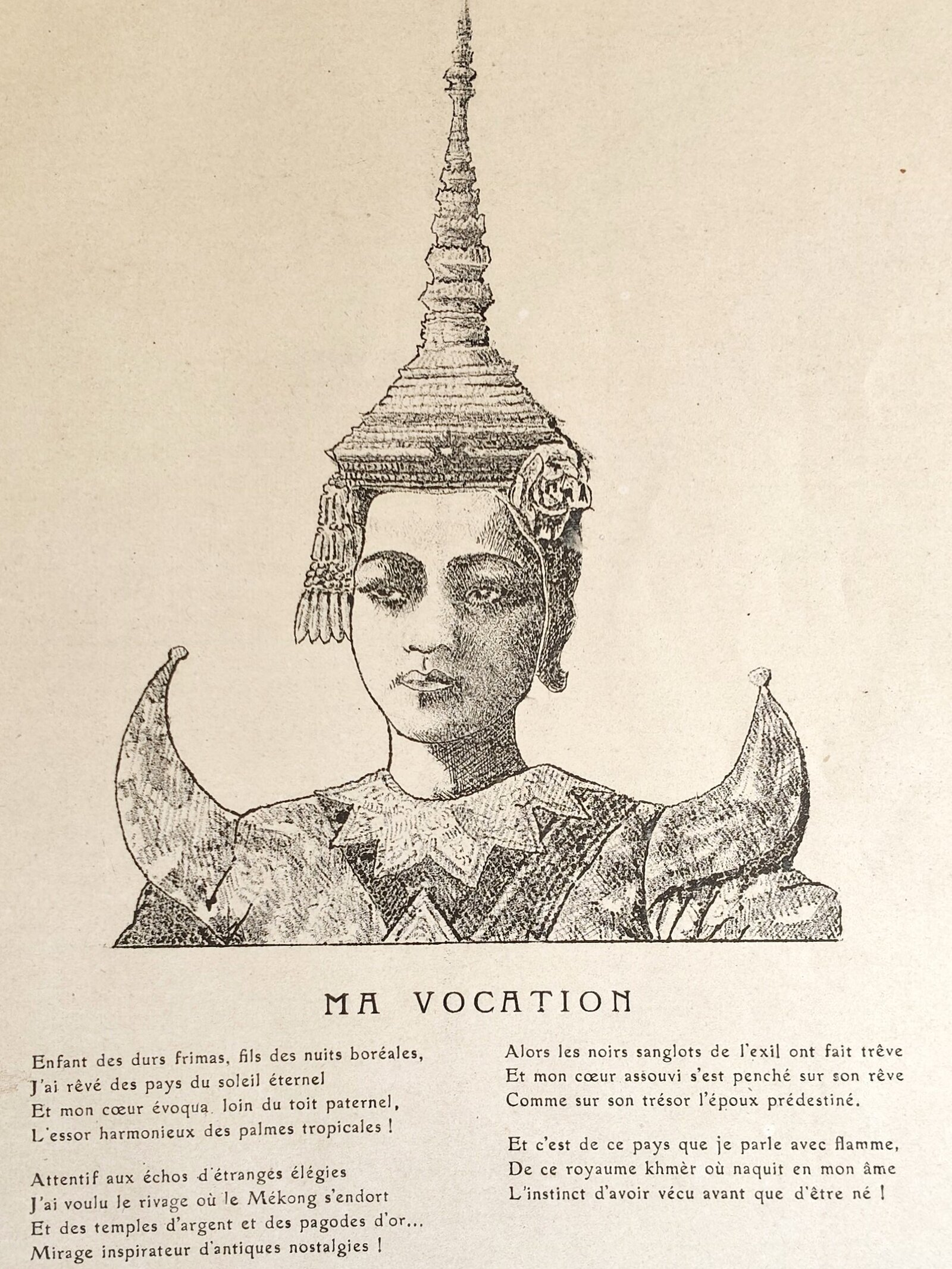
1)Saramani, danseuse khmèr -រឿង សារ៉ាម្នី លក្ខោនខ្មែរ, cover of the original 1919 edition. [លកោន (Modern KH ល្ខោន) lakhon, ‘theater, dance, dancer’, had three correct spelling forms at the time, according to Dictionnaire Guesdon Dictionary (1930) - លកោន, លខោន, លុកឃុន]. 2) On the stairway to Angkor Wat Central Tower in January 1918, clockwise from the left - F. Baudoin and his daughter, Suzanne Groslier seated near George, A. Sarraut at the top, a ‘Mlle Vibert’ and R. Meyer [photo found in Suzanne Groslier’s personal papers by Kent Davis when he was invited by the Groslier family to look through it after her passing in 1979, published in “Le Khmerophile”, English edition of Groslier’s Cambodian Dancers Ancient and Modern, p. 222]. 3) The frontispiece-dedication in the original 1919 edition: that same drawing was used as cover illustration for the 1922 version. The facial features definitely correspond to the photographs of the ‘real’ Saramani kept in the Meyer-Courtois family archive. [source: 1919 edition original edition at ADB Library.]
1)Saramani, danseuse khmèr -រឿង សារ៉ាម្នី លក្ខោនខ្មែរ, cover of the original 1919 edition. [លកោន (Modern KH ល្ខោន) lakhon, ‘theater, dance, dancer’, had three correct spelling forms at the time, according to Dictionnaire Guesdon Dictionary (1930) - លកោន, លខោន, លុកឃុន]. 2) On the stairway to Angkor Wat Central Tower in January 1918, clockwise from the left - F. Baudoin and his daughter, Suzanne Groslier seated near George, A. Sarraut at the top, a ‘Mlle Vibert’ and R. Meyer [photo found in Suzanne Groslier’s personal papers by Kent Davis when he was invited by the Groslier family to look through it after her passing in 1979, published in “Le Khmerophile”, English edition of Groslier’s Cambodian Dancers Ancient and Modern, p. 222]. 3) The frontispiece-dedication in the original 1919 edition: that same drawing was used as cover illustration for the 1922 version. The facial features definitely correspond to the photographs of the ‘real’ Saramani kept in the Meyer-Courtois family archive. [source: 1919 edition original edition at ADB Library.]
1)Saramani, danseuse khmèr -រឿង សារ៉ាម្នី លក្ខោនខ្មែរ, cover of the original 1919 edition. [លកោន (Modern KH ល្ខោន) lakhon, ‘theater, dance, dancer’, had three correct spelling forms at the time, according to Dictionnaire Guesdon Dictionary (1930) - លកោន, លខោន, លុកឃុន]. 2) On the stairway to Angkor Wat Central Tower in January 1918, clockwise from the left - F. Baudoin and his daughter, Suzanne Groslier seated near George, A. Sarraut at the top, a ‘Mlle Vibert’ and R. Meyer [photo found in Suzanne Groslier’s personal papers by Kent Davis when he was invited by the Groslier family to look through it after her passing in 1979, published in “Le Khmerophile”, English edition of Groslier’s Cambodian Dancers Ancient and Modern, p. 222]. 3) The frontispiece-dedication in the original 1919 edition: that same drawing was used as cover illustration for the 1922 version. The facial features definitely correspond to the photographs of the ‘real’ Saramani kept in the Meyer-Courtois family archive. [source: 1919 edition original edition at ADB Library.]
1)Saramani, danseuse khmèr -រឿង សារ៉ាម្នី លក្ខោនខ្មែរ, cover of the original 1919 edition. [លកោន (Modern KH ល្ខោន) lakhon, ‘theater, dance, dancer’, had three correct spelling forms at the time, according to Dictionnaire Guesdon Dictionary (1930) - លកោន, លខោន, លុកឃុន]. 2) On the stairway to Angkor Wat Central Tower in January 1918, clockwise from the left - F. Baudoin and his daughter, Suzanne Groslier seated near George, A. Sarraut at the top, a ‘Mlle Vibert’ and R. Meyer [photo found in Suzanne Groslier’s personal papers by Kent Davis when he was invited by the Groslier family to look through it after her passing in 1979, published in “Le Khmerophile”, English edition of Groslier’s Cambodian Dancers Ancient and Modern, p. 222]. 3) The frontispiece-dedication in the original 1919 edition: that same drawing was used as cover illustration for the 1922 version. The facial features definitely correspond to the photographs of the ‘real’ Saramani kept in the Meyer-Courtois family archive. [source: 1919 edition original edition at ADB Library.]
Meyer was even appointed to supervise the examinations in Chinese, a language he didn’t master at all, which shows that that mission was much more political than linguistics-related, as Chinese schools, especially in Southern Cambodia, were considered as foci of irredentist, anti-colonial feelings. As for ‘going native’, Saramani’s ‘Komlah’ — Meyer’s Khmer favorite nickname, from kh កំឡោះ, which has often been translated as ‘bachelor” but literally means ‘forever young man’, what classic English writers would have called a ‘cad’, an irreverent boy — did mention spending his spare time in his fiancée’s Cambodian-style house, in Prek Thmey ព្រែកថ្មីនេះ village (some fifteen kilometers south of Phnom Penh on the eastern bank of the Bassac River) but when their third daughter, Evelyne, was born in 1918, the address he gave to the French birth register was 100, rue du Commerce, in the fast-developing district right north of the Royal Palace. We have found no evidence that he ever befriended famous French ‘Khmerophiles’ such as George Groslier — whose house on the corner of Preah Ang Hassakan (modern St. 144) and Preah Ang Yukhantor (modern St. 19) Streets was close to Meyer’s -, Charles Gravelle or George Coedès, the latter two being happily married to Cambodian women. He was indeed notoriously close to Dr. Adrien Pannetier, a staunch critic of Baudoin (and of Minister of the Palace Thiounn), who explicitely quoted Saramani in his unconventional Au coeur du pays khmer (1921).
Was the publication of Saramani an opportunity for the French powers-that-be to send away this auto-proclaimed ‘Bard of Cambodia’ who, as a secret police chief, probably knew too much? Or did Meyer himself — who had ended up his novel with Komlah-Meyer going berserk and melodramatically breathing his last, with Saramani dying shortly after of literary sorrow — had enough of Cambodia, of Phnom Penh, ‘la ville assombrie dont il a partagé, pendant douze ans, toutes les fibres et qui, comme son cœur, saigne dans le crépuscule’ (dixit Komlah in the 1929 version), and even of the beloved Khmer dancer, who would follow him in Laos with two of their children but was back to Phnom Penh after less than two years, in 1922? Had Cambodia resulted to be unresponsive to this “oeuvre de régénération et de rééducation qui incombe au Protectorat Français”, as he described his personal ambition in his quite awkward essay ‘Inde ou Chine’ [‘India or China?’, 1925]?
Disciplinary demotion, or even ‘urgent exfiltration’ [as described by Meyer’s meticulous biographer Jean-François Klein] of a brilliant colonial administration who was at risk of paying with his own life the ire of the Cambodian officials, or just part of an enigmatic lifeline? His transfer to Laos by decree dated 22 March 1920 was published in Bulletin administratif du Cambodge several weeks before the newly-appointed Governor-General of Indochina Maurice Long (1866−1923) sent a confidential cable to the Ministry of the Colonies, found in Archives d’Outremer (Aix-en Provence, France) by researcher Lucie Labbé and quoted in her 2020 publication [see references below], in which Long warned of the “intense emotion provoked at the [Royal] Court and amongst the French citizenry by [this] publication. The Governor-General, an attorney by trade, had arrived in Hanoi in January 1920 and was already busy to make everything spotless for the visit of Maréchal Joffre to Saigon and Phnom Penh in December 1921. An old-school politician, he was closer to Baudoin than to the ‘young guard’ of Sarraut’s proteges such as Pierre Pasquier or Paul Blanchard de la Brosse.
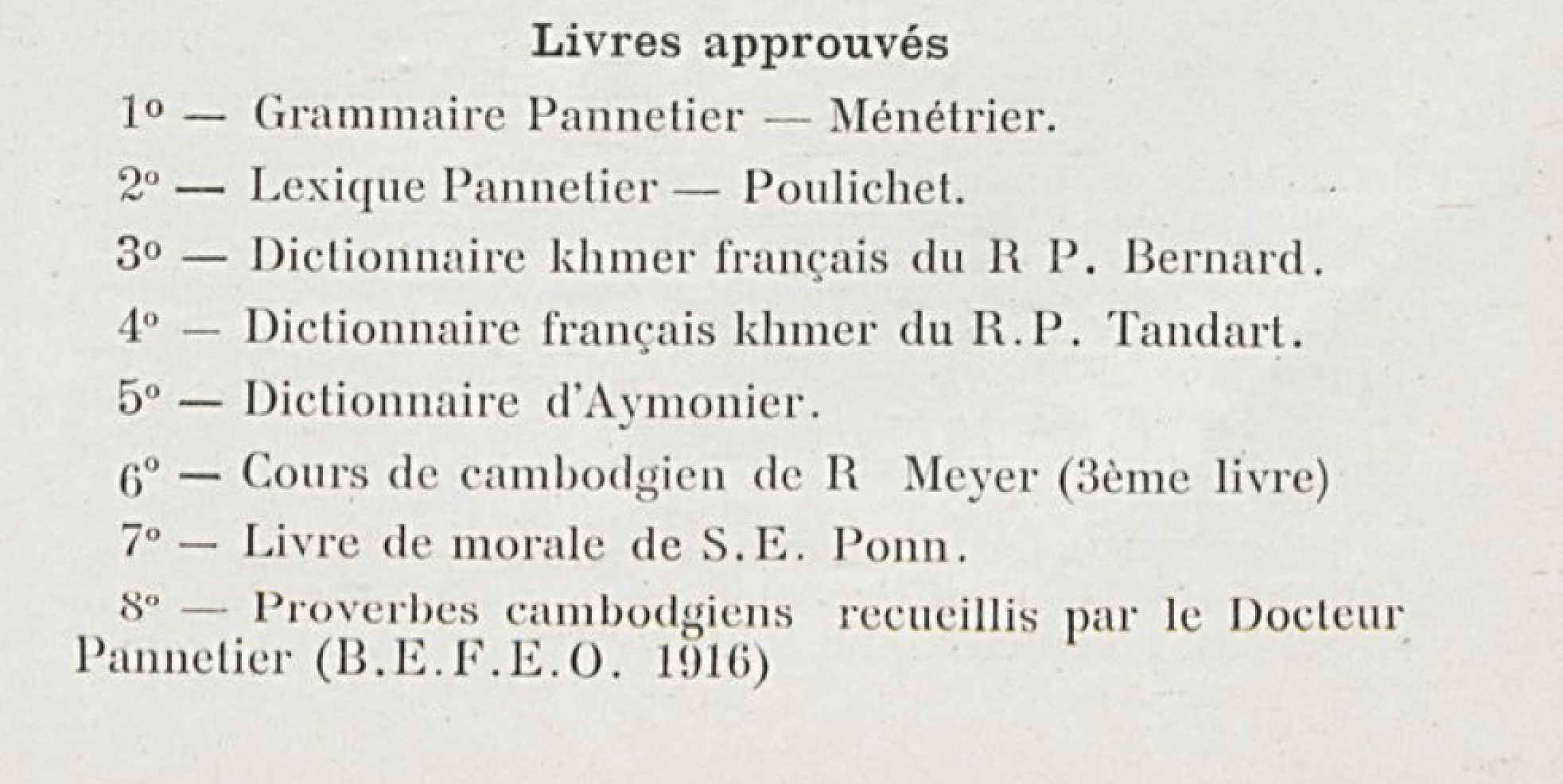
In fact, the Saramani incident didn’t impact his career — as an attaché to the Resident-Superior in Laos, he remained in charge of ‘indigenous affairs’ (secret police) before being appointed in 1928 Head of the French-Siamese High Commission on the Mekong River — with veteran negotiator Colonel Fernand Bernard coming in as backup to an official who had not the least diplomatic experience -, official representative of Laos at Paris Colonial Exhibition (1931), Commissaire du gouvernement de l’Indochine in Laos, Chevalier de la Légion d’honneur in 1933, Head of the Propaganda and Tourism section of Agence Economique de l’Indochine in 1936, advisor to the Minister of the Colonies in Paris from 1933 until his complete retirement in 1940…Hard to find the “rebellious poet” of Saramani fame. Also of note : as late as 1931, Meyer’s Cours de cambodgien [Manual of Khmer Language] was still in the — brief - list of educational books approved by the French Protectorate, along with Minister of Education Pich Ponn’s Cours de morale.
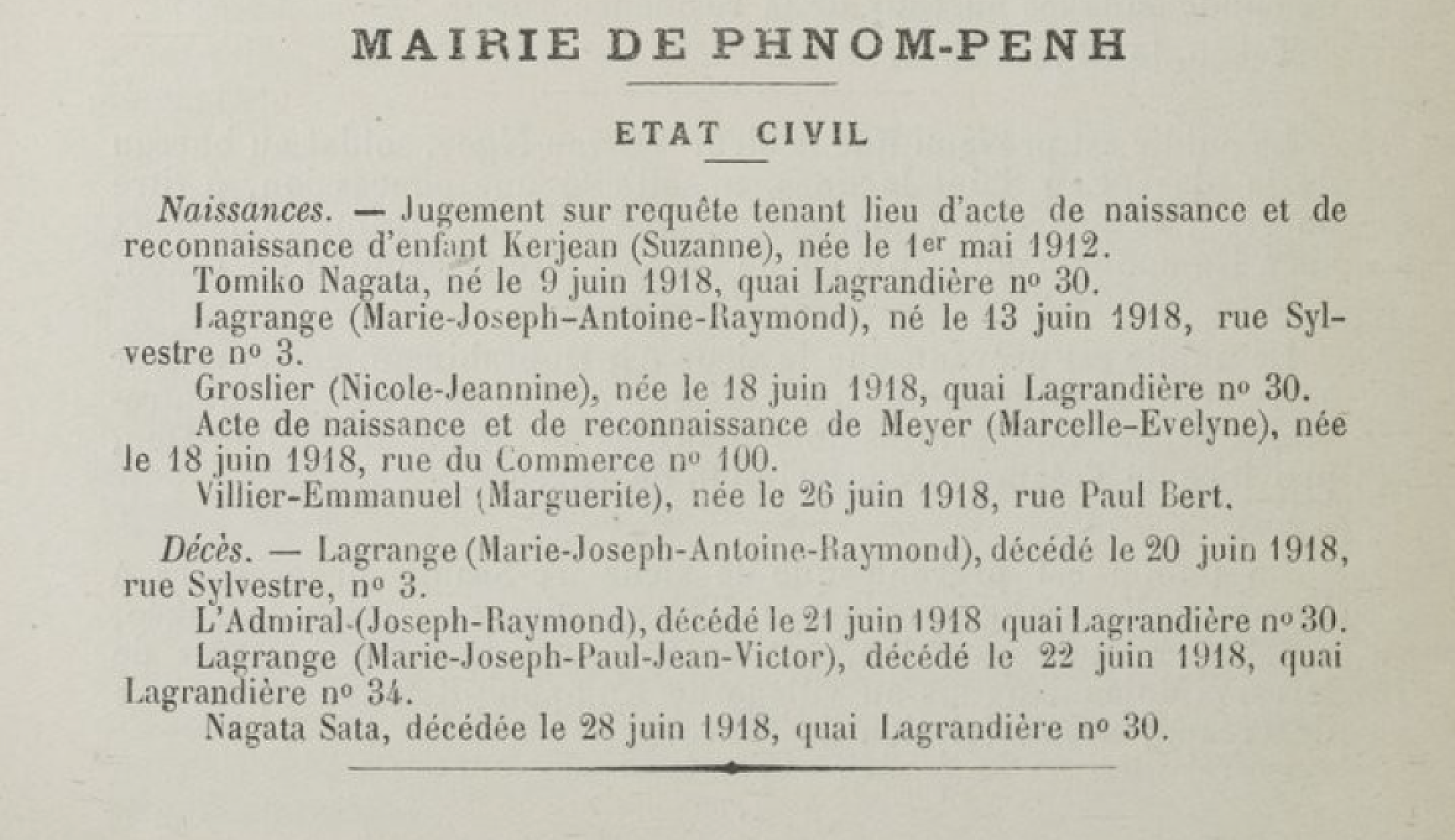
1) Birth and Recognition of daughter Marcelle-Evelyne registered at Phnom Penh Town Hall, 18 June 1918. 2) List of 8 books officially approved for Khmer language teaching in Cambodia [Bulletin administratif du Cambodge (BAC), Jan. 1931]
1) Birth and Recognition of daughter Marcelle-Evelyne registered at Phnom Penh Town Hall, 18 June 1918. 2) List of 8 books officially approved for Khmer language teaching in Cambodia [Bulletin administratif du Cambodge (BAC), Jan. 1931]
1) Birth and Recognition of daughter Marcelle-Evelyne registered at Phnom Penh Town Hall, 18 June 1918. 2) List of 8 books officially approved for Khmer language teaching in Cambodia [Bulletin administratif du Cambodge (BAC), Jan. 1931]
Finding Saramani
All along, Roland Meyer didn’t give one single clue (except in 1925, see below) that Saramani could have been a real person, and moreover the mother of four children with him. We have found the following notice in the Bulletin administratif du Commissariat de la République au Royaume du Laos [1er Jan. 1922, p. 34]:
Congés et Permissions/ Par arrêté No 22 du Résident Supérieur par interim au Laos, du 11 .Janvier 1922: Un congé administratif de six mois a solde entière de présence est accordé à M. Meyer, Roland, Administrateur-Adjoint de 1ere classe des Services Civils de l’Indochine pour en jouir à Versailles. Ce fonctionnaire […] prendra passage au compte du Budget local du Laos sur un des paquebots partant de Saigon à compter du 1er Avril 1922. M Meyer voyagera accompagné de ses deux enfants, Lucie, née le 21 Mai 1910 et Suzanne, née le 21 Février 1913. Ce fonctionnaire est autorisé à passer à ses frais par la route de Kratie a Saigon. Il touchera à Saigon sur présentation de factures régulières et le remboursement de ses frais de transport, par cette route, dans la limite des frais qu’auraient occasionnés son passage et celui de ses deux enfants, avec nourriture, de Kratié à Saigon par la voie fluviale.
[Authorized Leave of Absence/ By decree No. 22 of the Acting Resident Superior in Laos, dated January 11, 1922: A six-month administrative leave with full pay is granted to Mr. Roland Meyer, First-Class Assistant Administrator of the Civil Services of Indochina, to be taken in Versailles. This official […] will travel at the expense of the Laotian local budget on one of the steamships departing from Saigon starting April 1, 1922. Mr. Meyer will travel accompanied by his two children, Lucie, born May 21, 1910, and Suzanne, born February 21, 1913. This official is authorized to travel at his own expense by road from Kratie to Saigon. He will receive in Saigon, upon presentation of regular invoices, reimbursement of his transport costs by this route, up to the limit of the costs incurred by his passage and that of his two children, meals included, from Kratié to Saigon by river.]
From “Au Royaume des saphirs”, L’Eveil économique de l’Indochine, 22 Feb. 1925, p. 10. [via gallica.bnf.fr]
Roland Meyer’s itinerary in the Northwest, c. 1925. The author himself wrapped in mystery his motive for the trip: “Les fins de ce noùveau voyage ? Qu’importe ? Visite de quelque grand personnage ; tournée de pacification ou de propagande en faveur d’un empru:nt national, ou d’un recrutement de volontaires ; exploration de nouveaux territoires… tous les prétextes né sont-ils pas bons alors qu’on cherche une occasion de connaître l’Indochine et de mieux servir ses habitants?” [“Purpose of this new journey? What does it matter? A visit from some important figure; a pacification or propaganda tour in favor of a national loan, or the recruitment of volunteers; an exploration of new territories… any pretext is valid when one seeks an opportunity to get to know Indochina better and to better serve its inhabitants, isn’t it?” [“Au Royaume des Saphirs, L’Eveil économique de l’Indochine, 22 Feb. 1925, n. 40, p. 10 [via gallica.bnf.fr]
While Lucie and Suzanne entered a Catholic boarding school in Versailles, where they stayed until 1927, their father married on 12 Dec. 1922 in Paris Marie-Louise Blayo (22 Aug. 1902, Toulon, France — 24 April 1992, Clichy-la-Garenne, France) in Paris. [They had one child together, Rolande Meyer, and divorced on 8 April 1936; on 29 Oct. 1937, he was married again, this time to Christiane Rosa Désirée Renée Maupin (1914 – 1993)]. 1922 is also the year he published the “light” version of Saramani.
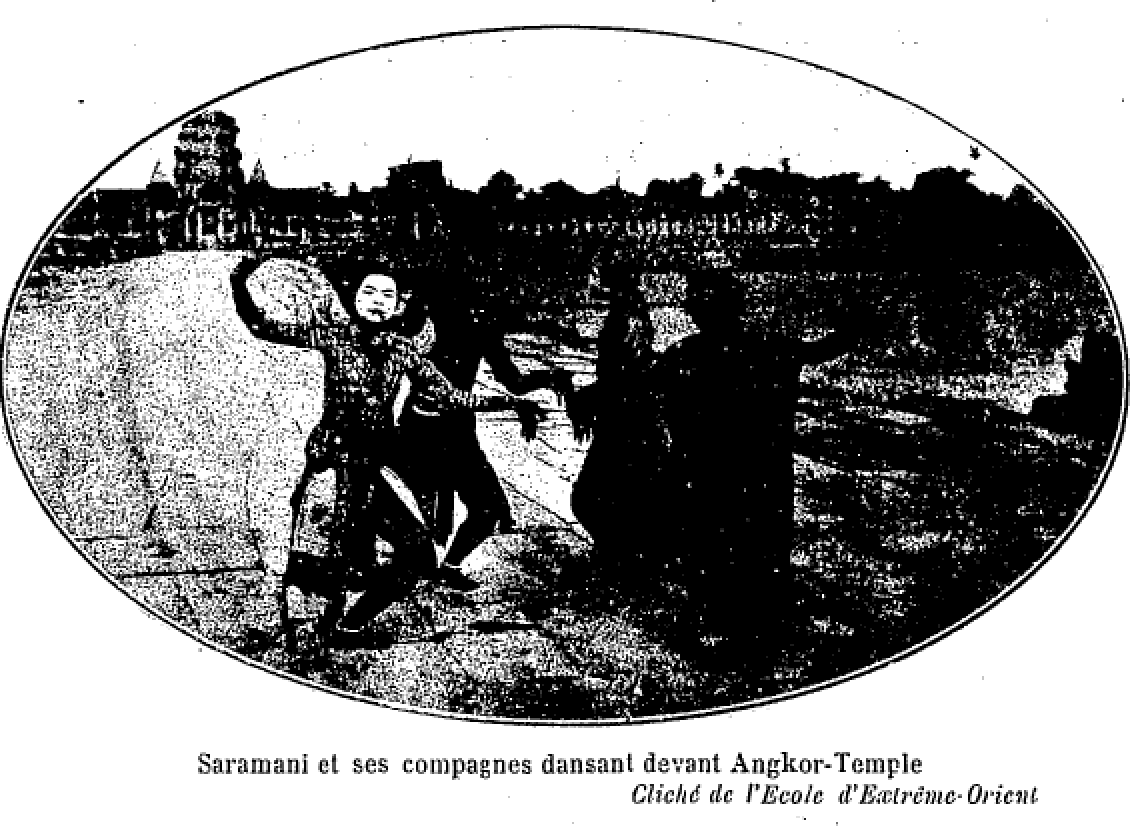
In 1925, shortly before new Governor-General Alexandre Varenne entrusted him with new assignments in Hanoi and Vientiane, Roland Meyer published a series of articles [later reprinted in Komlah, Visions d’Asie without mentioning previous publication]. In one of them, “Au royaume des Saphirs” [“In the Kingdom of Sapphires”], he recounted an undated trip to the westernmost part of Cambodia and the sapphire mines in Pailin with one stop at Angkor, inserting a blurry photo with the caption “Saramani et ses compagnes dansant devant Angkor-Temple; cliché de l’Ecole d’Extrême-Orient [sic]” [“Saramani and her partners dancing in front of Angkor-Temple; picture by the School of Far East”]:
Roland Meyer’s own words: “Saramani et ses compagnes dansant devant Angkor-Temple; cliché de l’Ecole d’Extrême-Orient [sic]” [“Saramani and her partners dancing in front of Angkor-Temple; picture by the School of Far East” [in “Au royaume des Saphirs”, L’Eveil économique de l’Indochine, 15 Feb. 1925 n. 401, p. 11 [scan via gallica.fr, pdf by ADB].
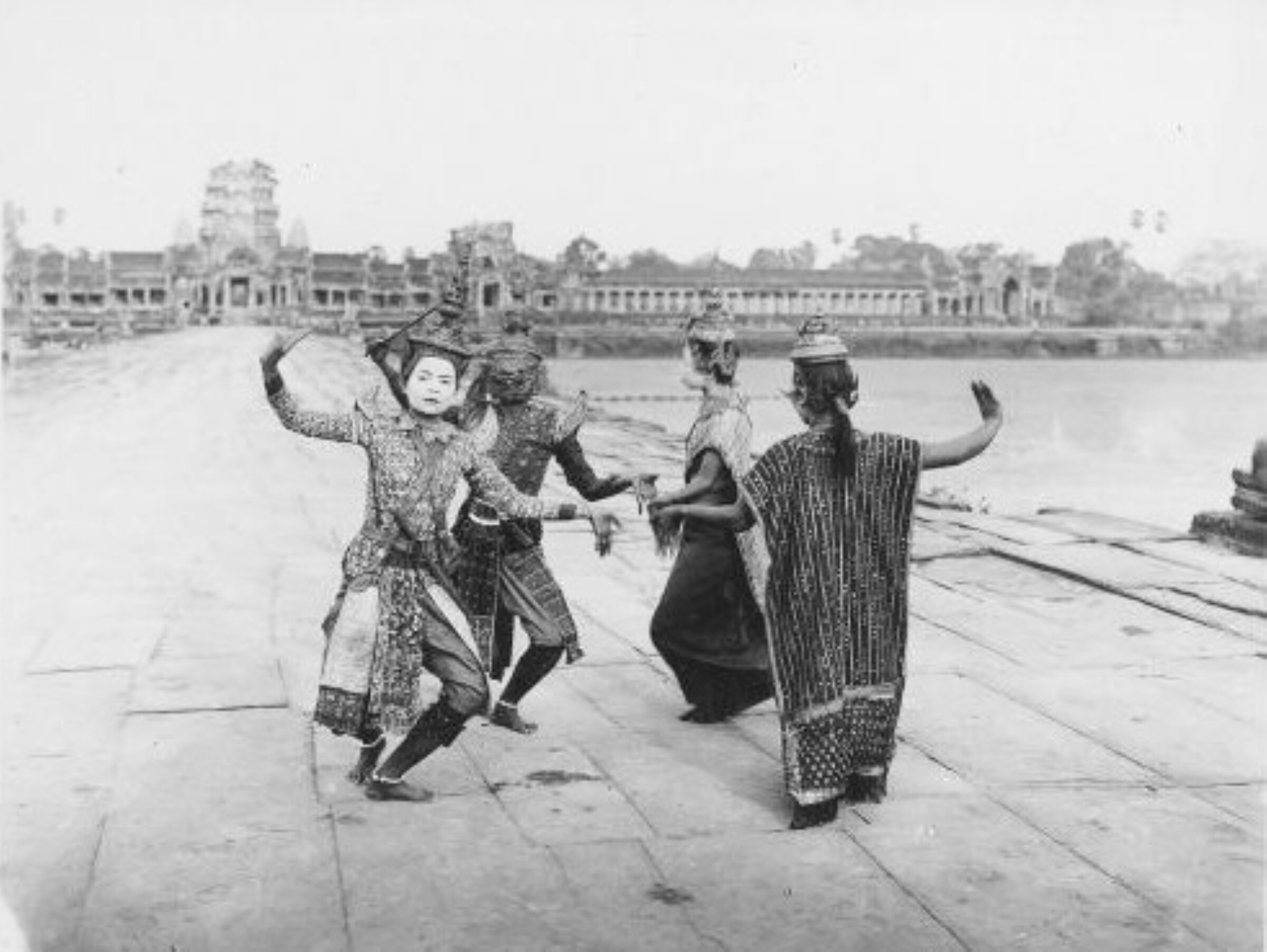
Royal Ballet dancers in front of Angkor Wat, photographer unknown, date unknown’. From Roland Meyer’s notation, we deduct that the dancer clearly depicted is Saramani, and from her personal history that it was taken during King Sisowath’s celebrations in Angkor in September 1909 [EFEO photo archive ref. CAM00358].
1) Roland Meyer’s own words: “Saramani et ses compagnes dansant devant Angkor-Temple; cliché de l’Ecole d’Extrême-Orient [sic]” [“Saramani and her partners dancing in front of Angkor-Temple; picture by the School of Far East” [in “Au royaume des Saphirs”, L’Eveil économique de l’Indochine, 15 Feb. 1925 n. 401, p. 11 [scan via gallica.fr, pdf by ADB]. 2) Browsing through EFEO online photo collection, we found the original picture, labeled ‘photographer unknown, date unknown’. From Saramani’s personal history, we can guess that it was taken during King Sisowath’s celebrations in Angkor in September 1909 [EFEO photo archive ref. CAM00358].
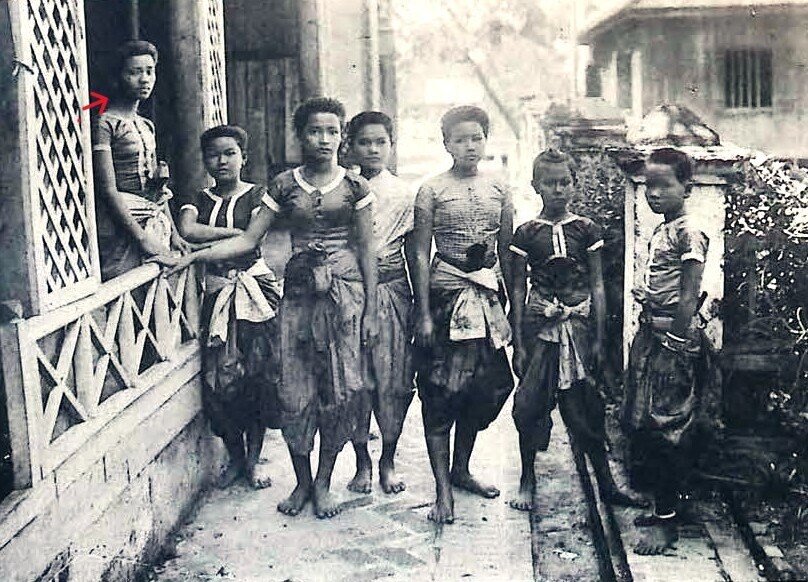
Independent researcher Kent Davis was the first (in 2010) to surmise that Saramani had been a real Cambodian dancer. Later [in a 2016 publication expanded in 2020], researcher Lucie Labbé, thanks in particular to her work on the Meyer-Courtois Family Archive and the Fonds Jacquemond in Paris, was able to prove that Saramani was the dancer standing at the left of a famous photograph (also printed as postcard) taken by Pierre Dieulefils at Phnom Penh Royal Palace around 1909 [see below] by comparing it with family photos.
Dancers of the Royal Ballet at their quarters in the Palace (Saramani, red arrow), part of Plate 56 (Phnom Penh — Favorites du roi, musiciennes, danseuses, domestiques) in Pierre Dieulefils, Indochine Monumentale & Pittoresque — Ruines d’Angkor, Hanoi, c. 1911. In the notice, the author remarked: “La population féminine du palais constitue une hiérarchie très compliquée, à titres multiples, depuis les reines (mahesei, tepi) jusqu’aux servantes (puok srei chau as nak), en passant par les favorites, les danseuses (lokhon), les musiciennes (puok phlêng). Le protocole en a été réglé par le roi Ang Duong.” [“The female population of the palace consists of a highly complex hierarchy, with multiple titles, from the queens (mahesei, tepi) to the servants (puok srei chau as nak), including the royal favorites, the dancers (lokhon), the musicians (puok phlêng). The protocol was regulated by King Ang Duong.” [ADB scan of original photo-album].
Dancers of the Royal Ballet at their quarters in the Palace (Saramani, red arrow), part of Plate 56 (Phnom Penh — Favorites du roi, musiciennes, danseuses, domestiques) in Pierre Dieulefils, Indochine Monumentale & Pittoresque — Ruines d’Angkor, Hanoi, c. 1911. In the notice, the author remarked: “La population féminine du palais constitue une hiérarchie très compliquée, à titres multiples, depuis les reines (mahesei, tepi) jusqu’aux servantes (puok srei chau as nak), en passant par les favorites, les danseuses (lokhon), les musiciennes (puok phlêng). Le protocole en a été réglé par le roi Ang Duong.” [“The female population of the palace consists of a highly complex hierarchy, with multiple titles, from the queens (mahesei, tepi) to the servants (puok srei chau as nak), including the royal favorites, the dancers (lokhon), the musicians (puok phlêng). The protocol was regulated by King Ang Duong.” [ADB scan of original photo-album].
Did the real Saramani (born as Mrek circa 1893 in Ken Svay Province — death between Dec. 1972 and April 1974, with her ashes possibly deposited at Wat Pibhatarangsey វត្តពិភទ្ទរង្សី, one of Phnom Penh five ‘historic pagodas’) dance in Paris and Marseille in 1906 during the notorious visit of King Sisowath and part of the Royal Ballet? This hasn’t been clearly established, even if Royal Meyer implied he had seen her during the Marseille performance and if a dancer named Yem was indeed mentioned in the account by the Minister of the Royal Palace Oknha Chauvea Veng Thiounn.
Apart from a brief and enigmatic appearance in young American travel writer Harry Hervey’s King Cobra (1927) as a former royal ballet dancer and proudly independent antiquities dealer in Phnom Penh, and a veiled tribute by Suzanne Meyer, Saramani and Meyer’s daughter and a Khmer classical plus ‘exotic’ dancer in 1930s Paris (1937), the muse fell out of sight for nearly eight decades.
As for Roland Meyer, after fleeing Paris under Nazi occupation in 1940 — where daughter Suzanne reportedly died of privation -, he spent one decade in Southeastern France before heading back to Paris suburbs, self-publishing Propos du vieux colonial [Musings of the Old Colonial] in 1952. And indeed, the self-proclaimed “Asiatiste” [Asianist] — or “Asiate”, a French term referring to “culturally hybrid” French citizens who had experienced Asia -, he was most and foremost a “colonial writer” as himself insisted to be referred to, one of those “héros ignorés de l’épopée coloniale” [“unrecognized heroes of the colonial saga”] he dedicated his book Komlah to, somehow critical of the most reactionary versions of colonialism but still sticking to the ideology of France’s “mission civilisatrice”. In 1965, he bequeathed all his writings to “mon ancien ministère de la France d’Outré-mer” [“my former Ministry of Overseas France,” the new name of the Ministry of Colonial Affairs].
In closing, let’s quote from perceptive author Virginia Thompson, who met Roland Meyer in person in the late 1930s and gave a harsh yet lucid assessment of the man and his literary work:
The Khmers are inordinately proud of their past, but do nothing to revive it or to even learn about it. They bask in an atmosphere of credulous naiveté and this eventually affects the Westernerin their midst. His reasoning slowly loses a common-sense basis. He begins to sleep with his head to the south [ADB: following the Vashtu Shastra principle], to pay attention to native omens and unconsciously to propitiate the spirits. Unlike learning Annamite customs, Cambodian life is contagious without effort. It is easier to slough off a superficial varnish of Western culture than to enter the complicated psychology of the Annamite mind. Roland Meyer’s story of Komlah is that of a European who found the Khmers so overwhelmingly congenial that he gave his life to studying them. He became so steeped in Khmer life that he was dominated by what he had intended to master. In analysing the cause of theircharming decadence his personality and will-power were eaten away. In feeling so keenly their charm he absorbed the germs of their decadence. [French Indochina(1937), p 357]
[1] This embryonic museum wasn’t located inside the Royal Palace, as it has been assumed by some authors, but at the Ecole française [Phnom Penh College], established in 1873 and renamed Lycée Sisowath in 1905, on the same spot the modern Sisowath High Schoolវិទ្យាល័យព្រះស៊ីសុវត្ថិ is located.
[2] Phou Khao Khouay National Park is nowadays a protected area of sandstone cliffs and hills, some 2,000 km² large and 40 kmsnortheast of Vientiane, Laos. Of ‘Ritaville’ have only subsisted some building foundations still visible on the foothills.
[3] Checking against the dates, this French Resident in Laos must have been Jules (Georges Théodore Gabriel) Bosc (6 Apr. 1871, Saissac, France — 20 April 1959, Nogent-sur-Marne, appointed 3 May 1918 to March 1931), and the “white fairy” his wife Jeanne Lafitan. Was ‘Rita’ a nickname, or was she Bosc’s temporary paramour? Still inquiring.
[4] Date stated in L’Avenir du Tonkin (Hanoi), 5 Aug. 1938, p 1.
[5] Recent publications have established the Saramani-Meyer descendency as follows: Lucie [named after Resident-Superior Louis-Paul Luce, Meyer having joined Luce’s circle of close collaborators in 1909] (21 May 1910, Phnom Penh — 24 July 1945, Nice, married to Roger Boivin); Suzanne (26 Feb. 1913, Phnom Penh — 1940, Paris), Charles (1916, Phnom Penh — ?), Marcelle Evelyne (18 June 1918, Phnom Penh — 24 April 1975, Phnom Penh, married (announcement on 20 Feb. 1940) to Louis Courtois (2 Nov. 1915, Phnom-Penh — 30 May 1993, Nice). The French registry listed Marcelle’s birth conjointly with the one of George Groslier’s daugher, Nicole Jeannine, born on 15 June 1918.
Publications
Cours de cambodgien, Tome 1. Notice sur l’étude de l ‘écriture khmère, Phnom Penh, Albert Portail, 1912, 49 p.
Cours de cambodgien, Tome II. Premier livre de lectures cambodgiennes, Phnom Penh, A. Portail, 1912, 92 p.
Cours de cambodgien, Tome III. Vocabulaire et conversation, Phnom Penh, A. Portail, 1914, 357 p. (a)
Saramani, Danseuse khmèr, Saigon, Albert Portail, 1919, 238 p; repr. Paris/Pondichéry, Kailash, 3 vol. (248 p., 334 p. et 238 p.), 1997 [with postface by Gérard Groussin]. ISBN 2−84268−018−9.
Cours de langue laotienne, Vientiane, lmprimerie du gouvernement, 1924.
“Une visite aérienne du Résident-Supérieur du Laos au roi du Lao siamois”, L’Eveil économique de l’Indochine, 23 Nov. 1924, n. 389,: 1 – 5. [via gallica.fr]
Cours de cambodgien et lectures cambodgiennes, nouvelle édition, Phnom Penh, A. Portail, 1929, 458 p.
Komlah, Visions d’Asie, Paris, Ed. Pierre Roger, 1929, 247 p.; repr. 1930, 1939; repr. Paris, A. Gérard, n.d., 184 p. [with author’s name Y. R. Meyer].
Le Laos, Hanoi, Imprimerie d’Extrême-Orient, 1930, 113 p [digital version via Humazur.univ].
(a) So far it has been impossible to find any of these manuals of Khmer language. Interestingly, in his “Notice de renseignements 1907 – 1940” hand-written by Meyer himself on 10 Dec. 1965 in Paris, he only mentioned in his bibliography “Cours de langue cambodgienne, Saigon, Ed. Albert Portail, 1929″. [document reproduced in Jean Courtois, “Roland Meyer et Saramani, Mes grands-parents outré-mer”, op-cit.: 220 – 1]
(*) articles reproduced in Komlah (1930) without mention of prior publication.
References & Background
Dr Berret & G. Jubin, “Popokvil et le mont Bokor, une station climatérique d’altitude maritime”, Revue Indochinoise 7 – 8, 9 – 10, July-Oct. 1919 (76 p., ADB pdf).
Gérard Groussin, Postface to Saramani danseuse khmer, Kailash ed. 1997, vol. III: 233 – 238 p.
Nhean Chamnan, L’éducation cambodgienne à travers le roman de Roland Meyer Saramani [Danseuse khmèr]: réalité cambodgienne ou vision occidentale?, Paris, Thèse de doctorat d’études khmères de l’INALCO, 2002, 192 p.
Kent Davis, “Roland Meyer, Saramani and a Cambodian Love Affair”, 9 July 2010, Devata.org blog.
Lucie Labbé, “Apsaras de pierre, apsaras de chair. Occurrences et réappropriation du passé dans la danse classique khmère”, Péninsule 73, 2016, pp. 53 – 79.
Rinith Taing, “Discovering the fact among the fiction in Roland Meyer’s ‘Khmer Dancer’ ”, Phnom Penh Post Weekend, 27 Aug. 2017 (retrieved on Khmer Circle blog).
Cristina Del Biaggio, “La marchandisation et le pillage du mont Bokor au Cambodge”, Journal of Alpine Research 106 – 4, 2018 (open edition).
Lucie Labbé, “Autour de Saramani. ‘Nouvelles données sur Roland Meyer et son oeuvre”, Péninsule 81 – 2 , 2020: 117- 48.
Lucie Labbé, “Saramani, danseuse exotique. Note sur Suzanne Meyer (1913−1942), fille de Roland Meyer et Saramani”, Péninsule 83, 2021: 171- 88.
Magali Bigaud, “Adhémard Leclère (1853−1917), Charles Gravelle (1864−1929), Charles Meyer (1923−2004), Trajectoires françaises singulières au Cambodge”, in Asiates: des Européens vers l’Asie, parcours et transferts culturels, Magali Bigaud, Henri Copin et Jean-François Klein (eds), Paris, Hemisphères-Maisonneuve, 2025, p. 75 – 86.
Jean Courtois, “Saramani et Roland Meyer, mes grands-parents outré-mer”, in Asiates…, 2025, p 197 – 222.
Jean-François Klein, “Roland Meyer, fonctionnaire colonial zélé et ‘Asiate’ archétypal”, in Asiates..., op. cit., p 223 – 248.
Henri Copin, “Saramani danseuse khmèr de Roland Meyer, ‘Asiatiste: Une étude littéraire, in Asiates..., op. cit., p 249 – 268.
ល្ខោនខោលl'khon khol, 'Masked theater', with a repertoire from the Reamker. In Cambodian masked theater, derived from ancient royal dance, each character bears a specific color: green for Ream (Rama), yellow for Preah Leak (Lakshmana), red for Seyda (Sita), white for Hanuman and its 18 monkey warriors, brick red for Krong Reap (Ravana), blue for Tupi (King of Buffaloes).
ល្ខោនគែនl'kon ken, a theater and dance form developed during the first reign of King Sihanouk (1945-195), in which the ken, a traditional Mon-Khmer and Laotian reed music instrument, played a central part.
kh: ឧកញ៉ា angk: uk-na | in ancient vn texts: Ốc nha (屋牙)
Khmer honorific meaning 'nobleman' or 'lord'. Initially envoys of the Angkor kings, then title in used during the Oudong monarchy from the 18th century, substituting Ponhea (ពញា - equivalent to Phraya (พญา) in Thai). The title "Oknha" was transformed into Thai as Okya (ออกญา) by the Ayutthaya Kingdom. The word Oknha occurs in ancient Vietnamese records.
Since 1993, title bestowed by the King (later by the Cambodian government) on civilians (non-royalty) distinguished for their goods deeds. Recently, 'oknha' has become a Khmer version of 'tycoon', as since 2017 wealthy people donating a minimum of 500,000 USD to the State can obtain the title.